


7 Data Issues Law Firms Don’t See Until It’s Too Late (And How to Fix Them)
Data problems don’t announce themselves with flashing warnings.
Imagine this: During final billing review, a firm discovers $1.2 million in “unbilled time” just 48 hours before client invoices must ship. Partners assemble expecting explanations, only to learn duplicate time entries from a recent Elite 3E migration quietly collided in production, and no one noticed until revenue hung in the balance.
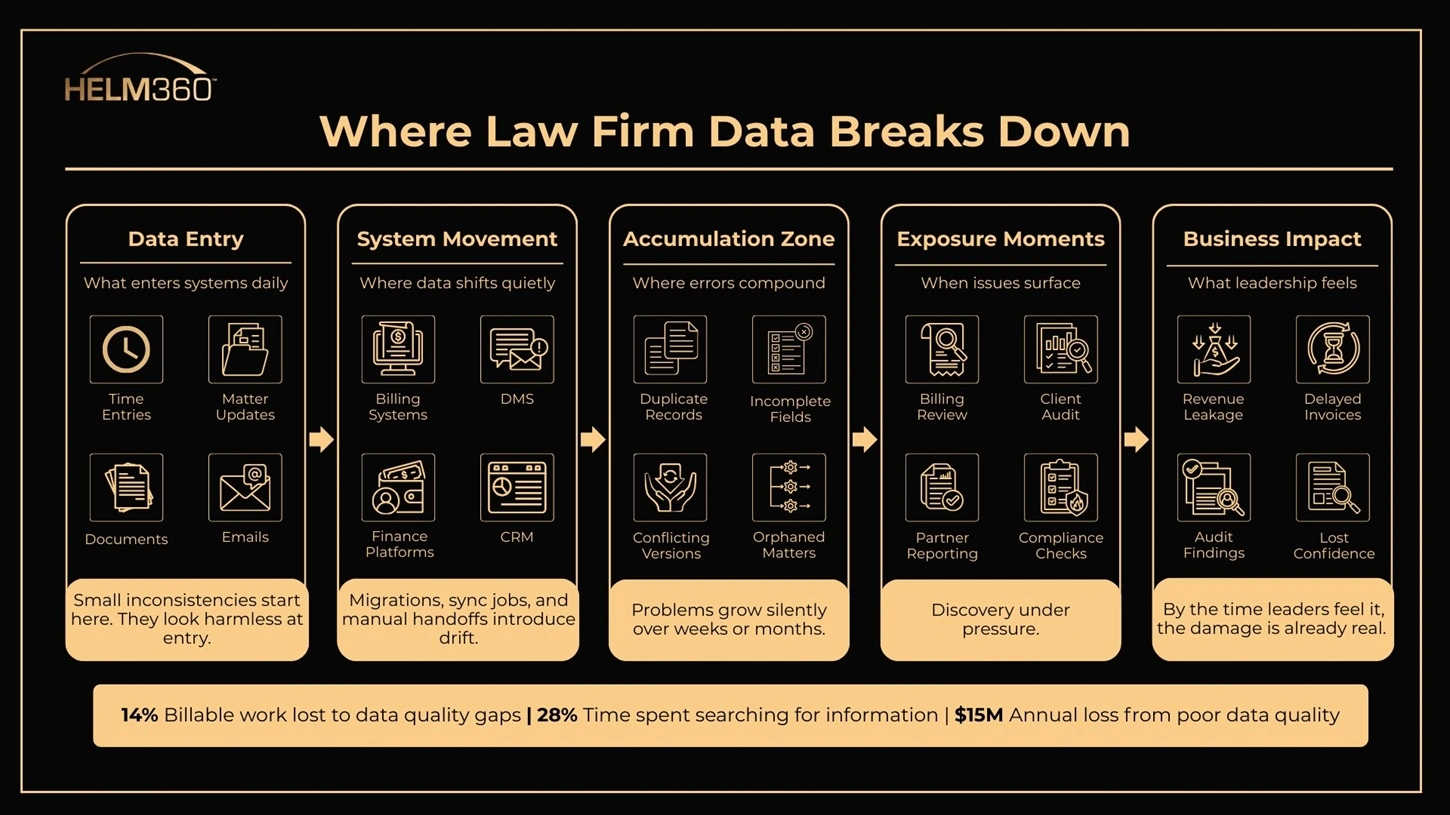
These scenarios occur far more frequently than firm leaders realize. According to the LeanLaw billing analysis, law firms lose 14% of billable work due to data quality gaps. For a $1M billing practice, that’s $140,000 annually in uncollected fees from poor descriptions, inconsistent codes, and mismatched entries.
The issue isn’t technology failure. It’s a data failure- silent, gradual, and invisible until revenue disappears.
What follows are the seven most destructive data issues that sophisticated law firms encounter, each accompanied by real-world consequences and proven remediation strategies.
1. Silent Data Drift in Billing Systems
What happens
Billing systems rarely fail outright. Instead, they drift. Over time, time entries become less specific. “Client call” replaces “Client call – litigation strategy.” At entry, the difference feels minor. At billing review, it becomes expensive.
Billing systems rarely fail outright. Instead, they drift. Over time, time entries become less specific. “Client call” replaces “Client call – litigation strategy.” At entry, the difference feels minor. At billing review, it becomes expensive.
Business impact
The LeanLaw billing analysis shows 10% of invoiced amounts go uncollected due to block billing, duplicate entries, and incorrect client codes.
The LeanLaw billing analysis shows 10% of invoiced amounts go uncollected due to block billing, duplicate entries, and incorrect client codes.
Real-world consequence
One mid-sized firm discovered 22% of Q4 invoices flagged as non-billable, not because the work was improper, but because time descriptions failed client guidelines.
One mid-sized firm discovered 22% of Q4 invoices flagged as non-billable, not because the work was improper, but because time descriptions failed client guidelines.
How to fix it
Introduce real-time validation rules in platforms like Elite 3E or Aderant that enforce minimum description standards. Standardized templates and early checks prevent billing drift before invoices reach clients.
Introduce real-time validation rules in platforms like Elite 3E or Aderant that enforce minimum description standards. Standardized templates and early checks prevent billing drift before invoices reach clients.
Download: To explore billing and collections through an AI and data governance lens, see The Future of Legal Revenue Management – AI-Driven Billing and Collections.
2. Migration Ghosts After System Upgrades
What happens
When legacy data moves into modern platforms, hidden issues follow. Duplicate IDs, orphaned matters, inconsistent formats, and unmapped custom fields often enter production quietly and surface later.
When legacy data moves into modern platforms, hidden issues follow. Duplicate IDs, orphaned matters, inconsistent formats, and unmapped custom fields often enter production quietly and surface later.
Business impact
Data migration remains one of the highest-risk technology initiatives. Over 80% of data migration projects exceed timelines or budgets , with financial data among the most error-prone due to historical customizations.
Data migration remains one of the highest-risk technology initiatives. Over 80% of data migration projects exceed timelines or budgets , with financial data among the most error-prone due to historical customizations.
Real-world consequence
During a billing system upgrade, a large law firm uncovered discrepancies in historical WIP data that required weeks of manual review and partner involvement before billing confidence was restored.
During a billing system upgrade, a large law firm uncovered discrepancies in historical WIP data that required weeks of manual review and partner involvement before billing confidence was restored.
How to fix it
Profile data before migration, map every custom field deliberately, and run parallel systems post-launch to catch issues before they affect billing and reporting.
Profile data before migration, map every custom field deliberately, and run parallel systems post-launch to catch issues before they affect billing and reporting.
3. Fragmented Client Data Across Systems
What happens
Matter details live in the document management system. Financial data sits in Elite 3E or Aderant. Communications are spread across Outlook and Teams. Conflicts information exists in separate tools. Lawyers are forced to move between systems just to answer routine client questions.
Matter details live in the document management system. Financial data sits in Elite 3E or Aderant. Communications are spread across Outlook and Teams. Conflicts information exists in separate tools. Lawyers are forced to move between systems just to answer routine client questions.
Business impact
McKinsey estimates the average interaction worker spends 28% of the workweek managing email and nearly 20% of their time looking for internal information or tracking down colleagues who can help with specific tasks. When critical information is fragmented across systems, these delays directly affect client responsiveness and decision-making.
Real-world consequence
A routine conflicts clearance that should take minutes stretched into hours because required matter data, prior communications, and financial records lived across disconnected platforms.
How to fix it
Provide governed, centralized access to client and matter information so professionals can retrieve answers across systems without switching tools or duplicating data.
4. Reports That Look Right but Tell the Wrong Story
What happens
Dashboards and reports pull from incomplete or misaligned data sources. Late-posted time, incomplete matter histories, or mismatched client codes can create outputs that appear polished but don’t reflect actual performance.
Business impact
The average business loses $15 million annually due to poor data quality a figure tied to inefficiencies, rework, misinformed decisions, and delays caused by unreliable data flowing through reporting systems.
The average business loses $15 million annually due to poor data quality a figure tied to inefficiencies, rework, misinformed decisions, and delays caused by unreliable data flowing through reporting systems.
Real-world consequence
Firm leadership approved staffing and pricing decisions based on utilization reports that excluded late-entered time, leading to underbilling and resource misallocation.
How to fix it
Establish reconciled, authoritative data sources. Enforce data validation before reports are distributed, and ensure executive dashboards draw from synchronized, governed datasets that reflect operational reality.
Read more: For a deeper look at how law firms can build reliable operational data and use it to inform decisions at every level, see Data-Driven Decision Making in Law Firms.
5. Access Bottlenecks That Slow Everyday Work
What happens
Lawyers often depend on finance, IT, or support teams to answer routine questions about billing status, matter history, or document access. Each dependency introduces a delay, creating internal friction that disrupts workflow and slows responsiveness.
Lawyers often depend on finance, IT, or support teams to answer routine questions about billing status, matter history, or document access. Each dependency introduces a delay, creating internal friction that disrupts workflow and slows responsiveness.
Business impact
Workplace friction, such as ineffective communication, overly complicated processes, and too many disconnected systems, hurts productivity and employee experience. According to a workforce study , 88% of respondents reported friction in their environment that contributes to wasted time and frustration, with poor communication and mismatched technology cited as primary causes.
Real-world consequence
Billing approvals and matter responses stalled while partners waited days for basic reports that existed across systems but weren’t easily accessible to attorneys.
Billing approvals and matter responses stalled while partners waited days for basic reports that existed across systems but weren’t easily accessible to attorneys.
How to fix it
Enable role-based, governed access to core billing, matter, and document data so professionals retrieve routine answers directly without support tickets, manual handoffs, or bottlenecks.
Enable role-based, governed access to core billing, matter, and document data so professionals retrieve routine answers directly without support tickets, manual handoffs, or bottlenecks.
6. Compliance Gaps That Surface During Audits
What happens
Data access rules, retention policies, and audit trails often vary across systems. Over time, gaps between documented policy and actual system behavior create exposure that only becomes apparent during audits or client reviews.
Data access rules, retention policies, and audit trails often vary across systems. Over time, gaps between documented policy and actual system behavior create exposure that only becomes apparent during audits or client reviews.
Business impact
According to the ABA’s Legal Technology Survey , only 43% of law firms have implemented formal data classification schemes, a foundational component of data governance. This gap reflects broader governance and compliance risk, since poorly governed data makes fulfilling ethical, regulatory, and retention obligations more difficult.
According to the ABA’s Legal Technology Survey , only 43% of law firms have implemented formal data classification schemes, a foundational component of data governance. This gap reflects broader governance and compliance risk, since poorly governed data makes fulfilling ethical, regulatory, and retention obligations more difficult.
Real-world consequence
Audit preparation revealed inconsistent access logs and undocumented retention policies across several systems, requiring emergency remediation and governance policy reform.
Audit preparation revealed inconsistent access logs and undocumented retention policies across several systems, requiring emergency remediation and governance policy reform.
How to fix it
Standardize data governance frameworks that define ownership, access controls, retention, and classification. Monitor compliance continuously rather than ad hoc, and ensure audit trails are consistently enforced across platforms.
Standardize data governance frameworks that define ownership, access controls, retention, and classification. Monitor compliance continuously rather than ad hoc, and ensure audit trails are consistently enforced across platforms.
7. Institutional Knowledge That Walks Out the Door
What happens
Critical firm knowledge often exists only in individual inboxes, personal folders, or informal team memory. When experienced staff leave, this institutional knowledge leaves with them, creating gaps in how work is performed and decisions are made.
Critical firm knowledge often exists only in individual inboxes, personal folders, or informal team memory. When experienced staff leave, this institutional knowledge leaves with them, creating gaps in how work is performed and decisions are made.
Business impact
Organizational memory plays a key role in operational continuity. When shared knowledge is lost or inaccessible, firms experience what is often described as corporate amnesia , where teams lack the context needed to respond quickly and accurately. This loss increases operational risk and slows day-to-day execution.
Organizational memory plays a key role in operational continuity. When shared knowledge is lost or inaccessible, firms experience what is often described as corporate amnesia , where teams lack the context needed to respond quickly and accurately. This loss increases operational risk and slows day-to-day execution.
Real-world consequence
New hires spent weeks recreating answers, workflows, and reference material that already existed elsewhere in the firm but were not documented or searchable.
New hires spent weeks recreating answers, workflows, and reference material that already existed elsewhere in the firm but were not documented or searchable.
How to fix it
Centralize firm knowledge in governed systems that are searchable and maintained. Encourage consistent documentation so expertise remains accessible regardless of staff changes.
Centralize firm knowledge in governed systems that are searchable and maintained. Encourage consistent documentation so expertise remains accessible regardless of staff changes.
Final Thought: Bring Data Under Control
Data is already embedded in every part of a law firm. Billing, reporting, compliance, client communication, and decision-making all depend on it.
The difference between firms that struggle and firms that stay in control is not the technology they use. It is how deliberately they govern their data. Clear standards. Verified sources. Secure access. Auditable workflows.
Firms that address data issues early reduce risk while improving efficiency, accuracy, and client confidence.
If your firm is evaluating how to strengthen data integrity across legal, financial, and operational systems, Helm360 can help you assess where risks exist and how to address them responsibly.