


3 Early Warning Signs of Data Problems in Law Firms

It’s Monday morning. Your finance director has three fires to put out:
- A major client is disputing last month’s invoice
- A senior partner sees conflicting numbers on his dashboard
- IT just found another batch of duplicate client records
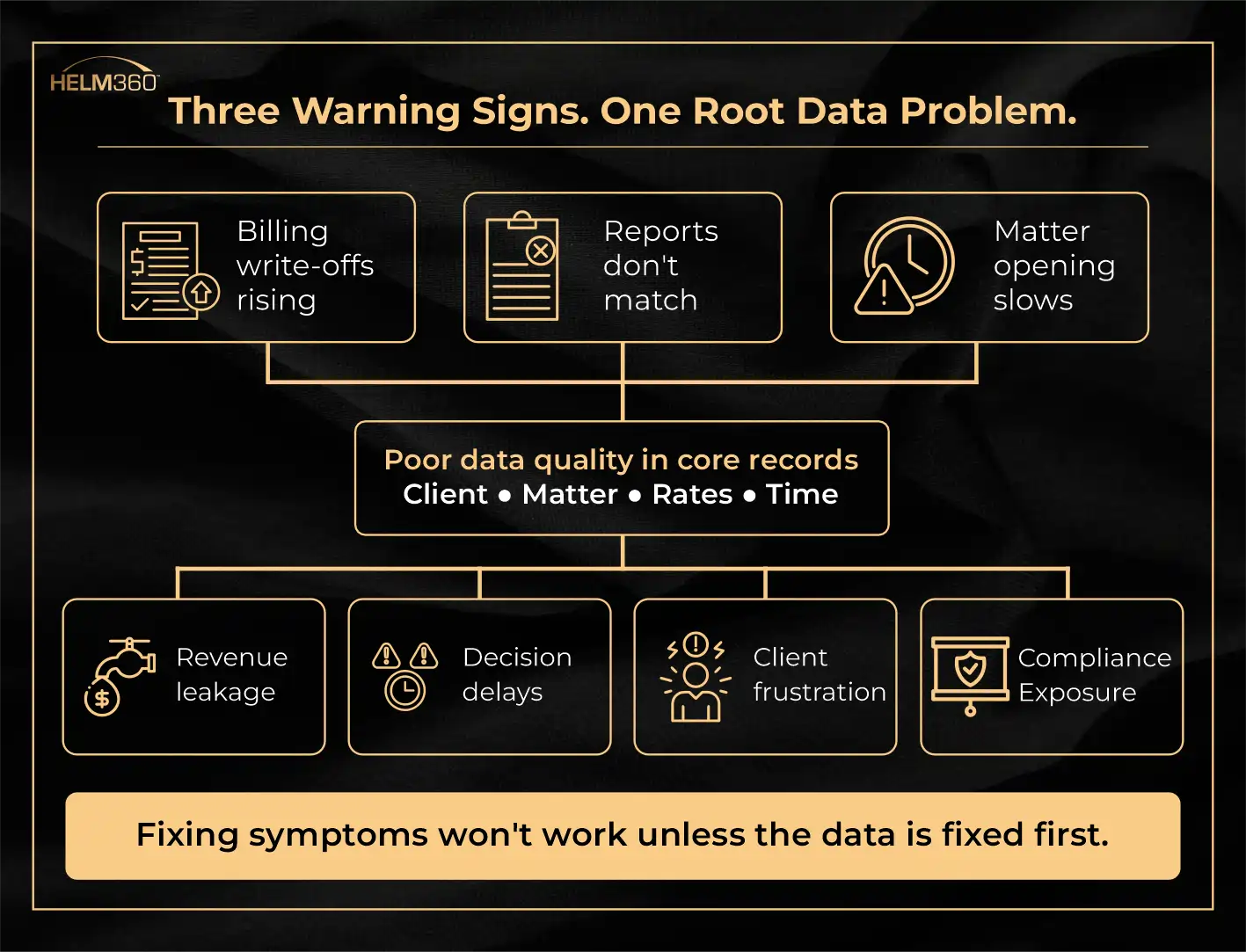
Three different problems. One root cause: data quality issues are slowly compromising your firm’s operations.
Here’s the thing about data problems in law firms: they don’t announce themselves. They start small. A missing client code here. An incomplete matter record there. Then six months later, you’re dealing with billing disputes, unreliable reports, and compliance headaches.
The good news? Data problems leave clues. Catch them early, and you can save your firm from revenue loss and costly cleanups.
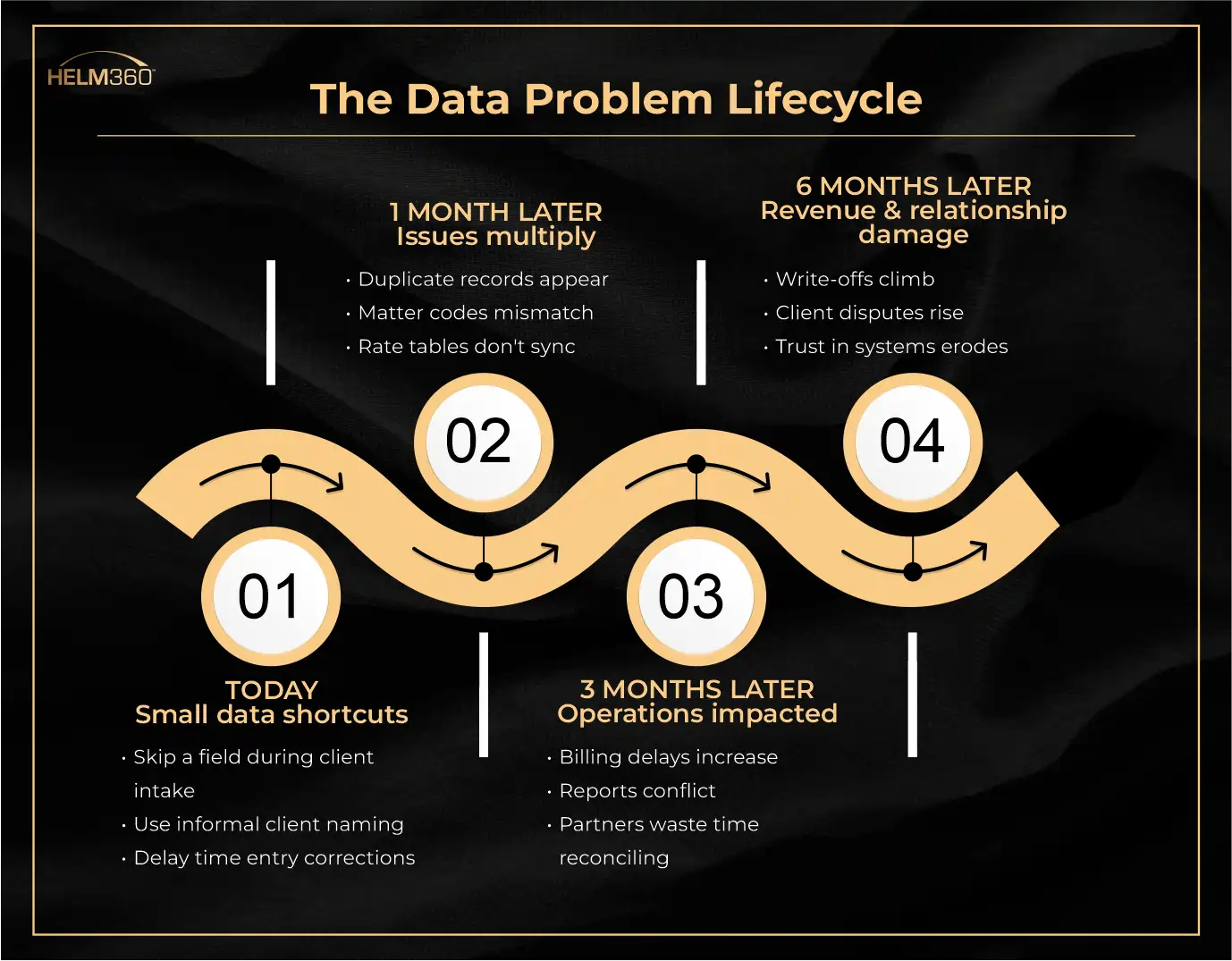
Here are three critical warning signs that your data needs immediate attention.
Warning Sign #1: Your Billing Write-Offs Keep Growing
When partners start questioning their billing statements, or worse, when clients do, you’ve got a data problem.
The Real Numbers
Let’s talk about what poor data quality actually costs:
- On average, lawyers bill just 2.6 hours (33%) of an 8-hour workday, leaving 67% of their time to non-billable tasks (Clio’s 2024 Legal Trends Report)
- 59% of law firms confirm write-offs have increased over the past year, with 43% reporting increases of more than 10% (BigHand 2024 Annual Law Firm Finance Report)
- 59% of law firms confirm write-offs have increased over the past year, with 43% reporting increases of more than 10% (BigHand 2024 Annual Law Firm Finance Report)
- Mid-sized law firms carry 47 days of unbilled work on average, representing over $387,000 in trapped revenue (K38 Consulting Law Firm Profitability Report).
- Delayed time entry costs individual attorneys $50,000 to $75,000 in lost billings annually. Lawyers who wait until the end of the week to record time lose 50% of billable hours (LeanLaw Legal Billing Research).
A big chunk of this comes from data problems.
Here's How It Happens
An attorney enters time against Matter 12345 in the timekeeping system. Finance has it coded as Matter 12346 in billing. Result? That time gets lost, unbilled, or written off.
Multiply this across dozens of matters and hundreds of time entries each month. The revenue impact is massive.
What to Watch For
- Rising write-off percentages – When write-offs trend upward month after month, it’s often data quality deteriorating, not just fee adjustments.
- Billing cycles taking longer – If your average time from month-end to invoice keeps increasing, your billing team is spending extra hours fixing data inconsistencies.
- More client disputes – According to The Law Society, lock-up days (the time it takes to collect payments) rose from 143 to 146 days in 2024 for UK law firms.
- Meanwhile, US firms saw accounts receivable grow by 14.2% (Citi Hildebrandt Client Advisory). Many disputes start with billing inaccuracies caused by bad data.
- Partners spending more time on pre-bills – When your most expensive resource (partner time) is being consumed by correcting invoices, you’ve got a serious data problem.
The Client Guidelines Problem
Corporate clients have strict billing requirements. When your billing system has inconsistent matter codes or wrong rate tables, their systems flag violations. You don’t just lose revenue, you damage the client relationship.
Warning Sign #2: Your Reports Don't Match
Picture this: The CFO presents quarterly financials. A practice group leader pulls up her dashboard. The work-in-progress differs by $200,000.
The meeting stops. Everyone tries to figure out which number is right.
This isn’t a software problem. It’s a data problem.
Why This Happens
Most firms operate across multiple systems that are not fully aligned.
The issues usually surface as:
- Client billing details differ between CRM and practice management systems
- Matter budgets vary between finance and project tracking tools
- Time entries fail to sync consistently across platforms
Legacy environments amplify the problem. Each data conversion, extraction, or system upgrade introduces new points where records drift out of sync if controls are not enforced.
The Dashboard Trust Issue
Business intelligence tools are only as good as their data. When partners stop trusting their dashboards because “the numbers don’t feel right,” they go back to asking assistants to manually pull reports.
You’ve just defeated the purpose of automation and created another data silo.
Decision-Making Gets Paralyzed
Should you invest more in a practice area? Which clients are actually profitable? Where are your capacity constraints?
These questions need accurate data. When firm leaders can’t trust their numbers, they make decisions based on gut feeling instead of facts.
Red Flags to Look For
- Manual reconciliation every month – If your monthly close requires someone to “true up” numbers across systems, you have a synchronization problem.
- Multiple versions of the same report – When different versions of the “same” report circulate with different numbers, people have lost confidence in your data.
- Reports taking longer to produce – If standard management reports take longer each quarter, data quality issues are compounding.
- Only certain people can read reports – When only specific people can interpret reports because they “know which fields to trust,” you’ve built a workaround around bad data.
Recent industry studies show the average data breach for professional services firms (including law firms) cost $5.08 million,with costs rising year over year. So yes, security and compliance during intake matter.
But when new matter opening consistently takes days or weeks because of data issues rather than necessary compliance checks, you’re losing competitive advantage.
Why Clients Care
Modern clients expect speed. When a potential client comes to you with urgent work, delays in onboarding send a bad message about your firm’s capabilities.
Yet many firms struggle with matter opening because of data problems:
- Address book chaos – Address book maintenance is a major pain point for law firms. Your address data has duplications, incomplete records, missing information, and inconsistent formatting. Someone has to manually verify whether “Goldman Sachs International,” “Goldman Sachs & Co.,” and “The Goldman Sachs Group, Inc.” are the same client or three different entities requiring separate conflict checks. You’re paying today for yesterday’s shortcuts.
- Duplicate clients – Without clean, standardized client data, your conflict checking system can’t work properly. If you have three different client records for the same corporation, entered slightly differently over the years, you risk missing conflicts. Worse, you’re creating billing and reporting problems down the line.
- Rate table confusion – Client-specific rate agreements should flow automatically from the client record to new matters. When they don’t (because rate information is incomplete or inconsistent), matters open with wrong billing arrangements. First invoice arrives. Client questions it. Relationship damaged.
The Downstream Effect
Intake data issues do not stay isolated. They spread.
- Matter budgets built on incorrect templates
- Reports unable to roll up client activity accurately
- Conflict systems missing related entities
- Billing arrangements misaligned with client expectations
Compliance risk follows. Industry reviews show many AML failures trace back to poor data capture and maintenance during client intake.
What Your Firm Can Do Now
Recognizing these warning signs is step one. Here’s how to fix them:
1. Run a Data Health Assessment
Before you can fix data problems, understand their scope:
- How is data distributed across your core tables?
- Where are duplicate, incomplete, or orphaned records hiding?
- How do data entry practices differ across users and departments?
- Are your setup tables syncing properly with transactional data?
Tools like Helm360’s Digital Eye can identify data quality issues in hours instead of weeks of manual work.
2. Fix High-Impact Problems First
Not all data problems matter equally. Prioritize:
- Client and matter master data – Flows through every system and process
- Billing rate tables – Direct impact on revenue
- User and timekeeper records – Foundation for accurate time capture
- Chart of accounts mapping – Critical for financial accuracy
3. Prevent New Problems
Cleaning existing data is important. Preventing new problems is essential:
- Validation rules that enforce standards at point of entry
- Automated processes that flag potential duplicates during intake
- Regular monitoring instead of annual “cleanup projects”
- User training that explains why data quality matters
Solutions like Helm360’s Termi support prevention by giving users a simple way to ask questions of firm data in real time. By making data easier to access and understand through a conversational interface, issues surface earlier, before they spread across billing, reporting, and intake.
4. Establish Who's Responsible
Technology alone won’t solve this. You need clear ownership:
- Who is responsible for client master data accuracy?
- What standards govern matter opening?
- How are data quality metrics tracked and reported?
- When and how are exceptions approved?
5. Get Expert Help When Needed
For firms with complex systems like Elite 3E, ProLaw, or Aderant, professional data services can speed up improvement and reduce risk.
Whether you’re planning a system upgrade, merger integration, or just need to address accumulated data problems, experienced consultants bring proven methods and purpose-built tools.
The Bottom Line
Data quality problems don’t appear overnight. They build gradually. A shortcut here. An incomplete record there. A cleanup project that never gets prioritized.
The impact compounds over time.
When you see:
- Billing write-offs trending upward
- Reports that don’t reconcile
- Matter opening taking longer than it should
Do not treat these as isolated operational issues. They are symptoms of underlying data quality problems that need attention.
Firms that treat data quality as a strategic asset see clear benefits:
- Faster billing cycles
- More reliable business intelligence
- Smoother client onboarding
- Stronger financial performance
Your data tells the story of how your firm operates. The question is whether you can trust what it’s telling you.
Take Control of Your Firm's Data Quality
Is your firm experiencing these warning signs?
Helm360’s data quality experts can help you diagnose issues, clean critical data, and implement controls that prevent future problems.
Our Data Services team specializes in:
- Comprehensive data health assessments
- Data migration and conversion with quality assurance
- Ongoing data quality monitoring and remediation
- Custom solutions for Elite 3E, ProLaw, and Aderant environments
If billing accuracy, reporting confidence, or intake speed are under pressure, it is time to address the root cause.
Contact Helm360 to start a data quality assessment and bring clarity, consistency, and control back to your firm’s data.