


How to Manage Annual Rate Increases in ProLaw Without Billing Disruptions
At some point each year, every law firm using ProLaw reaches the same moment. New rates are approved, expectations are clear, and someone in billing or finance has to implement those changes without disrupting what is already in motion.
It sounds routine. In practice, this iswhere gaps can begin to appear.
Updates are made. Pre-bills go out. Then the questions begin:
- Why is a timekeeper still billing at last year’s rate?
- Why does this invoice not reflect the agreed client arrangement?
- Why are we issuing credit memos on work that was already approved?
Nothing here is unusual. But none of it should be happening.
The issue is not the rate increase itself. It is how that change moves through the system.
This matters more now because rates are rising steadily across the industry:
- 8.3% average rate increase across Am Law 100 firms (2025, Brightflag)
- 60% of firms raised worked rates by 6% or more in a single cycle (LawVision)
- 15–20% of revenue is often lost before billing due to write-downs and inefficiencies (Law Firm Velocity)
As rates rise, even small gaps in execution directly impact realization, timelines, and client trust.
In ProLaw, billing rates exist across standard rate cards, matter-level overrides, timekeeper-specific exceptions, and negotiated client arrangements, all of which can be active at the same time.
Updating one layer without aligning the others is how invoices go out at the wrong rate, and revenue quietly slips away.
This guide walks through how to manage the entire process correctly, from audit to invoice, so that annual rate updates become something your team handles with confidence rather than something it recovers from.
Where Rate Changes Break Down in ProLaw
ProLaw’s rate architecture is designed for flexibility. Rates can be assigned at the timekeeper level, managed through rate cards, and overridden at the matter level, with matter overrides taking precedence. This works well in day-to-day billing, but during a rate change cycle, that same flexibility creates multiple points where inconsistencies can be introduced.
The challenge lies in how changes are applied across these layers.
In practice, issues tend to surface in a few predictable ways:
- Partial updates to timekeeper rates
- WIP crossing the effective date without a defined approach
- Matter-level agreements not reviewed before new rates go live
- Inconsistent handling of overrides across matters
Each of these may seem small in isolation, but together they create gaps that only become visible once billing begins.
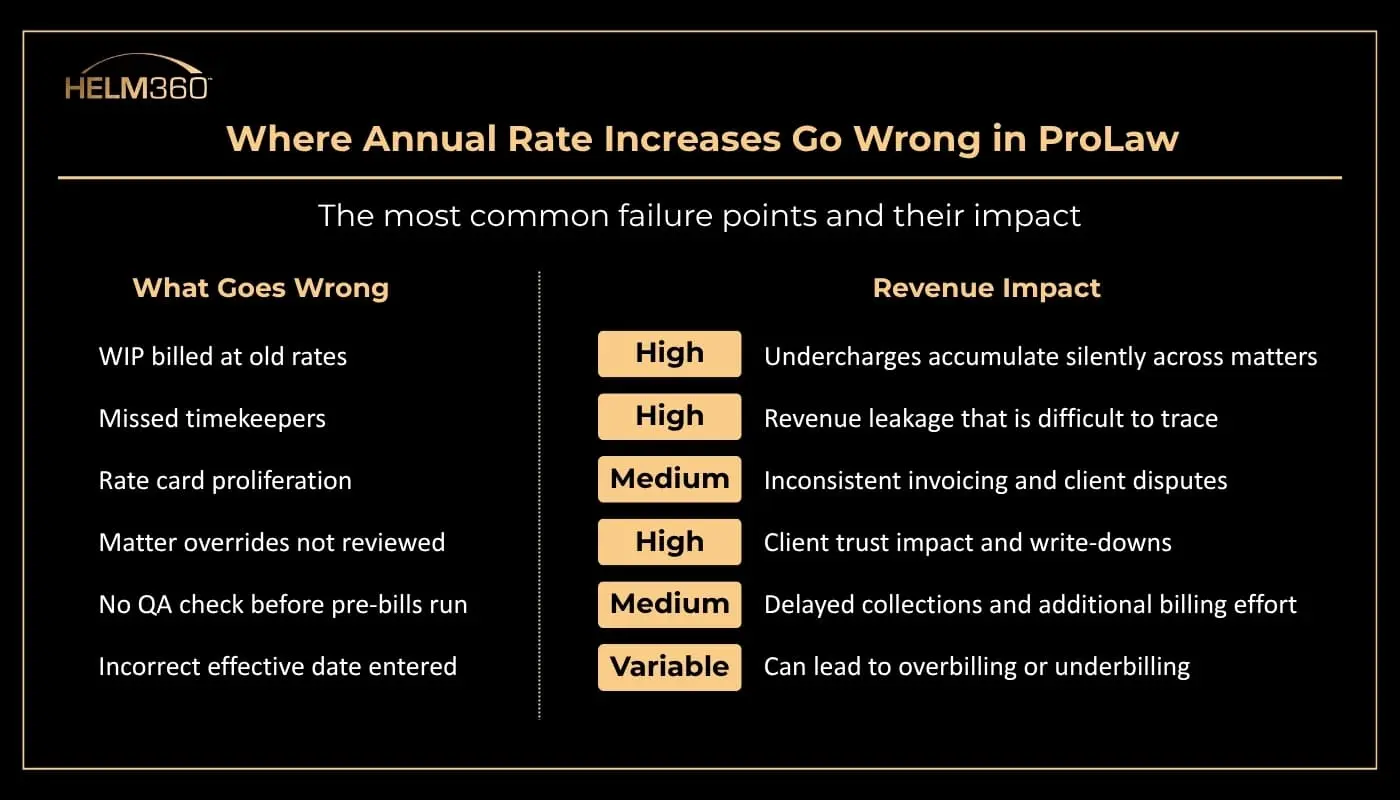
These issues follow clear, recurring patterns.
Billing disruptions during rate changes do not happen randomly. They tend to cluster around a small number of known failure points, each of which can be addressed with the right checks in place before the first pre-bill is generated.
The Six-Step Process for Managing Rate Increases Without Disruptions
Firms that implement rate changes cleanly in ProLaw are not defined by size or complexity. They follow a clear, repeatable process that ensures every layer of billing stays aligned with the approved rates.
The six steps below outline how to move from preparation to billing with control and consistency.
1. Simplify your rate cards before making updates
If your firm has accumulated a new rate card for every client over time, each update cycle becomes harder to manage. The objective is a controlled set of standard rate cards, with matter-level overrides used only where necessary. As a general guideline, more than 10–15 active rate cards often indicate a need for consolidation.
2. Update every timekeeper, not most of them
Run a complete report of all active timekeepers and validate each one against the approved rate schedule before the effective date. Partial updates are one of the most common sources of billing discrepancies, and they often remain unnoticed until invoices are reviewed.
3. Use effective-date controls instead of overwriting
ProLaw allows rate changes to be applied with effective dates, ensuring historical data remains intact while new rates take effect at the correct time. Overwriting removes traceability and creates exposure during billing reviews or client discussions.
4. Review all matter-level overrides and agreements
Before new rates go live, identify all active matters with overrides or negotiated arrangements. Each one should be reviewed individually to confirm that agreed terms remain intact. This step prevents misaligned invoices and avoids unnecessary adjustments later.
5. Make rate visibility part of the pre-bill review
Rate verification should be immediate and visible during review. Positioning rate summaries clearly within the pre-bill format ensures that reviewing attorneys can validate rates before approving time entries, not after.
6. Run QA checks before invoices are generated
Use ProLaw’s QA reporting to identify mismatches between transaction values and assigned rates. Running these checks during the billing cycle ensures that discrepancies are identified internally, before they reach the client.
A structured approach like this does not add complexity. It removes uncertainty. Each step ensures that rate changes are applied consistently across the system, reducing the need for adjustments and protecting both revenue and client relationships.
What Protects Revenue vs What Creates Risk
This is where the difference between a clean rate update and a disruptive one becomes visible. It is not about system capability. It is about whether the process is structured before changes are applied or adjusted later under pressure.
The comparison below shows how common approaches translate directly into billing outcomes.
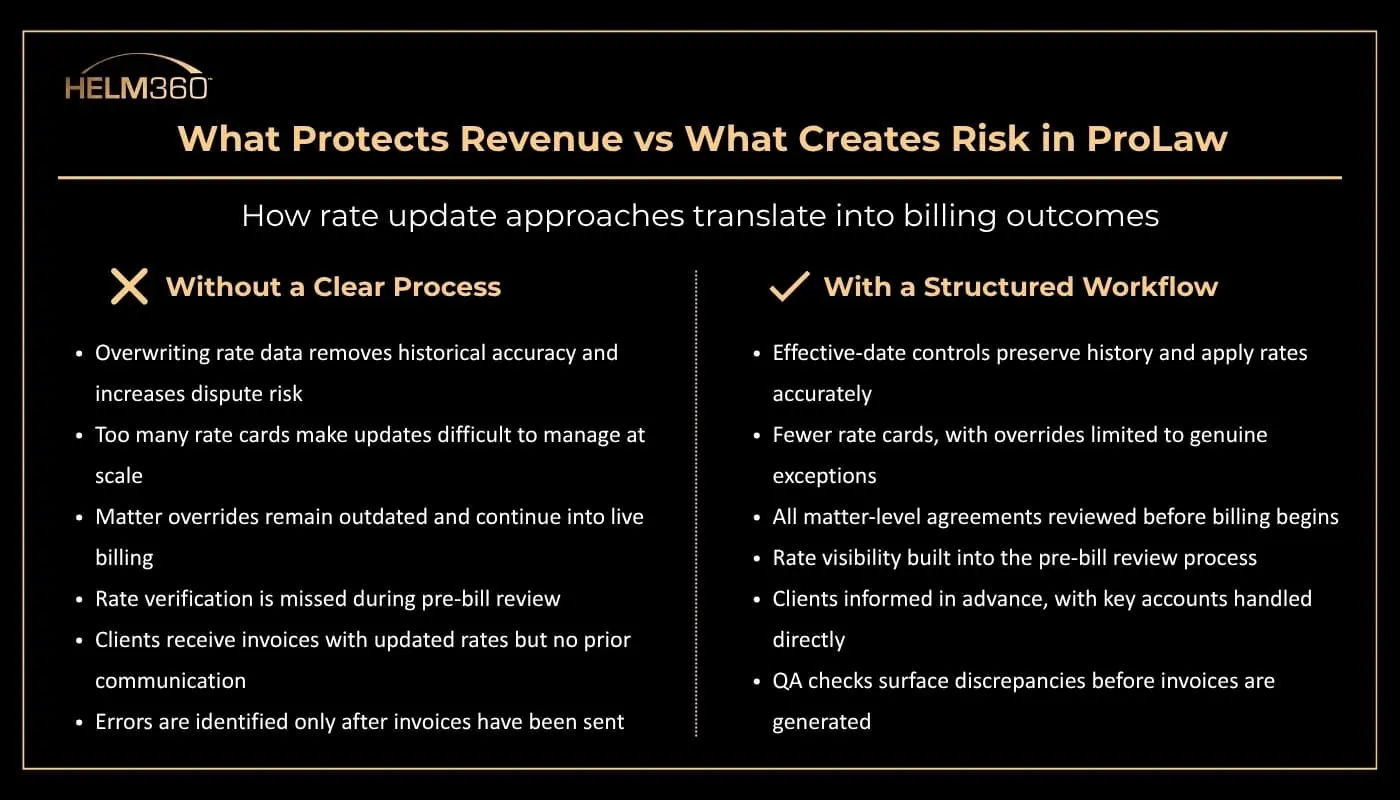
The difference comes down to how early the process is defined and followed.
ProLaw is fully capable of supporting the structured approach on the right. The difference lies in how consistently the process is applied before billing begins, rather than how quickly issues are addressed after they appear.
Manage Rate Changes in Phases, Not Deadlines
A useful shift in managing annual rate updates in ProLaw is to stop thinking in calendar deadlines and start thinking in phases.
Many firms treat rate changes as a last-minute task. That approach compresses preparation, system updates, and validation into the same window, which is where errors are most likely to occur. Firms that handle this cleanly separate the process into distinct phases, each with a clear purpose.
Phase 1 · Prepare
Get everything aligned before touching the system
- Benchmark and finalize rate changes
- Identify all client-specific agreements and exceptions
- Consolidate redundant rate cards
- Review the full list of active timekeepers
- Secure formal approval from partners and finance
No system updates happen here. The goal is a clean, approved rate structure with full visibility into every exception.
Phase 2 · Update
Apply changes in ProLaw with control and verification
- Enter new rates using effective-date controls
- Update the full timekeeper rate table
- Validate all matter-level overrides
- Adjust pre-bill format to make rate visibility immediate
- Run a test pre-bill before going live
Accuracy matters more than speed. Every update should match what was approved before billing begins.
Phase 3 · Protect
Monitor early and resolve issues before they reach clients
- Run QA rate checks before each initial pre-bill
- Apply WIP handling consistently across matters
- Notify clients and follow up on key accounts
- Resolve discrepancies as they appear
The first billing cycle after a rate change carries the highest risk. Early monitoring prevents small issues from turning into write-offs or client conversations.
Separating these phases reduces pressure, improves accuracy, and ensures that rate changes are applied consistently across the system.
A Rate Update Checklist Your Team Can Actually Use
Firms that manage rate updates cleanly are not relying on ad hoc fixes. They follow a repeatable process that the billing team can execute consistently every time rates change.
60 Days Before
- Audit all active rate cards and consolidate duplicates
45 Days Before
- Finalize rate approvals with partners and finance
- Document all client-specific exceptions and agreements
- Notify clients, with direct outreach for key accounts
30 Days Before
- Enter new rates in ProLaw using effective-date controls
- Pull a full report of matters with overrides
21 Days Before
- Review and update all matter-level overrides
14 Days Before
- Adjust pre-bill templates to display rate tables clearly
After Effective Date
- Reconcile any flagged issues
- Update internal process documentation for future cycles
End of First Billing Cycle
- Reconcile any flagged issues
- Update internal process documentation for future cycles
Firms that avoid billing disruption are not reacting faster. They are following a process that is defined, tested, and repeated each time rates change.
The Layer Nobody Talks About: Infrastructure
Even with a clean rate update process, billing disruptions can still occur if ProLaw performance slows down at the exact moment your team needs it most.
Rate updates and billing cycles place peak load on the system. Multiple users updating rates, running QA checks, generating pre-bills, and reviewing matters at the same time can expose infrastructure limits that remain hidden during normal operations.
This is where process alone is not enough.
When performance drops, teams start working around the system instead of through it. Manual adjustments increase, validation steps get skipped, and small inconsistencies can begin to affect billing accuracy.
A slow system during billing is not just a performance issue. It can impact data reliability during billing cycles.
This is also why many firms are re-evaluating how ProLaw is hosted and managed. As explored in The Future of Legal Practice: ProLaw in the Cloud, infrastructure plays a direct role in system reliability, especially during high-pressure billing periods.
Firms that avoid this ensure ProLaw remains stable and responsive during billing-critical periods, so the process stays controlled and nothing moves outside the system.
The Client Side of Rate Changes
In ProLaw, rate updates are applied within the system, but their impact becomes visible in client invoices and conversations.
How you communicate those changes often matters as much as how accurately they are implemented.
Recommended approach:
- Notify clients of rate changes in advance
- Reference negotiated agreements clearly
- Confirm updated rates before the first invoice is issued
For clients with specific arrangements, direct communication is more effective than formal notices. These clients expect clarity, especially when their billing structure differs from standard rates.
Handled well, this step prevents disputes, reduces delays, and keeps billing cycles on track.
Let’s Make Your Next Rate Rollover the Cleanest One Yet
Managing rate updates in ProLaw depends on aligning system configuration, validation, infrastructure, and client communication. It requires coordination across billing configuration, validation, infrastructure, and client communication.
Helm360 supports law firms across each of these areas through structured ProLaw Support Services and reliable ProLaw Cloud Hosting Services, helping ensure rate updates are implemented cleanly and billing cycles run without disruption.