


Measuring Marketing ROI in Law Firms Using System Data

There is a conversation happening in almost every law firm right now.
Marketing: “The campaigns are working. We are seeing strong engagement and enquiries.”
Finance: “We cannot see where that turns into revenue.”
Leadership: “So do we increase the budget or not?”
This is where most firms get stuck. And it is not a people issue. It is a data issue with a clear fix.
Law firms already hold the data they need to measure ROI. Billing records, intake logs, client origin data, time entries, and collections all sit inside systems, like Elite 3E and ProLaw. The gap is not availability. The gap is a connection. Marketing activity and financial outcomes are not linked in a consistent, reliable way. That single structural gap is costing firms money every quarter.
The numbers confirm it:
These numbers point to a structural gap. Budget decisions still rely more on instinct than clear evidence, which limits how confidently firms can scale what works.
The firms pulling ahead have taken a different approach. They have built visibility across the full journey, linking marketing spend to actual revenue, practice group by practice group and matter by matter.
Fix the connection between marketing activity and financial data. The rest follows.
Why the Gap Exists in the First Place
Marketing and legal operations have evolved separately. Each function uses different systems and tracks performance in its own way.
Marketing reports traffic, clicks, and enquiries. CRM systems track leads and interactions. Financial systems capture billable hours, matter values, collections, and client origin data.
The issue is not missing data. It is fragmented data. These systems do not connect by default, which makes it difficult to link a campaign to actual revenue without manual effort.
There is also a timing challenge.
A client journey spans months. Someone reads a thought leadership piece in January, attends a webinar in March, and engages counsel much later. By the time revenue appears, earlier touchpoints are no longer visible.
Only 18% of law firms use multi-touch attribution to track this kind of journey. Most rely on the most recent or most visible interaction, even when it was not the deciding factor.
Understanding this gap is the first step. Closing it requires a structured approach built on the systems you already use.
What the Data Shows by Channel
Not every marketing channel delivers equal value, and the numbers across the legal industry often challenge common assumptions. The benchmarks below reflect how core channels perform across law firms in terms of ROI and adoption. They provide direction, but not answers.
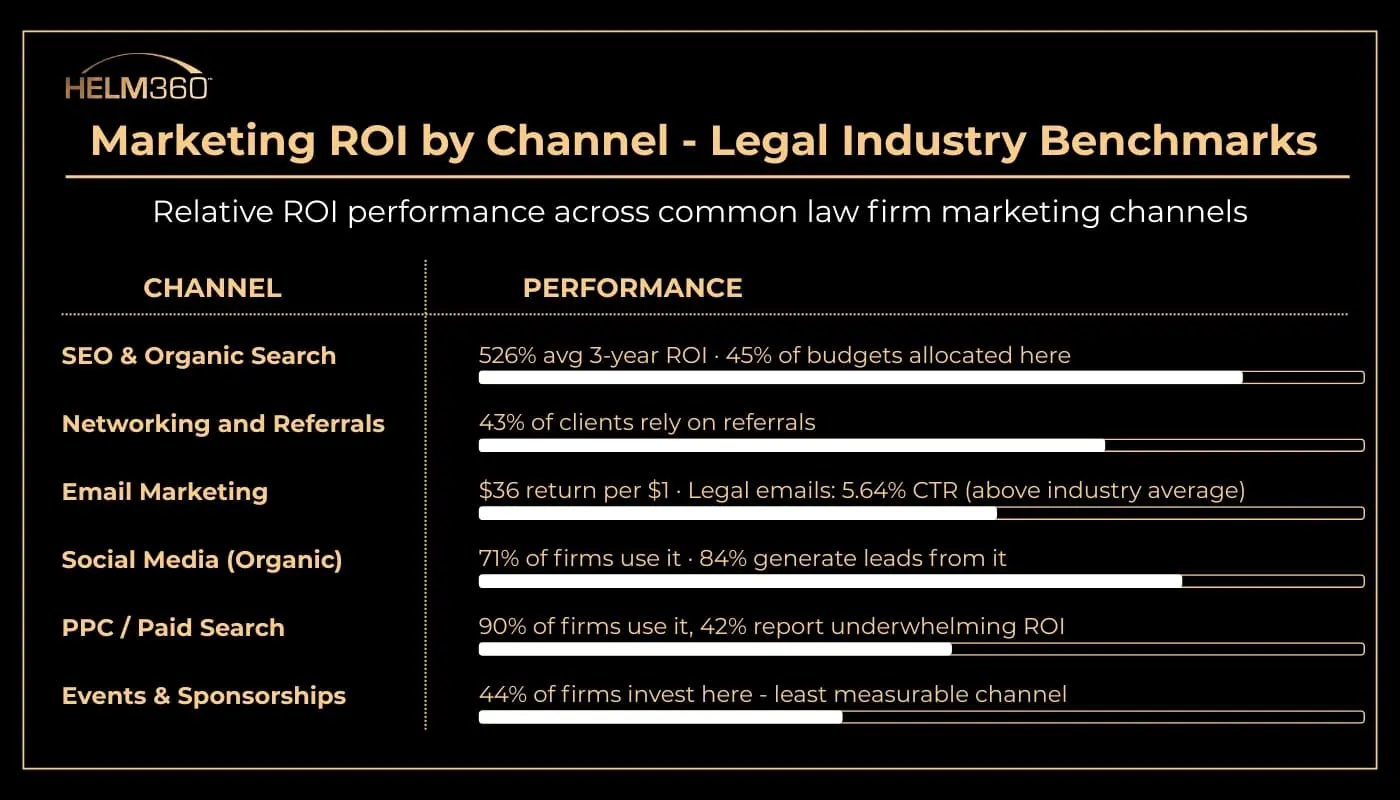
Sources: FirstPageSage (SEO ROI & budget share) · CallRail 2025 (PPC ROI, social media, referral ask rate) ·CallRail (Referrals) · Hubspot & Cyberimpact via SeoProfy (email ROI & CTR) · MyCase 2025 (events & sponsorships)
What these benchmarks reveal is not which channels to choose, but how easily performance can be misread. A channel showing weak ROI at the industry level often suffers from poor attribution, not poor performance. A campaign evaluated on clicks or enquiries will always look different from one measured on signed matters and collected revenue.
The takeaway is simple. Channel benchmarks are starting points, not verdicts. The real answer sits inside your own system data, where marketing activity connects directly to matter value.
Six Metrics Every Law Firm Should Be Tracking
Most firms already track multiple metrics, yet still struggle to connect them to revenue. The following six metrics connect marketing activity directly to financial outcomes:
- Cost per Acquired Client (CPAC)
Total marketing spend divided by new clients signed. Tracked by channel, this reveals where budget is working. - Lead-to-Matter Conversion Rate
The percentage of enquiries that become matters. Low conversion often signals intake or positioning issues, not channel failure. - Average Matter Value by Source
Not all clients are equal. This separates high-value work from high-volume noise. - Realization Rate by Client Origin
What percentage of billed fees are collected. Weak realization reduces true ROI. - Client Lifetime Value (CLV)
Some channels bring repeat clients and referrals. Others do not. This metric captures long-term impact. - Time-to-First-Bill by Source
How quickly revenue starts after intake. This affects cash flow, not just total revenue.
None of these require new tools. They rely on how consistently data is captured and how well it is connected across systems.
For firms looking at how this shift is being implemented in practice, Legal Technology Trends for Law Firms 2026 outlines how reporting and data visibility are evolving across the industry.
A Practical Starting Point: Three Steps This Quarter
If structured attribution is not in place, the goal is progress, not perfection.
- Audit your intake data
Ensure source and origin are captured consistently for every new matter. Standardize source categories. - Build a simple attribution report
Map new matters to source, value, and collections. Even a basic version reveals patterns. - Create a review cadence
A monthly review of spend vs revenue by channel creates accountability and better decisions.
These steps create visibility without disrupting operations.
The Infrastructure That Makes It Possible
Improving marketing ROI is not about adding more tools. It is about how existing systems are configured to work together.
In most firms, practice management, billing, and CRM systems operate independently. Reporting then becomes a manual exercise, stitched together when needed, rather than something leadership can rely on in real time.
When these systems are structured and aligned properly, reporting shifts from reactive to continuous. Performance can be viewed by partner, practice group, or client origin without waiting on custom reports or manual data pulls.
This is where structured data and business intelligence become critical.
Helm360’s Data Services support law firms in connecting these systems into a consistent reporting framework, improving how data is captured, organized, and surfaced for decision-making.
For a practical perspective on how firms are approaching this shift, you can explore this Legal Helm Podcast episode on marketing and resilience.
Closing Thought
At some point, improving marketing performance stops being a marketing exercise.
It becomes a question of how reliably your systems can support decision-making.
When leadership reviews performance, the expectation is simple, clear attribution, consistent reporting, and the ability to compare outcomes across practice areas and client sources. Most firms struggle here not because the data is missing, but because it is not structured or surfaced in a way that supports those decisions.
That is where the real shift happens.
See How Your Reporting Holds Up Under Real Questions
Can your current reports break down revenue by client origin across practice groups?
Can you compare performance across channels without manual data pulls?
Can leadership access this view without waiting on a custom report?
If not, it is worth evaluating how your reporting layer is built on top of your existing systems.
Helm360 supports law firms in configuring platforms like Elite 3E and ProLaw to deliver consistent, usable reporting across matters, billing, and client origin, without adding operational overhead.
If you’re exploring how to strengthen reporting across your systems, this is a practical starting point for firms looking to improve reporting structure and data visibility: