
The Impact of Legal Tech Consolidation: What It Means for Firms and Clients

Clients rarely ask what technology their law firm uses.
They ask simpler questions:
- Why did this take so long?
- Why did the cost change?
- Why does every update require another email?
Behind many of those frustrations sits a fragmented legal technology stack- systems that were never designed to work together. Legal tech consolidation is addressing this gap, not by replacing legal expertise, but by removing the friction that slows firms down and clouds client visibility.
How Law Firm Technology Became Fragmented
This didn’t happen because firms made bad decisions.
It happened because they made reasonable ones at different times, for different needs.
- A document management system was implemented to organize files.
- A billing system followed to track time and expenses.
- Research tools became essential.
- Collaboration platforms were added.
- More recently, AI tools entered the mix.
Each tool solved a real problem.
What didn’t happen was coordination.
Most of these systems were never designed to share data with each other. As a result:
- Information is entered multiple times
- Reports are rebuilt manually
- Lawyers rely on email and spreadsheets to connect systems
Even answering a basic client question like “What’s the current status of this matter?” can require checking several platforms before anyone is confident enough to respond.
Over time, that friction becomes visible to clients.
What Legal Tech Consolidation Actually Means
Consolidation does not mean forcing everything into one system.
In practice, it means three things:
- Fewer disconnected tools
- Better data flow between systems
- Less manual coordination by people
Many firms are moving toward integrated platforms and partner-led ecosystems, rather than isolated point solutions. According to Thomson Reuters’ analysis of consolidated legal technology stacks, firms that reduce fragmentation gain clearer visibility into matters, costs, and performance without requiring lawyers to change how they practice law.
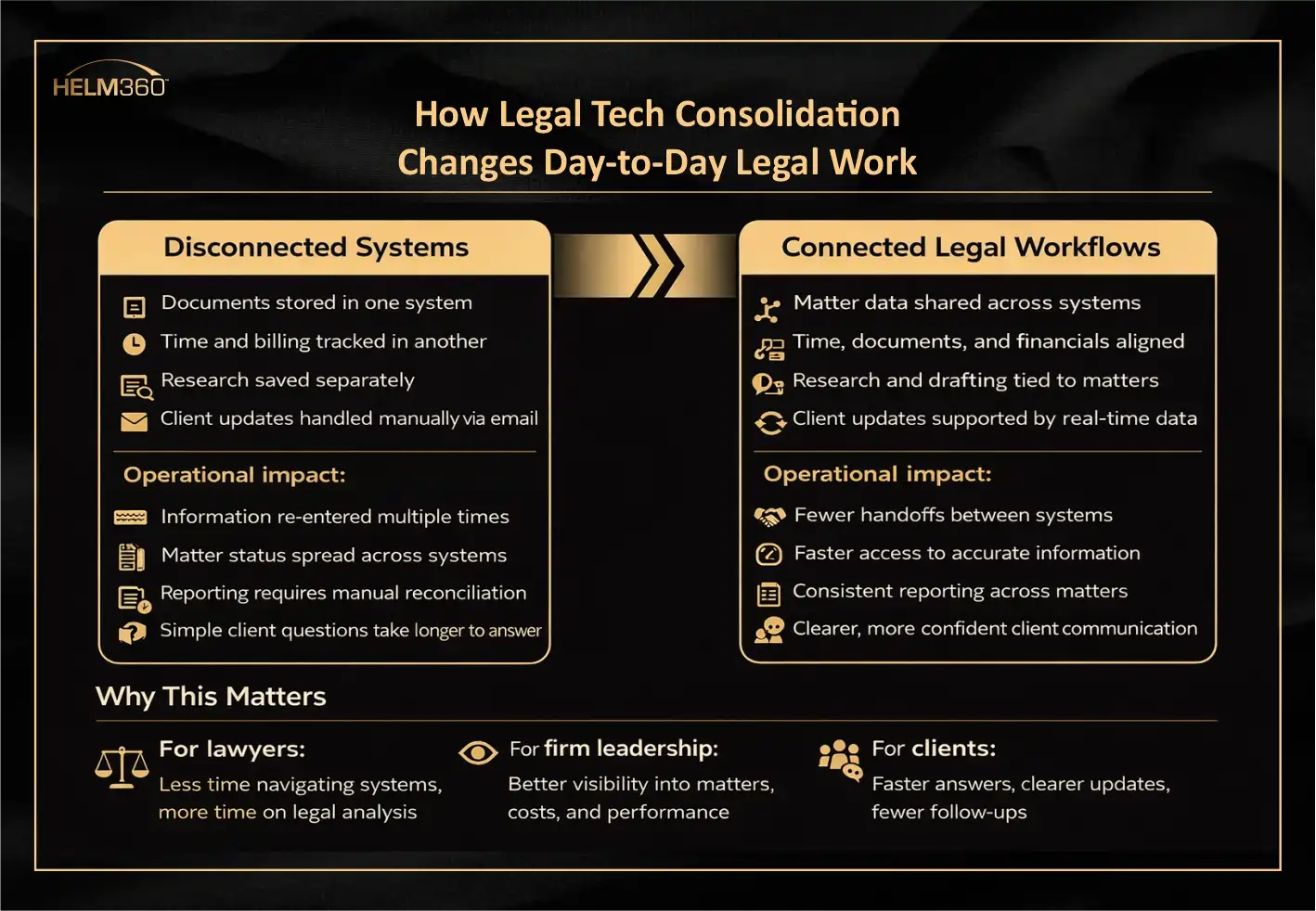
The outcome is straightforward: lawyers spend less time navigating systems and more time focused on legal analysis, client advice, and decision-making.
Why Consolidation Is No Longer Optional
For many law firms, consolidation is no longer a future-looking strategy. It is a response to everyday operational pressure. As client expectations increase and internal systems become harder to manage, fragmented technology introduces delays, uncertainty, and avoidable risk.
Three practical realities are pushing firms to act.
1. Clients Expect Clarity, Not Extra Follow-Ups
Clients want timely updates, predictable costs, and clear answers. When matter information is spread across multiple systems, even simple questions require internal coordination before anyone can respond with confidence.
More connected technology environments make it easier to access accurate, up-to-date information in one place. This reduces delays, unnecessary follow-ups, and confusion, improving both client experience and internal efficiency. Over time, firms find that without consolidation or integration, meeting these expectations consistently becomes difficult.
2. AI Exposes the Limits of Fragmented Systems
When documents, time entries, financials, and research live in separate systems, AI has no consistent view of a matter. The result is limited or inconsistent output that firms struggle to rely on. Guidance on the legal AI adoption curve shows that firms see meaningful value when AI is embedded into existing workflows rather than added as a standalone tool. In practical terms, AI adoption forces firms to address fragmentation. Without integration, AI cannot scale responsibly or deliver real value.
3. Fragmentation Increases Security and Compliance Burden
Each disconnected system introduces its own access controls, permissions, and security requirements. Managing these separately increases oversight effort and raises the risk of gaps or inconsistencies.
More integrated environments simplify governance by centralizing controls and standardizing processes. As regulatory and client scrutiny increases, firms find that reducing fragmentation is often the most practical way to strengthen security and compliance.
How Consolidation Changes Daily Operations Inside Law Firms
When systems are connected, the impact shows up quickly in everyday work. Routine tasks become easier, information is easier to access, and decision-making becomes more reliable across the firm.
The changes below are what firms experience most directly.
1. Less Time Managing Technology
When systems work together, lawyers spend less time searching for information, re-entering data, or reconciling reports. Fewer manual workarounds are needed just to complete routine tasks.
2. Better Visibility Across Matters
Connected systems make it easier to understand:
- where matters currently stand
- how time and resources are being used
- what is driving changes in cost or scope
That visibility supports better planning and more confident conversations with clients.
3. A More Sustainable Lawyer Experience
Lawyers expect tools that support their work without adding friction. Consolidation improves usability and consistency, which helps adoption and reduces frustration, especially as firms onboard new talent.
Consolidation does not mean rigidity. The goal is a connected ecosystem, not a single inflexible platform.
What Clients Experience When Firm Systems Are Connected
Clients may never see a firm’s technology stack, but they experience the results of how well it works.
When internal systems are connected, clients notice very real changes in how legal services are delivered. Information is easier to access, updates are clearer, and fewer issues need to be revisited because of missing or inconsistent data.
As a result, clients experience:
- faster responses to routine questions
- clearer and more predictable billing
- fewer follow-up emails asking for status or clarification
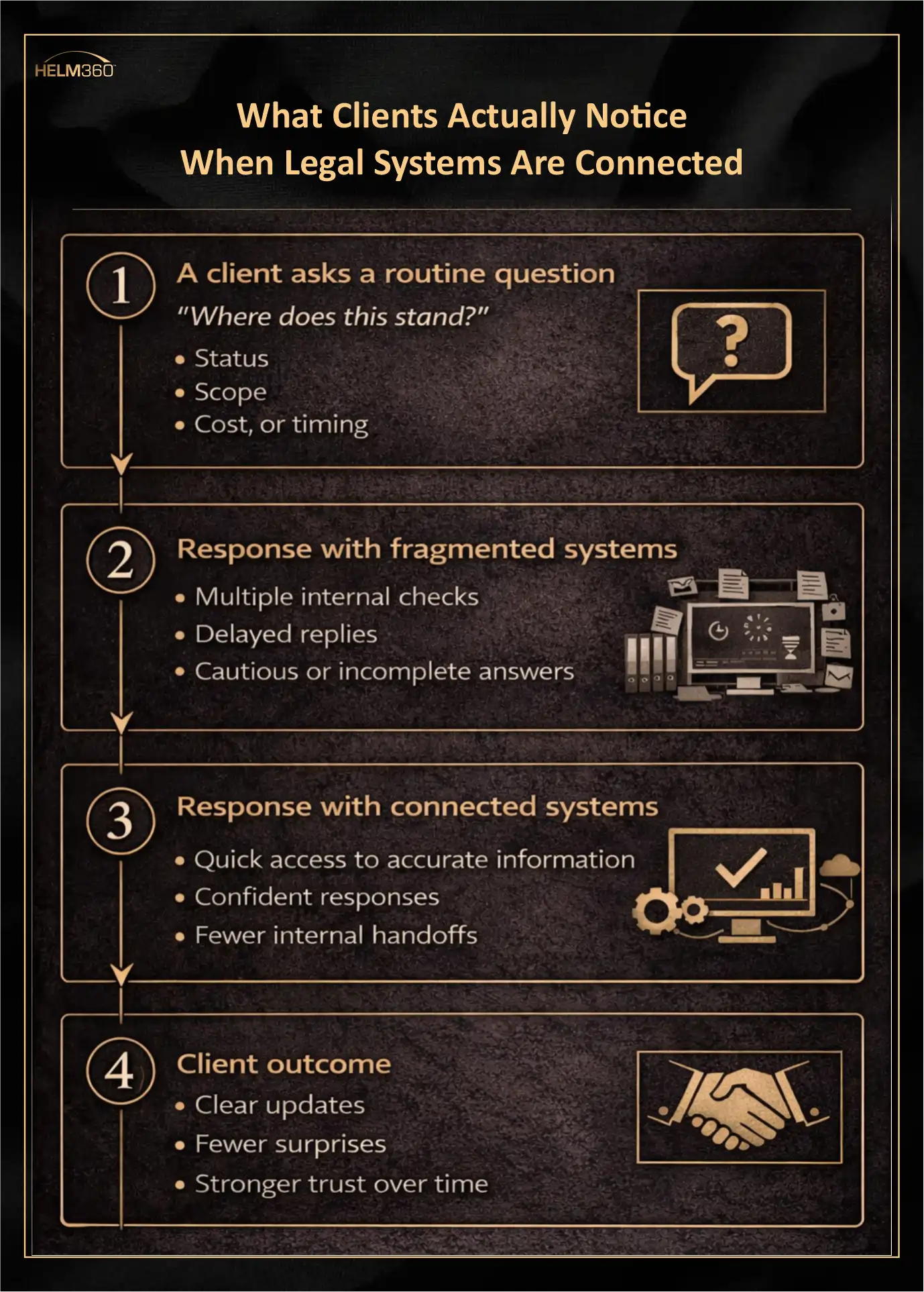
For many firms, this shift directly affects how clients perceive reliability and professionalism. Improving internal information flow has become inseparable from improving the overall client experience.
Where Strategic Partnerships Fit Into Consolidation
Not all consolidation happens through a single platform or vendor.
Many law firms reduce fragmentation through partner-led integration, where trusted service and product providers work together to ensure systems align without forcing rigid technology decisions.
Programs like the Helm360 Alliance Partner Program support this approach by bringing together vetted legal technology partners. The emphasis is on alignment and interoperability, helping firms build connected environments where systems and services work together in practice, not just on paper.
This ecosystem-based model allows firms to modernize thoughtfully while preserving flexibility and minimizing disruption.
How Firms Are Approaching Consolidation Successfully
Firms that navigate consolidation effectively tend to follow a consistent approach:
- They start with client and business outcomes, not individual tool features
- They prioritize integration and governance early
- They plan for adoption and change management, not just technical implementation
This approach reflects a broader shift toward operational maturity, where technology decisions are closely tied to service quality, risk management, and long-term sustainability.
Final Thoughts
Legal tech consolidation is not about following trends or adopting technology for its own sake.
It is about removing friction that slows work, complicates communication, and frustrates clients.
For law firms, consolidation creates clarity, operational efficiency, and better visibility across matters.
For clients, it delivers transparency, predictability, and confidence.
Handled thoughtfully, it strengthens both sides of the firm–client relationship.
Thinking About Simplifying Your Legal Technology Environment?
Helm360 works with law firms to evaluate, align, and optimize legal technology, helping firms build connected systems that support real legal work.
Start a conversation with our team: