


Why Law Firms Experience Billing Delays Even When Systems Are Working

Law firms today are busier than ever. Attorneys are putting in long hours, billing platforms are up and running, and the team is doing everything right. So why do invoices still take longer than expected to reach clients?
The answer is almost never the software. It is the small, easy-to-miss gaps in the process that sit between finishing a task and sending a final invoice. These gaps show up at every firm, regardless of size or technology. Once you know where they are, addressing them is straightforward.
Here are the five most common reasons billing slows down, even when everything else is working just fine.
1. Time Entry Gets Pushed to "Later"
It starts small. An attorney wraps up a client call, plans to log the time after the next meeting, and moves on. Hours pass. Sometimes a full day. By the time they sit down to enter it, the details are fuzzy, and the entry ends up shorter than the actual time spent.
This is called reconstructive billing, and it is one of the most common reasons firms lose billable revenue. According to practice management consultant Ann Guinn, writing for the American Bar Association, attorneys who wait until the end of the day to record their time lose 10 to 15% of their billable hours. Wait until the next day, and that rises to 25%. Wait until the end of the week and the loss can reach 50%. That is earned revenue that simply never makes it onto a proforma.
It is not a willingness issue. It is simply a memory issue. No one can accurately recall every phone call, email, or research task from days ago.
What typically gets missed:
- Short calls and emails that individually seem minor but add up
- Internal coordination time on client matters
- Review and revision rounds that happen between drafts
- Travel time and preparation for client meetings
Quick Win: Encourage attorneys to log time at the end of each task rather than at the end of the day. Even a two-minute habit change here has a measurable impact on monthly revenue.
2. Proformas Sit Waiting for Partner Approval
Even when time entries are captured well, the next step is the proforma review cycle, and this is where many firms quietly lose weeks.
Draft invoices go out to the responsible partners. Partners are busy with active matters, client calls, and court prep. Reviewing proformas, as important as it is, rarely feels as urgent as the live work in front of them. Approvals get pushed to the end of the week, then to the following Monday, and before long, billing coordinators are sending follow-up reminders just to move things forward. By the time a proforma is approved, the time billed on it may already be weeks old from the client’s perspective.
Common signs this is happening at your firm:
- Billing coordinators routinely send multiple follow-ups before getting approvals.
- Invoices go out in large batches at month-end instead of steadily through the month.
- Partners frequently ask billing to “hold” proformas without a clear timeline.
- Client invoices regularly carry time that is 45 or more days old.
Quick Win: Set a firm-wide proforma review window of five to seven business days. A simple calendar reminder or automated nudge from your billing system can make this a standard without requiring extra effort from partners.
3. How a Small E-Billing Mistake Can Delay an Entire Invoice
Many corporate clients require invoices to be submitted through e-billing platforms such as eBillingHub or Thomson Reuters Legal Tracker. These systems automatically check each invoice against the client’s billing rules before payment is processed. If something does not match, the invoice comes straight back.
A rejection means the billing team has to stop, find the issue, fix it, and resubmit, often while juggling a full queue of other work. Each round trip adds days to the payment timeline.
What makes this particularly disruptive is that a rejected invoice does not just sit on hold. It comes back to the billing team requiring someone to stop what they are doing, find the specific issue, correct it, and resubmit, all while the rest of the billing queue continues to grow.
Most common rejection triggers:
- Time entries logged in billing units the client has not agreed to, for example, billing in 15-minute blocks when the client only accepts 6-minute increments.
- Hourly rates that are higher than what was agreed in the client’s billing guidelines or engagement letter
- Missing UTBMS task codes or activity codes
- Timekeepers who have not been approved for that specific matter
- Invoice descriptions that do not match the scope of work
Quick Win: Keep a billing guidelines summary sheet for each major corporate client. One page, easy to reference before submitting. This alone reduces re-work significantly.
4. Billing Volume Spikes and the Team Cannot Keep Up
Billing workloads are not consistent throughout the year. Year-end pushes, pre-trial preparation, post-merger transitions, and busy practice cycles all create sudden spikes in volume. When these hit, even a well-staffed billing team can fall behind.
The situation becomes more difficult when a key billing person is on leave or moves on during one of these peak periods. Bringing in temporary help from a general staffing agency sounds like a quick fix, but it often is not. Someone who is unfamiliar with the firm’s billing systems and workflows needs weeks of training before they can contribute meaningfully. By the time they are ready, the backlog has grown even further.
Signs your team may be stretched too thin:
- Proforma backlogs grow noticeably at month-end or year-end.
- Billing staff regularly work late or on weekends to catch up.
- Invoice aging reports show a pattern of delays rather than one-off exceptions.
- Clients are following up on invoices before the billing team gets to them.
Quick Win: Plan for volume spikes in advance rather than reacting to them. If year-end is always a crunch, bring in experienced billing support a few weeks before the rush begins, not after the backlog has already built up.
5. Vague Descriptions Lead to Client Questions
Here is a situation most billing professionals know well. A client receives an invoice. One line reads: “Review and analysis of documents, 4.5 hours.” The client does not know which documents, which matter, or why it took that long. They send an email. Or they call. Now the billing team has to pull the file, get clarification from the attorney, and follow up before the client approves payment.
That back-and-forth, which starts with one vague time entry, can push payment out by two to three weeks. Clients are not being difficult. They are simply asking a reasonable question about a bill they have been asked to pay. Clear, specific descriptions remove that question before it is ever asked.
Here’s what that difference looks like in practice:
- Too vague: “Review documents”
Better: “Reviewed deposition transcripts for Smith v. Jones and identified key inconsistencies for the cross-examination outline.” - Too vague: “Client call”
Better: “Conference call with the client regarding settlement negotiation strategy and an updated timeline.” - Too vague: “Research”
Better: “Researched recent case law on force majeure clauses in commercial contracts for an ongoing contract review.”
Quick Win: Share two or three examples of strong time entry descriptions with your attorneys and billing team. Making the standard visible makes it much easier to follow.
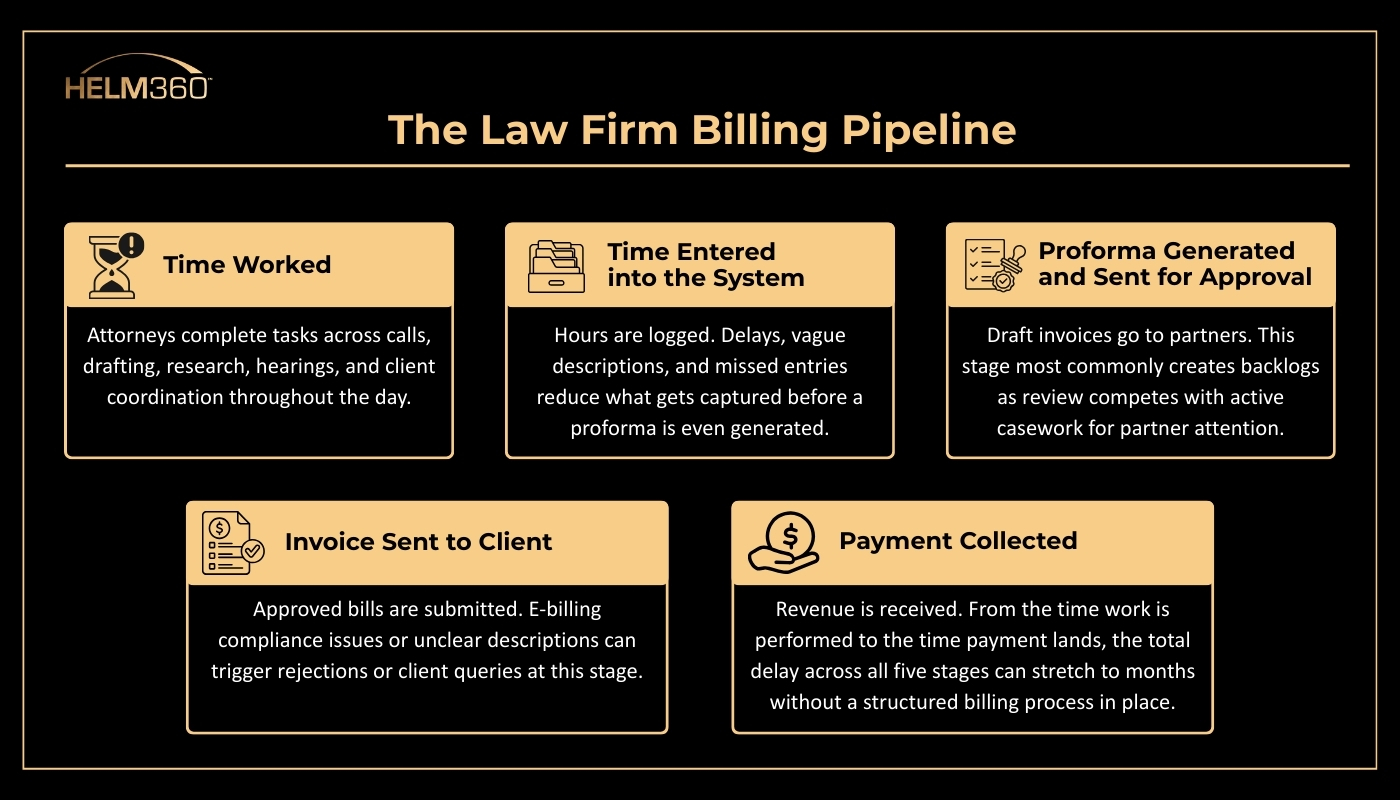
We have walked through all five reasons. Here is how they each connect to a single billing journey. Every stage below is a point where delays from one or more of these reasons can appear.
So, What Can Your Firm Do About It?
The good news is that none of these delays require a new system or a large investment to fix. They require awareness, a few consistent habits, and the right support when the workload grows. Firms that get these foundations right tend to see invoices go out faster, fewer back-and-forth conversations with clients, and a steadier flow of incoming payments.
How Helm360 Helps
Billing delays are rarely a one-time problem. For most firms, they are a recurring cycle that gets harder to break the longer it continues. Helm360’s Billing Support Services are built to break that cycle.
Our team already knows Thomson Reuters 3E, Workspace Paperless Proforma, and the full legal billing workflow. We do not need weeks to learn your system. We step in, we get to work, and your billing starts moving again.
While your internal team is offline, our offshore team is processing proformas. By the time your day starts, everything is ready for partner review. For anything urgent, our nearshore team is available to step in with same-day support. Whether you need two people or ten, we scale to fit what your firm actually needs right now.
Here is what our clients have seen:
- $3M in unprocessed billing successfully cleared
- 3 weeks to fully resolve a billing backlog
- 2 weeks to get fully up and running on a new engagement
- Under 1 hour turnaround on urgent billing requests
- 24/7 processing so your revenue never sits still
Billing delays are common. Staying stuck in them is optional. If your firm is ready to get invoices out faster and keep cash flow steady, we would love to have that conversation.
Your Backlog Ends Here
Talk to the Helm360 team and let us show you how quickly things can change.