


Upcoming FCA AML Oversight for Law Firms: Key Changes and How to Prepare

For most law firms, AML compliance has always meant one thing: keeping the SRA satisfied. The annual review, the risk assessment, the file audits, all calibrated to a familiar regulator with a known approach. That relationship is about to end.
The UK government has confirmed that the Financial Conduct Authority (FCA) will take over Anti-Money Laundering and Counter-Terrorist Financing supervision for law firms and other professional services providers, replacing the SRA’s current AML role entirely. Full implementation is expected in 2029. Firms that start preparing now will be in a fundamentally stronger position than those that wait.
What's Actually Changing and Why Now?
At present, AML supervision for professional services is handled by 22 different supervisory bodies across the UK. That means a law firm doing conveyancing work and a trust services provider down the road could be held to quite different standards, even though both carry real financial crime risk. It is an inconsistent system, and the government has decided it needs fixing.
The plan is to bring all AML supervision for legal, accountancy, and trust and company services under one roof: the FCA. The FCA already supervises banks and financial institutions for money laundering compliance, so it has the experience and the infrastructure to do this at scale. One regulator means one standard applied consistently across the board.
It is worth being clear about what this does and does not mean for your firm. The rules themselves are not changing. The Money Laundering Regulations 2017 remain the legal foundation for what firms are required to do. What shifts is who is checking your compliance, and the rigour with which they do it.
There is also a cost dimension to this. The FCA plans to recover its supervision costs through fees charged directly to the firms it oversees. The exact fee structure will be confirmed once the consultation process concludes, but firms should start factoring an additional regulatory cost into their planning now rather than waiting for the final figures.
What the FCA's Enforcement Record Tells You
The simplest way to understand what this transition means in practice is to look at how the FCA has handled AML non-compliance compared to the regulators already supervising professional services firms.
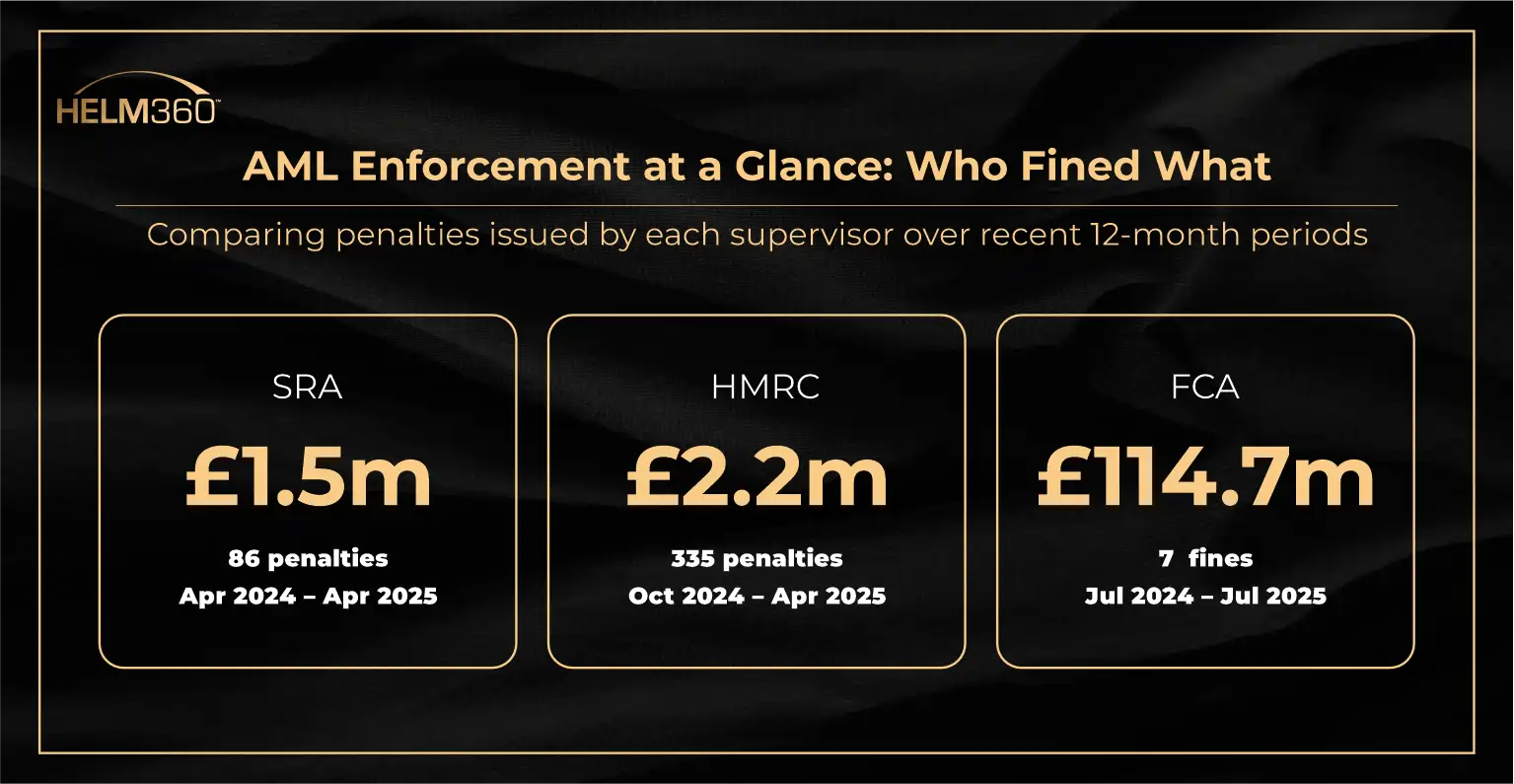
The FCA issued just seven money laundering fines over that period, far fewer than either the SRA or HMRC, yet the total came to £114.7 million. That is because the FCA bases its penalties on up to 20% of a firm’s relevant annual revenue, which is a fundamentally different calculation to the fixed-scale fines the SRA has historically applied.
Is Your Firm in Scope?
The FCA will supervise any firm carrying out activities that fall within the scope of the Money Laundering Regulations. For the legal sector, this is broad. The three main categories in scope are:
- Legal service providers – solicitors, barristers, conveyancers, and notaries whose work touches property transactions, company matters, or client money.
- Accountancy service providers – audit, tax, and advisory firms performing MLR-regulated activities.
- Trust and company service providers (TCSPs) – firms forming companies, providing registered offices, or acting as nominee directors or trustees.
The SRA will continue to regulate professional conduct matters as before. On AML and CTF, however, the FCA becomes the only regulator that counts.
The Timeline: What to Expect Between Now and 2029
The legislative process is already under way. Here are the key milestones firms need to be aware of:
- Summer 2026: King’s Speech to announce the new AML Supervision Bill
- Autumn 2026: Draft legislation setting out the FCA’s expanded remit.
- Mid-2027: Bill to receive Royal Assent
- 2027: FCA preparatory phase begins
- 2028: Transition period during which the FCA is expected to publish a new AML Handbook for Professional Services
- 2029: Full implementation, with the FCA formally taking over AML supervision for all firms in scope
Source: Norton Rose Fulbright. Timings are indicative and subject to parliamentary availability.
2029 may feel distant, but the preparation required between now and then is substantial. Governance restructuring, policy updates, staff training, and board reporting all take longer in practice than they do on paper. The SRA remains the active supervisor until the formal handover, so existing compliance standards must be maintained throughout.
Your Preparation Checklist
Getting FCA-ready is not something that can be handled by one person or one team. It requires coordinated action across the firm, and firms that begin this work early will be significantly better positioned when the 2029 deadline arrives.
Impact Assessment
- Map your activities against the MLR perimeter. Work through each practice area and matter type to identify what brings your firm into scope.
- Appoint a named owner to monitor FCA registration triggers and maintain an up-to-date view of in-scope entities within the firm.
Resourcing for Transition
- Build a cross-functional change team covering legal, compliance, HR, IT and data, finance, and operations.
- Set milestones and board-level reporting for FCA readiness, covering registration, governance, policies, staff training, and any overseas implications.
Whistleblowing
- Update your whistleblowing policies to direct AML and CTF disclosures to the FCA rather than the SRA.
- Ensure confidential reporting channels are in place and that non-retaliation protections are clearly documented.
Getting Your Systems Ready
The FCA expects firms to be able to produce compliance records accurately and promptly when asked. That means client risk assessments, due diligence documentation, transaction records, and governance sign-offs all need to be accessible, current, and well maintained. Firms that rely on manual processes or disconnected systems will find this difficult to deliver consistently.
This is where having the right technology foundation matters. Helm360 is a full-service legal technology products and services provider that uses proven and emerging technologies to help law firms manage their data properly and keep their systems up to date with minimal downtime and maximum effect. From business intelligence and reporting to cloud hosting and beyond, Helm360 helps firms ensure that practicing law remains efficient, effective, and profitable.
The right time to review your technology setup is now, not when the 2028 deadline is at your door.
Your Technology Should Work as Hard as You Do
FCA supervision will demand more from your firm’s data and reporting than ever before. Helm360 helps law firms get the most from their legal technology, manage their data properly, and keep their systems running at their best.