


Why Your Law Firm’s Systems Are Exhausting Your Attorneys and What to Do About It

The most expensive resource in a law firm is attorney thinking. And right now, a significant portion of it is being spent on the wrong problems, not because attorneys are distracted, but because the systems around them are making simple things unnecessarily hard.
Law firms invest heavily in hiring sharp minds. But sharp thinking depends on the right environment. When an attorney starts the day switching between platforms, logging into disconnected systems, and manually assembling information that should already be unified, their cognitive energy is depleted before meaningful work begins.
This is the hidden cost of a fragmented tech stack. It does not show up as a system failure. It shows up as a steady, daily drain on productivity, decision-making, and the people who drive the firm forward.
What the Data Is Actually Telling Us
The numbers from recent legal industry research paint a consistent picture. Attorneys are putting in long hours, but a surprisingly large share of that time is going to tasks that technology should be handling. According to Bloomberg Law’s Attorney Workload and Hours Survey, the average attorney worked 48 hours a week in 2024, yet only 36 of those hours were billable. That is a full 12 hours every week, per attorney, absorbed by administrative overhead rather than client work.
The burnout picture is equally direct.
A survey of legal professionals by Rev found that 4 in 5 lawyers experience burnout sometimes, often, or constantly. Fewer than 4% reported never feeling burned out in the past year. For attorneys with 10 or fewer years of experience, nearly half describe burnout as a regular or constant state.
These are not numbers generated by exceptional workloads alone. They are numbers shaped by systems that make routine tasks harder than they need to be. When Bloomberg Law’s survey asked attorneys about their biggest collaboration challenges, the top answers were telling: 41% named tracking tasks and deadlines, 39% said getting a clear picture of project status, and 32% cited communicating efficiently with team members. None of these should require mental effort if the right systems are in place.
Law firms increased their technology spending by 9.7% in 2025, the fastest growth rate the industry has ever seen. The firms investing strategically are pulling ahead. The ones still running fragmented stacks are falling behind.
Taken together, these numbers point to one conclusion: the bottleneck in most law firms is not attorney capacity, it is the friction built into the systems attorneys use every single day.
What System Friction Feels Like on a Real Working Day
Cognitive exhaustion rarely arrives as a single moment. It builds through a pattern of small, daily frictions that most firms have quietly accepted as normal. Here is what that looks like inside a firm where the tech stack was built piece by piece, without a unified plan:
- A billing coordinator opens three separate platforms to build what should be a single matter summary, because none of the systems share data automatically.
- A partner approves work already flagged for a conflict because the intake workflow depends on a manual check that was never completed.
- A senior associate spends 45 minutes rebuilding a document trail because version control was managed informally, through email and local saves.
- An attorney fills in time entries at 6:30 pm from memory, guessing at durations for calls taken eight hours earlier, because nothing captured them in real time.
- A practice group leader waits two days for a financial report that a properly configured dashboard would have surfaced in under a minute.
Each of these moments draws on the same mental reserve that legal analysis requires. Multiply that across a 50-person firm, and you have thousands of hours a month quietly disappearing into friction that should not exist. Seen together, these moments tell a bigger story.
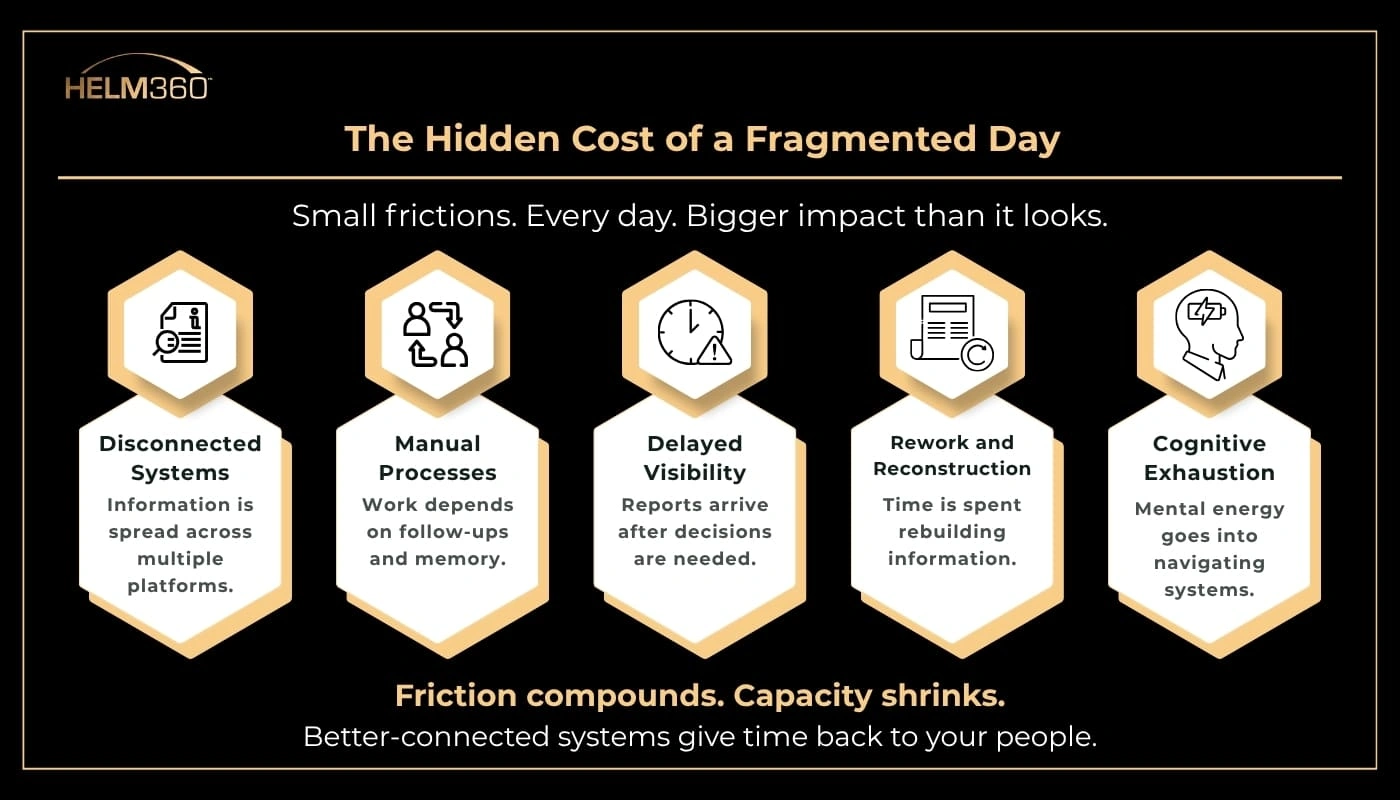
Four Places Where the System Is Costing You the Most
Not every technology issue carries the same weight. These are the areas where friction builds most consistently, and where the right approach can make a measurable difference.
1. A Practice Management System That Works in Theory, Not in Practice
Many firms running Elite 3E find they are not getting its full value. The issue is rarely the platform itself. It is how it has been implemented, configured, and adapted over time.
A billing workflow can appear correct in testing, yet still break down in daily use. Small gaps in configuration or integration often surface only after they begin affecting billing accuracy or reporting.
This is where structured QA, testing, and continuous validation become critical. Without that layer, issues remain hidden until they show up in financial outcomes.
2. Financial Visibility That Arrives Too Late
When financial data is not available in real time, decision-making slows.
Partners rely on finance teams for updates. Reports are generated manually. Billing cycles extend beyond what they need to be.
Platforms like Elite 3E are designed to provide integrated financial visibility, but only when reporting and data layers are properly aligned. Firms that move toward live dashboards and accessible reporting reduce delays and make decisions with greater confidence.
3. Intake and Conflicts Still Running on Trust and Memory
In many firms, intake and conflicts still depend on emails, manual checks, and individual follow-ups.
This creates inconsistency. Information is missed. Risk builds quietly.
Structured intake and conflicts workflows, supported by systems like Intapp, shift this from a reactive process to a controlled one. When data flows across systems and checks happen automatically, attorneys are no longer responsible for stitching together critical information.
4. Infrastructure That Relies on Individuals
Every firm has systems that depend on specific people.
Configurations are understood by a few. Workarounds become permanent. When those individuals leave, the knowledge leaves with them.
Over time, this creates instability. Upgrades become harder. Integrations take longer. Teams adapt by working around systems instead of relying on them.
A more structured approach to system ownership ensures continuity, stability, and long-term scalability.
What Firms That Get This Right Actually Look Like
In firms where systems are aligned, technology fades into the background.
Billing runs without intervention. Conflicts are flagged early. Reports are available when needed. Attorneys spend less time navigating systems and more time focusing on legal work.
This kind of environment is not accidental.
It comes from systems that are implemented with intent, connected properly, and maintained with a clear understanding of how the firm operates day to day.
Tools like Termi simplify how attorneys access firm data by bringing information from multiple systems into a single, intuitive interface. But the quality of those insights still depends on how well the underlying systems are connected and maintained.
At that point, the challenge is no longer access to technology. It is how effectively that technology supports the way the firm works.
If your systems are slowing down work instead of supporting it, it is worth understanding where that friction begins.
Talk to a Helm360 Consultant to assess how your systems are performing and where they can be improved.