


The Real Cost of Manual Reporting in Legal Operations

The gap between what firms hold and what leadership can actually access and act on is where the real cost of manual reporting lives. And it is far wider and far more expensive than most firms account for.
According to a Bloomberg Law survey, 77% of lawyers still rely on email as their primary tool for task and project management. Not integrated systems. Not real-time dashboards. Email. And the same research found that automating manual tasks ranks as the number-one driver of legal technology investment, above AI and cloud migration.
Firms already know what the problem is. What is often missing is a structured approach to fixing it and a clear view of what it costs when left unaddressed.
The Core Problem: Disconnected Systems Don't Just Slow You Down, They Blind You
Most law firms run on a combination of financial management platforms, practice management systems, matter intake tools, time tracking software, and compliance workflows. Each system performs its function well.
Some offer reporting and analytics, but they operate in isolation, not as a unified, real-time view across the firm.
The result is a visibility problem that affects every operational decision. Consider the questions that should have instant answers, but don’t:
- Which client relationships are genuinely profitable? That answer lives across at least three systems and takes days to compile manually.
- Where is WIP aging past 60 days? You’ll need a manual extract, a reconciliation, and a conversation with whoever holds the spreadsheet.
- Which timekeepers are below utilisation targets? Buried in a billing export that hasn’t been pulled yet this week.
This is not a technology failure in the traditional sense. The platforms most law firms already operate are built to handle exactly this complexity.
The issue is that the data they hold has never been connected into a single reporting layer. It remains fragmented, waiting for manual effort to bring it together.
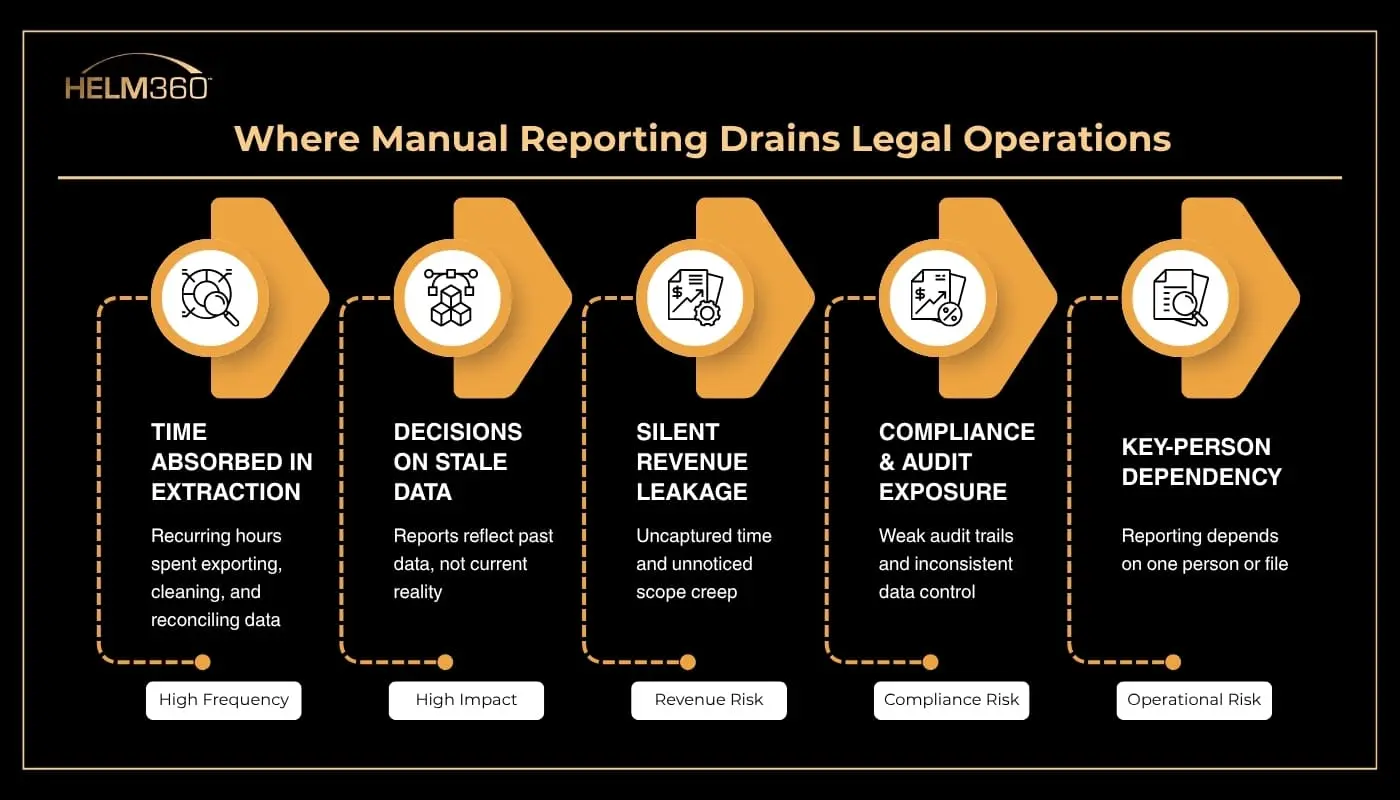
And every time that effort is repeated, the risks compound: version errors, stale figures, inconsistent methodologies, and audit trails that exist only in inboxes.
To see how this affects day-to-day operations, look at where manual reporting creates the most pressure.
The Visibility Question: What Leaders Are Actually Asking For And Why It Takes So Long
Ask any managing partner, CFO, or COO at a law firm what they want from their reporting environment, and the answers are consistent.
Which practice groups are actually profitable?
Where is our cash tied up in WIP?
Which client relationships are costing us more to service than they return?
These are not complex questions. They are the foundational intelligence that any well-run business should have on demand. But in a firm running on manual reporting workflows, answering them accurately means a multi-day extraction, and by the time the answer arrives, the conditions have shifted.
47% of legal professionals specifically want AI tools to help them surface insights from their firm’s own financial data not external research. The frustration is not with the platforms. It is with the gap between what the platform holds and what leadership can actually access.
Federal Bar Association, Legal Industry Report 2025 →
That statistic says something important: firms know the data exists. The barrier is access, not availability. The real shift happens when that data becomes consistently accessible and usable across the organisation.Read more on how law firms are approaching data-driven decision-making.
The Operational Shift: What Actually Changes When the Reporting Layer Works
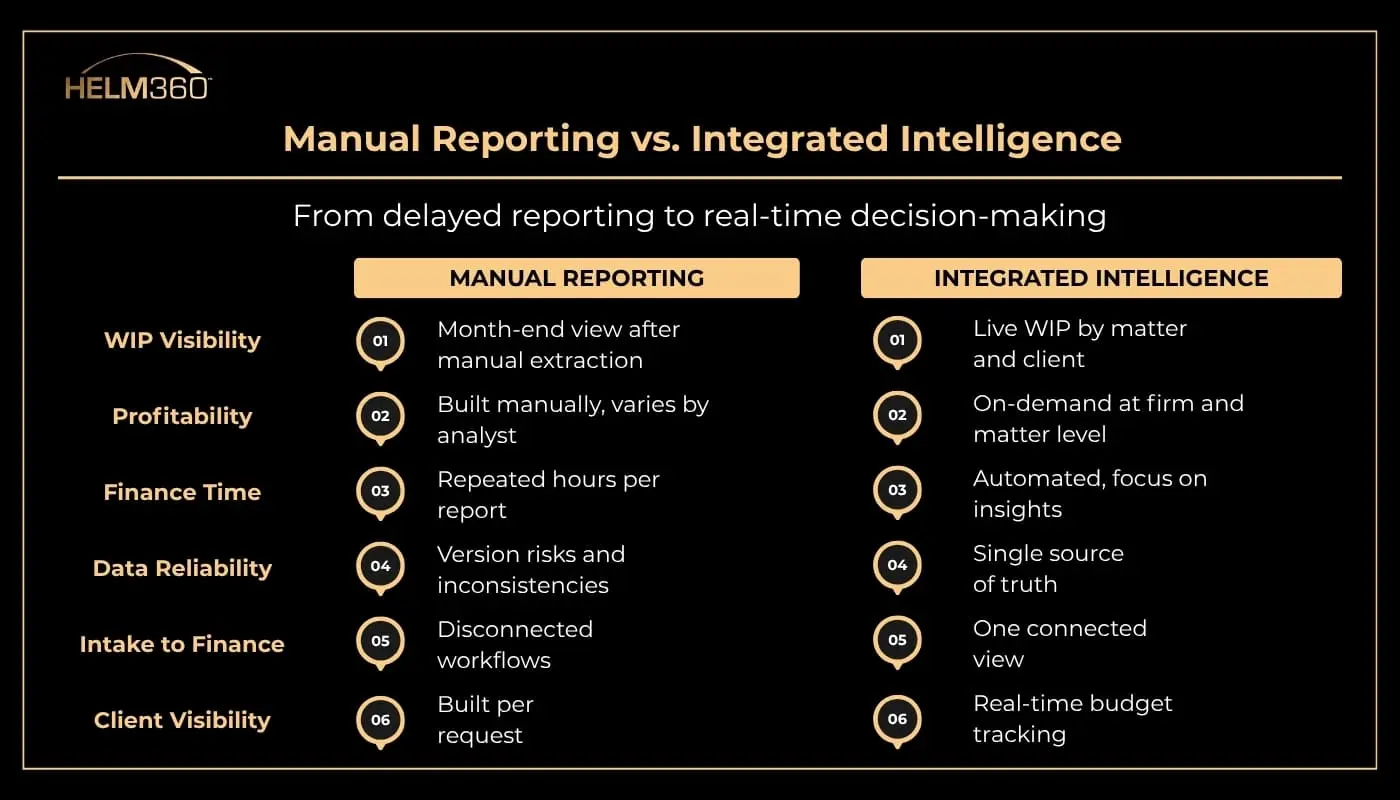
The difference between a firm running on manual exports and one with integrated, real-time business intelligence is not simply a matter of speed. It is a change in what leadership can see, when they can see it, and how quickly they can act on it.
Firms that have made this transition describe the same inflection point: the moment their data became accessible in real time was the moment they shifted from managing reactively chasing aged WIP, discovering billing discrepancies at invoice time, reviewing profitability only at year-end, to running the firm proactively.
That shift becomes clearer when you compare how reporting works in each model.
The Path Forward: Connecting What Already Exists
Fixing this does not require replacing systems. Most firms already have the core platforms in place. The challenge is not capability. It is how those systems are connected and how their data is surfaced.
The most effective approach is incremental. Improve how data moves across systems, align workflows, and build a reporting layer that brings financial, operational, and risk data into one view.
Across firms, the pattern is consistent. Financial and practice management systems sit at the core of operations, capturing billing, WIP, and profitability data, whether in platforms like Elite 3E, ProLaw, Aderant, or similar systems used across firms.
Alongside them, workflow and risk platforms manage intake, conflicts, and compliance processes that directly shape those financial outcomes.
Individually, these systems perform well. The limitation is that they operate in parallel, not as a connected reporting layer. Financial outcomes and workflow context remain separated, and reporting becomes the manual effort required to bring them together.
Closing this disconnect means improving how data flows across systems, aligning practice and financial platforms, and enabling leadership to access information without relying on manual extraction.
However, this is also where most efforts stall. Integration remains one of the most persistent challenges in legal operations, especially when firms attempt to connect systems that were never designed to operate as a unified reporting environment.
For a deeper look at how firms approach this integration in practice, download our whitepaper on integrating practice and financial management platforms.
Only once this foundation is in place does AI become meaningful. Instead of waiting for reports, leadership can query firm data directly and act in real time, extending the same reporting capability into immediate, on-demand insight, as seen in solutions like Termi.
The Question Worth Asking
If a Partner Asked Right Now, What Would Your Answer Be?
“What is our current WIP position by practice group, and which matters are most at risk of write-off?”
If the honest answer is hours or days, the cost of manual reporting is already being paid. It is being paid in delayed decisions, in analyst time spent on data extraction rather than strategic insight, and in the clarity that simply was not available when it mattered most.
The data to answer that question already exists within your systems. What’s missing is the infrastructure to surface it and the ability to access it when decisions are being made, not after.
Firms that address this effectively don’t replace their systems. They connect them, structure the data, and make it accessible in real time.
That is the role of a well-built reporting environment, supported by the right expertise and approach.
Helm360 works with law firms to strengthen how their systems and data come together, helping turn existing platforms into a more connected and insight-driven environment.
Take the Next Step: Improve How Your Systems Work Together
Helm360 helps law firms improve how information flows across systems, making it easier to access and use data for decision-making.
From business intelligence and reporting optimisation to workflow integration and data services, the focus is on turning fragmented data into clear, actionable insight.
If your reporting still depends on manual effort, it may be time to reassess how your systems are working together and where that connection can be improved.