


How High-Growth Law Firms Are Automating Intake and Conflicts with Intapp
Growth is supposed to feel exciting. But in a law firm, growth also brings more client requests, more lateral hires, more matter variations, more conflict reviews, and more chances for important details to slip through the cracks. For mid-market and high-growth firms, intake and conflicts are no longer back-office processes. They are the strategic front door to the firm.
The gap between firms modernizing these processes and those relying on manual workflows is becoming more visible. Leading firms are already automating intake and conflicts to reduce risk, speed up approvals, and create a smoother client experience from the first interaction. Others are still managing these processes through spreadsheets, disconnected systems, and long email chains.
For growing firms, the message is clear: modernizing intake and conflicts now can help reduce risk, move faster, and create a stronger first impression for every client.
Why Manual Intake and Conflicts Break Under Growth
Ask any conflicts attorney at a growing firm about their process five years ago, and you’ll hear a familiar story: printouts, sticky notes, and a master spreadsheet that someone forgot to update after a lateral came on board. Manual conflict checking isn’t just slow. It becomes increasingly difficult to manage reliably as firms grow.
The exposure is real. Overlooking a conflict of interest can lead to disqualification from a matter, malpractice claims, or bar complaints. And the pressure compounds as firms expand, with more laterals, more matters, and more complex relationships across jurisdictions and practice areas. Regulators and bar associations are also demanding stronger documentation around when and how conflicts are checked during intake, placing additional strain on manual processes.
The operational impact of staying manual shows up in predictable ways:
- Slow matter opening – 2 to 5 business days from inquiry to engagement letter remains common, and often avoidable.
- Incomplete conflict searches – name-only searches miss related parties, corporate hierarchies, and historical adverse relationships that automated systems are better equipped to identify.
- Limited auditability – when disputes arise later, email threads are rarely sufficient as a defensible record.
- Data silos – intake data lives separately from matter management and billing, forcing teams to re-enter information multiple times.
- Declining process consistency at scale – workflows that once felt manageable often begin breaking down as firms scale.
The difference becomes clearer when you compare manual intake workflows with a more integrated and automated approach.
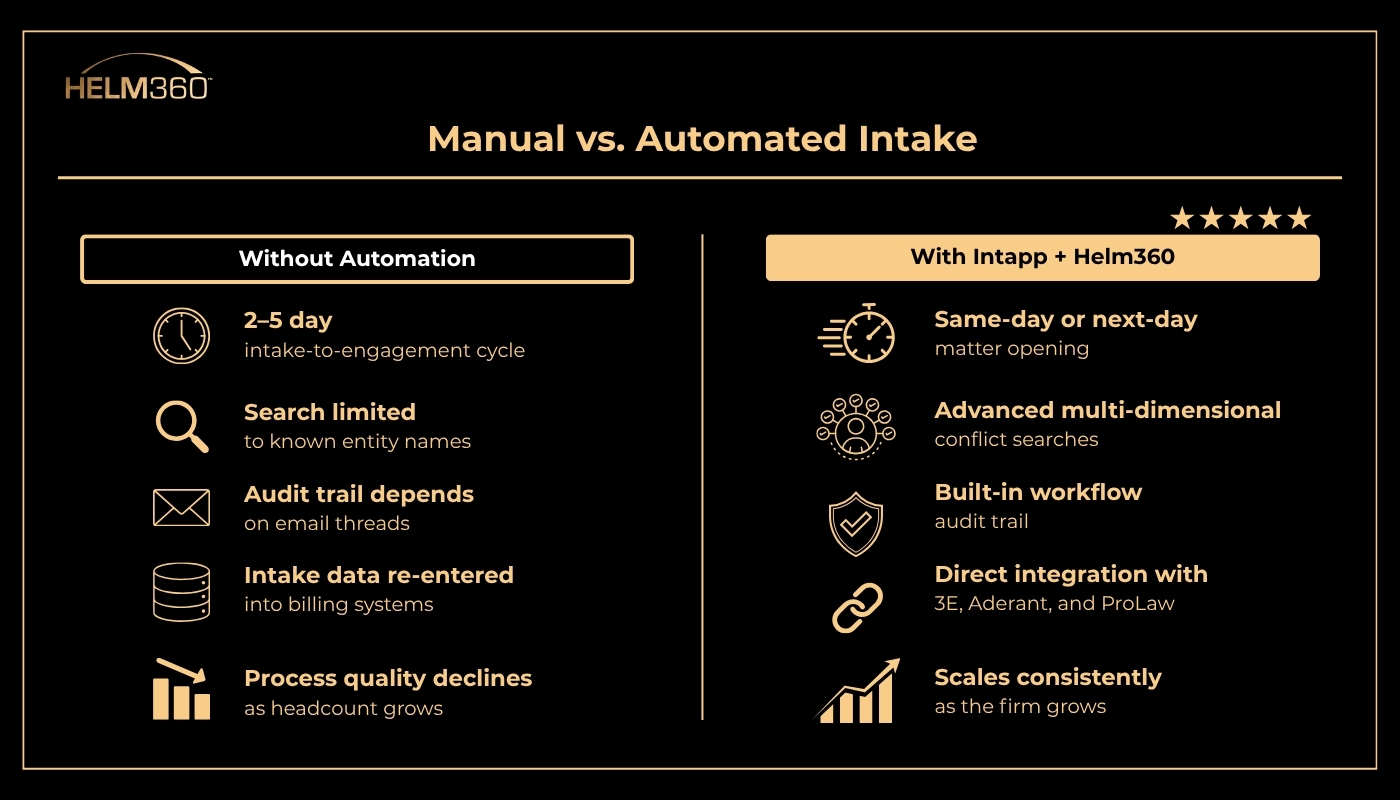
This comparison highlights why high-growth firms are moving away from manual intake processes. The difference is not only efficiency. It is greater visibility, stronger risk management, and a more scalable foundation for growth.
How Intapp Supports Modern Intake and Conflicts Workflows
There is a meaningful difference between generic workflow automation and purpose-built legal technology. Intapp Intake and Intapp Conflicts were designed specifically for professional services firms. The platform understands concepts like matter relationships, adverse parties, ethical walls, and the distinction between current, former, and prospective clients, nuances that general-purpose workflow tools are not designed to handle.
For growing firms, this matters because intake and conflicts are no longer isolated administrative tasks. They directly influence risk exposure, operational speed, client experience, and how efficiently new matters move into the firm.
The Intapp product suite supports the full new business lifecycle through four connected capabilities:
1. Structured intake workflows
Customizable intake forms capture the right information at the source – practice area, fee arrangement, originating attorney, billing preferences, so nothing gets reconstructed later. Approval routing follows firm-defined rules automatically.
Customizable intake forms capture the right information at the source – practice area, fee arrangement, originating attorney, billing preferences, so nothing gets reconstructed later. Approval routing follows firm-defined rules automatically.
2. Advanced conflicts search
Searches go beyond name matching to include related parties, corporate hierarchies, and historical adverse relationships. AI flags nuanced conflicts that keyword searches miss, the kind that create professional responsibility exposure.
Searches go beyond name matching to include related parties, corporate hierarchies, and historical adverse relationships. AI flags nuanced conflicts that keyword searches miss, the kind that create professional responsibility exposure.
3. Ethical walls and information barriers
Intapp Walls automates the creation and enforcement of information barriers, critical when lateral hires bring relationships that require confidentiality segregation. No IT ticket. No spreadsheet tracking screen access.
Intapp Walls automates the creation and enforcement of information barriers, critical when lateral hires bring relationships that require confidentiality segregation. No IT ticket. No spreadsheet tracking screen access.
4. Direct integration with practice management systems
Intapp connects with Elite 3E, Aderant, and ProLaw, the systems Helm360 specializes in, so approved matters flow directly into billing and matter management without duplicate data entry. This creates a more connected intake-to-finance workflow with better visibility and process consistency.
Intapp connects with Elite 3E, Aderant, and ProLaw, the systems Helm360 specializes in, so approved matters flow directly into billing and matter management without duplicate data entry. This creates a more connected intake-to-finance workflow with better visibility and process consistency.
Firms looking to modernize these workflows further can explore how firms are using Intapp integration to transform legal workflows.
For high-growth firms, connected intake and conflicts workflows help reduce onboarding delays, improve consistency, and create a more scalable foundation for risk management and client intake as the business grows.
Why Client Experience Starts with Intake
Legal operations conversations about intake automation typically center on risk reduction and process efficiency. Both are legitimate. But intake also shapes the client experience in ways firms often overlook, and for growing firms, that has a direct effect on business development and revenue.
Prospective clients form their first impression of your firm during intake. Firms that respond quickly, communicate clearly, and guide clients through structured onboarding win disproportionately. Automated intake contributes directly to that experience in three specific ways:
- Faster response time– Digital intake eliminates back-and-forth emails, enabling first meaningful contact within hours.
- Clearer next steps for clients – Automated acknowledgments and status updates replace communication gaps that often erode trust.
- Professional first impression – Opening matters within 24 hours signals operational discipline from the first interaction.
That signal matters. In a competitive mid-market, the intake experience is often a client’s first real indication of how organized, responsive, and scalable a firm actually is.
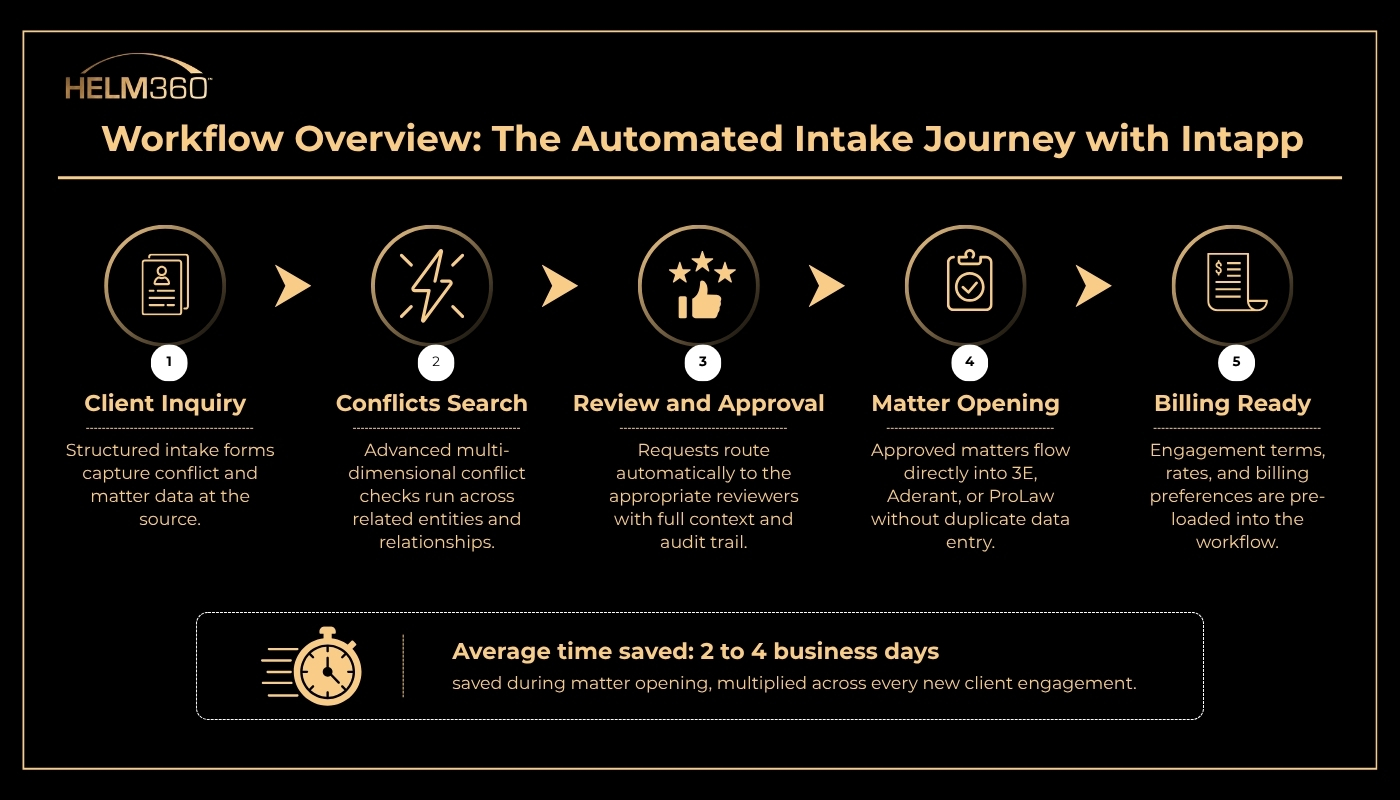
The operational workflow behind that experience is what ultimately determines how quickly firms can move from initial inquiry to approved matter opening.
Why Implementation Quality Determines Actual ROI
Selecting the right platform is only the first step. How Intapp is deployed, configured, and integrated ultimately determines whether firms achieve meaningful operational improvement or simply add another disconnected workflow to the environment.
This is a pattern Helm360 has seen consistently: firms that implement intake and conflicts tools without a clear integration strategy often end up duplicating processes instead of reducing friction across systems.
As an official Intapp partner, Helm360 approaches implementations with the broader operational workflow in mind. That includes connecting Intapp with the firm’s existing practice management environment, whether Elite 3E, Aderant, or ProLaw, so data flows cleanly between intake, conflicts, billing, and matter management.
The partnership between Helm360 and Intapp is built around a simple reality: implementation quality has a direct impact on adoption, efficiency, and long-term ROI. Firms evaluating modernization efforts can also hear how legal organizations are rethinking intake, workflow automation, and the broader quote-to-cash journey in Episode 35 of The Legal Helm podcast featuring Marie-Claire Le Houerou from Intapp.
The Window for Operational Advantage Is Open Now
As firms grow, intake and conflicts processes become harder to manage through disconnected systems, email chains, and manual approvals. Processes that once felt manageable often begin creating operational friction as matter volume, client relationships, and regulatory complexity increase.
This is why many firms are re-evaluating intake and conflicts workflows now, not only to improve efficiency, but to create stronger operational consistency, faster matter onboarding, and better visibility across the intake-to-finance lifecycle. Firms that modernize these workflows earlier gain more time to refine processes, improve adoption, and scale more effectively as the business grows.
For firms evaluating how intake, conflicts, and workflow governance are evolving under greater compliance scrutiny, this piece on the next wave of scrutiny explores the changing expectations shaping modern legal operations.
See How Intake and Conflicts Automation Can Work in Practice
For firms evaluating Intapp, or looking to improve an existing deployment that never fully connected across practice management and operational systems, implementation quality often determines whether automation delivers measurable long-term value.
Helm360 works with firms to connect intake, conflicts, billing, and matter management workflows across platforms like Elite 3E, Aderant, and ProLaw, helping firms build more connected and scalable operational environments.