
How to Identify System Bottlenecks in Law Firms

You just closed out another billing cycle. The numbers look acceptable on the surface, but somewhere in the back of your mind, a question persists: Where is all the time actually going?
Your attorneys are working. Your systems are running. And yet billing timelines keep stretching. Reports take too long to pull. A partner mentions, again, that a matter sat untouched for three days waiting on a workflow step no one could explain. Sound familiar?
Here’s the honest reality: most law firms aren’t losing revenue to dramatic failures. They’re losing it to bottlenecks so routine they’ve become invisible. A stalled approval here, a late time entry there, a system that slows to a crawl every month-end- none of it looks catastrophic on its own. Together, it adds up to something that absolutely is costing you growth.
The good news? Bottlenecks that are systematic are also identifiable and fixable. Now let’s examine exactly where they hide, what they cost, and how to build a firm that catches them before they compound.
Why This Matters More Than Most Firms Realize
Before diving into the where, the why is worth sitting with for a moment.
According to Thomson Reuters, the average law firm partner writes down approximately 300 hours of their own time annually. Even at conservative billing rates, those write-downs can represent millions of dollars in unrealized revenue across a large firm.
The challenge extends beyond write-downs. One leading legal industry trends report found that the average law firm utilization rate sits at just 38%, meaning lawyers capture only 3.0 billable hours in an eight-hour workday. After realization, firms invoice clients for approximately 2.6 hours of billable work.
Taken together, these numbers point to a larger issue. The gap between work performed and revenue captured is rarely a matter of effort. More often, it stems from operational friction, disconnected processes, and manual workflows that create inefficiencies long before an invoice is sent.
Where Bottlenecks Most Commonly Form
Most firms know something is slowing them down. Fewer have mapped out exactly where. Here are the five areas where operational friction most consistently forms in legal environments.
1. Billing and Time Entry: The Revenue Leak Nobody Authorized
Billing pressure is where revenue loss becomes visible, but rarely where it starts. The real friction lives upstream: inconsistent time entry habits, late narrative reviews, and approval chains that stall at the same predictable points every month.
Early warning signals to watch for:
- High volumes of bill holds going into month-end
- Time recorded days after work was performed, relying on reconstructed memory
- Frequent narrative edits during pre-bill review that push cycles back
- Write-down rates that vary significantly across partners with no clear explanation
Any one of these points to a process quietly absorbing time and creating downstream pressure for your finance and collections teams. For firms running platforms such as Elite 3E, Aderant, or ProLaw, slow system performance during high-volume periods can amplify these issues in ways that often appear procedural but originate from technology constraints.
2. Matter Handoffs: The Delays Nobody Documents
Every matter passes through a chain of transitions: intake to conflict check, conflict check to engagement letter, engagement to matter setup, and eventually to closing. Each handoff is a potential stall point, and in most firms, these transitions are partially manual and dependent on individual habits rather than system-enforced processes.
What makes this tricky is that the problem does not show up in aggregate reporting. It shows up in variance.
Ask yourself:
- How long does intake-to-matter setup take on average, and what is the range?
- Where do approvals consistently stall?
- Which handoff steps require the most follow-up to complete?
If your practice management system cannot surface these metrics, that gap is itself worth addressing. You cannot fix what you cannot see.
3. Data Integrity and Reporting Latency: The Blind Spots Nobody Notices
When data systems are fragmented, leadership teams make decisions on reports that do not reflect current reality, sometimes by days, sometimes by weeks. A practice management platform, a document management system, a billing tool, and a reporting layer pulling from all three creates multiple points where data can be inconsistent, delayed, or missing entirely.
A simple test:
- Can leadership pull reliable matter profitability and realization data without hours of manual assembly?
- Are finance and legal ops consistently working from the same numbers?
- Do your KPIs reflect this week’s reality, or last month’s?
If the answer to any of these is no, a data bottleneck is already affecting decision quality, whether your underlying numbers are strong or not. Firms addressing this are increasingly turning to dedicated legal data services that centralize operational reporting and reduce the manual overhead sitting between raw data and usable insight.
4. Application Performance Under Load: The Delays Nobody Anticipates
When attorneys and billing staff experience slow system response during high-volume periods, month-end runs, year-end closes, major reporting cycles, the instinct is to treat it as a one-time IT issue. It rarely is.
Performance degradation creates cascading delays, and over time, teams build workarounds that fill the gap. Those workarounds become standard procedure. The manual steps become the process. The inefficiency gets institutionalized, and the original constraint goes unfixed because nobody questions it anymore.
What that progression looks like:
- A slow billing run pushes month-end close by two days
- Staff create a manual workaround to compensate
- The workaround becomes routine, and the performance issue disappears from view
Proactive performance testing under realistic load conditions is the most reliable way to catch this before it reaches that stage.
5. Process Standardization Gaps: The Variance Nobody Tracks
Not every bottleneck lives inside a system. When two teams handle the same task differently, that variation is the bottleneck. Exceptions get escalated. Rework fills the gap. Time disappears into a process that was never designed to be repeatable.
Signs a standardization gap is driving friction:
- The same task takes noticeably longer in one office or practice group than another
- New staff take much longer to reach productivity because processes are not documented
- The same question gets escalated repeatedly, with no authoritative answer in place
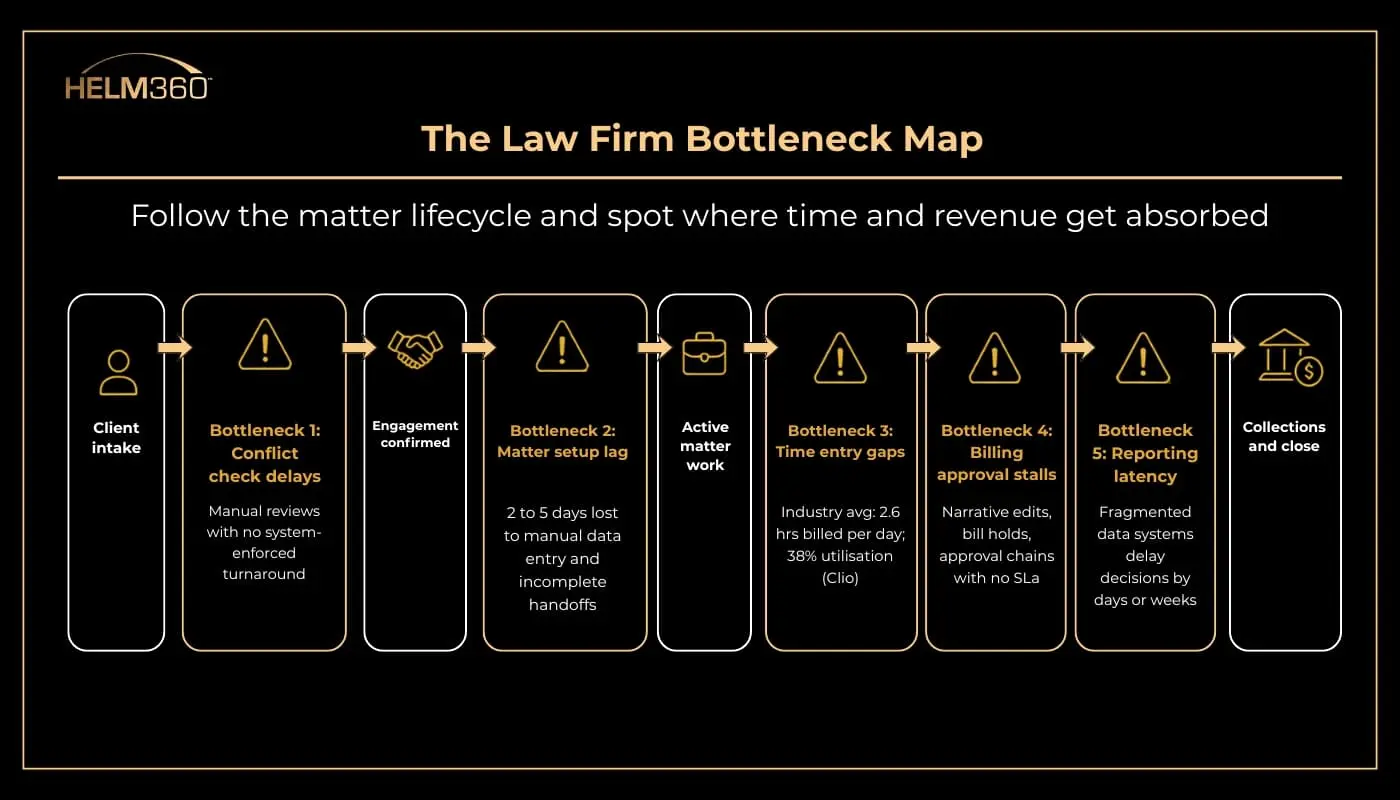
Identifying these gaps requires mapping workflows as they actually operate, not as they were designed, and noting where variance and exception handling are highest. The friction is almost always concentrated in a small number of steps. Finding those steps is the work.
Each of these bottlenecks does not sit in isolation. They connect across the matter lifecycle, and they compound. The map below shows exactly where they land, from intake through to collections, and what each one signals at the process level.
How to Build a Practical Bottleneck Identification Process
Identifying bottlenecks is not a one-time project. It is an ongoing operational discipline. The following approach is structured for legal operations and technology teams at firms of any size.
Step 1: Establish baseline metrics.
Before you can identify where performance is degraded, you need to define what normal looks like. Key metrics include billing cycle length, realization rates by practice group, time entry lag in days, matter setup completion time, and system response benchmarks during peak usage.
Step 2: Map workflows against actual behavior.
For each operational area, trace the process steps and measure cycle time at each stage. Variance is often more informative than averages: consistently long completion times at a specific stage point to a structural constraint, not an outlier.
Step 3: Review application performance data.
Most practice management platforms generate performance data. Query response times, session load data, and error frequency during high-volume periods can surface technical bottlenecks that are invisible in routine use.
Step 4: Engage cross-functional input.
Attorneys, billing staff, finance teams, and IT each experience bottlenecks differently. A structured review that brings these perspectives together surfaces constraints that no single team was fully aware of.
Step 5: Build ongoing visibility.
The firms that address bottlenecks most consistently are those with operational dashboards that provide real-time insight, not just periodic audits. Visibility transforms bottleneck identification from a reactive exercise into a proactive capability.
The Role of the Right Technology Partner
Identifying a bottleneck and resolving it are two different problems. The gap between knowing what is wrong and implementing a meaningful fix is where progress often stalls, particularly when the constraint sits inside a platform that requires deep configuration expertise to change.
A technology partner with genuine legal industry depth, particularly one familiar with the specific platforms your firm runs, shortens that cycle significantly. The difference between a firm that finds a bottleneck and fixes it in weeks versus one that spends months in assessment is usually the quality of operational and technical experience they can bring to bear.
Helm360’s Application Managed Services and Consulting Services are built around exactly this kind of partnership: not just implementing technology, but ensuring it performs at the level your firm’s operations require, consistently.
Conclusion
System bottlenecks in law firms are almost never dramatic. They accumulate gradually, absorbing revenue and creating friction that eventually feels normal. The billing cycle that runs three days late. The realization report that takes half a day to pull. None of these feel like crises in isolation, but together they represent a significant and recoverable operational cost.
The firms addressing this well are not the ones with the most technology. They are the ones who understand what their systems are actually doing, and act on that knowledge before small inefficiencies become embedded habits.
If any of the patterns in this blog look familiar, that is a useful starting point. Helm360’s team works with law firms to move from identification to resolution, without months of assessment in between.
Frequently Asked Questions
1: What are the most common bottlenecks in law firm operations?
The most common ones are billing and time entry delays, matter handoff gaps, fragmented reporting systems, application performance issues during peak periods, and inconsistent processes across practice groups. Most firms are dealing with more than one at the same time, which is why they tend to compound quietly before anyone names them.
2: Why is law firm billing inefficiency so hard to fix?
Because the problem rarely starts at the billing stage. It originates upstream in how time is captured, how narratives get reviewed, and where approvals stall. Fixing the output without addressing those habits tends to produce short-lived improvement.
3: How do I know if my law firm has a data reporting bottleneck?
If pulling a reliable realization or matter profitability report requires someone to manually assemble a spreadsheet first, you already have one. Another clear sign is finance and legal ops consistently working from different numbers.
4: What causes slow performance in legal practice management software?
Usually, a combination of infrastructure not sized for peak load, database queries that have not been optimized, and configuration issues that accumulate over time. The problem often goes unaddressed because teams adapt with workarounds rather than escalating it as a system issue.
5: How can law firms reduce billing write-downs?
Start by understanding why they are happening. The most common causes are late time entry, narrative inconsistencies during pre-bill review, and junior work that exceeds partner expectations. Visibility into write-down patterns by timekeeper and practice group is usually the first step toward meaningful reduction.