


Why AI Will Not Replace Legal Professionals but Change How They Work

Law firm technology spending jumped 9.7% in 2025, the fastest growth rate the industry has ever recorded. Much of that investment is flowing toward AI tools that promise to reshape how legal work gets done.
But as adoption accelerates, one question keeps surfacing in partner meetings and innovation committees: will this technology eventually replace the people it is supposed to help?
The data tells a clear story.
Nearly seven in 10 legal professionals now use generative AI tools for work, a figure that more than doubled in a single year. Yet despite this rapid uptake, law firm headcount grew by nearly 3% in 2025, the third consecutive year of historically strong hiring, even as AI reduced headcount in other industries.
The reality emerging from law firms is more considered than the replacement narrative. AI is not eliminating legal roles. It is changing what those roles look like, and where professional time is actually spent.
Where the Legal Industry Actually Stands on AI Adoption
The adoption picture shows real momentum, but also a clear gap between what individual lawyers use and what firms have built into their strategy.
- Individual AI use among legal professionals jumped from 31% to 69% in a single year, one of the most significant adoption spikes any professional sector has recorded.
- The share of legal organizations actively integrating generative AI rose from 14% in 2024 to 26% in 2025, with 45% of law firms planning to make it central to their workflow within one year, per Thomson Reuters.
- Yet only 34% of firms have adopted legal-specific AI tools at the institutional level, reflecting how wide the gap remains between what attorneys experiment with individually and what firms have formally built into operations.
- Firms with a formal AI strategy are 3.9 times more likely to experience measurable benefits than those without significant adoption plans, per the same Thomson Reuters report.
That final point is where the conversation becomes more important.
The value of AI does not come from simply giving professionals access to tools. It comes from building the operational structure, governance, workflows, and data strategy required to use those tools consistently and responsibly across the firm.
For a practitioner-level conversation on what moving from AI experimentation to actual firm-wide implementation looks like, the Legal Helm Podcast episode with Michael McCready of McCready Law is worth listening to. McCready, a 30-year managing partner and recognized voice on legal AI, discusses what most firm leaders underestimate when they move past the pilot phase.
What AI Actually Does in a Law Firm and What It Saves
The most productive case for AI in legal environments is not theoretical. It shows up in time recovered, accuracy improved, and administrative load reduced across specific, repeatable task types.
1. Document Review and Contract Analysis
What it does: Surfaces key clauses, flags inconsistencies, and cross-references contract language against defined standards
What it saves: AI contract review accuracy sits at approximately 95%, compared to roughly 80% for manual review. For high-volume contract work, that gap is not marginal. It is the difference between a two-day associate task and a two-hour workflow, without sacrificing accuracy.
2. Legal Research Acceleration
What it does: Identifies relevant precedents, organizes case law by jurisdiction and issue, and produces initial research summaries for attorney review.
What it saves: Research workflows that once consumed associate hours can be compressed significantly. AI legal research tools can surface case law up to 30% faster than manual research, giving attorneys more time to apply judgment rather than accumulate sources.
3. E-Discovery
What it does: Classifies, prioritizes, and routes documents for review in large-scale productions using relevance and privilege detection.
What it saves: AI-assisted e-discovery recall rates have improved from 75% to over 90%, reducing both the cost and attorney hours required on productions where manual-only review was once the baseline.
4. Correspondence and Drafting Support
What it does: Produces first-draft correspondence, engagement letters, status updates, and routine client communications for attorney review and sign-off.
What it saves: 54% of legal professionals already use AI to draft correspondence, per the ABA. Time previously spent on standard communications shifts toward higher-value client work.
5. Billing, Operations, and Firm Intelligence
What it does: Analyzes time entry data, surfaces billing anomalies, identifies matter profitability trends, and provides insight into resource allocation across practice groups.
What it saves: 47% of legal professionals are interested in AI tools that deliver insights from firm financial data, per the ABA. This extends AI’s utility well beyond legal work into the operational decisions that affect firm economics.
Among professionals already using AI, 38% report saving one to five hours per week, with 14% saving six to ten hours weekly. At a fully loaded billing rate, those hours have real financial significance for any firm tracking realization and productivity.
Where Human Expertise Remains Non-Negotiable
The efficiency gains AI delivers only create value when the underlying legal work remains accurate, strategic, and professionally sound. That is where human expertise continues to matter most.
Law is not a process profession in the way logistics or manufacturing is. It is a judgment profession, and the judgments attorneys make carry real consequences for clients, courts, and businesses. Some of what lawyers do simply cannot be handed off:
- Strategic legal advice shaped around a client’s specific risk profile, business goals, and industry context, where the right answer depends on factors no model can fully weigh
- Ethical discretion, including the professional responsibility obligations that govern attorney conduct and client duty in ways that shift with every matter
- Client counsel in high-stakes situations where trust, communication style, and the ability to read a room are as important as technical knowledge
- Jurisdictional nuance in cross-border matters where local law, regulatory culture, and even judicial temperament shape outcomes
- Accountability to courts as licensed professionals with standing and obligations no AI tool holds
The point is not that AI always gets things wrong. The risk is that legal work can appear correct on the surface while still missing critical context, jurisdictional nuance, or recent developments.
That gap between content that looks credible and work that is legally sound is exactly where attorney oversight remains indispensable.
If your firm is managing AI-generated content in client-facing or court-facing contexts, Helm360’s practical checklist for using AI-generated content in law firms offers a structured review workflow your team can apply immediately.
Why Firm-Wide Adoption Is Slower
Most of the friction around AI in legal environments is not philosophical. It is practical, and it is solvable.
1. Data Privacy and Client Confidentiality
41% of lawyers cite data privacy as a primary concern when considering AI adoption. Privilege, confidentiality, and ethical obligations around client data are non-negotiable constraints that general-purpose AI tools are not always designed to respect. Firms that have moved forward confidently tend to use legal-specific tools or private deployment environments rather than consumer-grade platforms.
2. Disconnected Systems and Integration Gaps
Standalone AI tools that do not connect with existing practice management, billing, or document management systems create workflow islands that attorneys route around. 43% of legal professionals rank integration with existing trusted software as their top evaluation criterion when assessing any AI tool, which is why technology fit matters as much as capability.
3. The Absence of Firm-Level AI Policy
Unstructured individual use creates inconsistency and untracked risk. More than half of legal professionals say their firm has no AI policy, or they are unaware of one. Without governance, adoption cannot scale, and the benefits that show up at the individual level never consolidate into firm-wide operational improvement.
4. Billing Model Pressures
As AI compresses task time, the economics of hourly billing face real structural questions. Only 45% of law firms have an official policy on the use of generative AI tools, according to ILTA data, meaning the majority of firms are scaling individual AI use without a governance framework in place. Firms that plan for this shift proactively will be better positioned than those who treat it as a future problem.
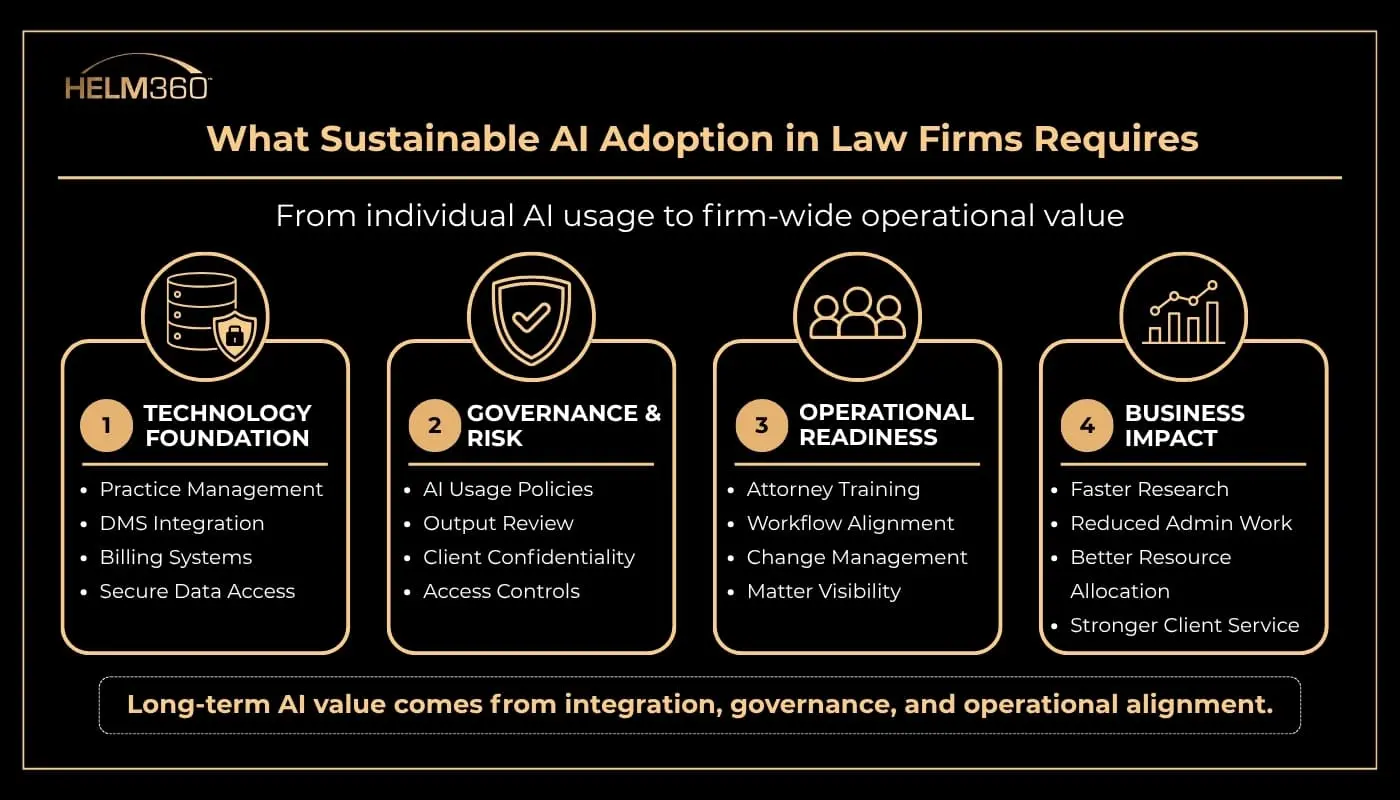
The shift from isolated AI usage to scalable firm-wide adoption usually depends on a few foundational operational areas working together consistently across the firm, as outlined below.
How Firms Can Scale AI
The firms seeing real, measurable return from AI are not necessarily those who adopted the most tools. They are the ones who adopted the right tools within a structured, governed environment, and connected them to the systems that already run the firm.
A few principles that consistently separate effective implementation from performative adoption:
- Start with high-volume, lower-risk processes. Document summarization, time entry review, first-draft correspondence, and billing data analysis are natural entry points. They generate visible ROI without introducing risk to work with direct client or court exposure.
- Treat integration as a requirement, not a preference. AI tools that connect with your practice management, financial, or document management systems deliver compounding value over time. Tools that exist outside that ecosystem rarely get used consistently, regardless of how strong their standalone capability is.
- Build governance before scaling. AI acceptable use policies, output review standards, and data handling protocols are not overhead. They are the structure that allows attorneys to use AI confidently rather than cautiously, and that gives firm leadership the visibility to manage risk appropriately.
- Measure outcomes at the matter level. Track billing accuracy, matter profitability, research turnaround, and attorney capacity, not just which tools are active. The business case for continued investment depends on outcomes, not activity.
The Infrastructure That Determines How Much AI Delivers
AI is not arriving in law firms as a standalone event. It is arriving as part of a broader ecosystem of practice management systems, financial platforms, data infrastructure, and client-facing technology. For legal technology leaders and CIOs, the AI decision is not a separate procurement question. It is an extension of how well the firm’s existing technology environment is connected, governed, and maintained.
Firms with clean data, integrated systems, and well-managed infrastructure will extract considerably more value from AI than those treating it as an add-on to fragmented operations. The technology is only as capable as the environment it runs in.
At At Helm360, we work with law firms and professional services organizations to build and maintain that foundation through application managed services, data services, billing support, and legal technology consulting. The goal across all of it is the same: give legal professionals a stronger infrastructure so that tools like AI have something solid to run on.
The Honest Summary
AI is not coming for legal careers. It is coming for inefficiency, and there is a meaningful amount of it in most firms.
Legal professionals who will benefit most are those who treat AI as a capable tool operating within clear limits, not a shortcut and not a threat. Judgment, strategy, ethics, and client relationships remain human work. The document-heavy, research-intensive, administratively burdensome tasks that consume disproportionate attorney time are where AI earns its place.
The firms that will see the most return are not necessarily those with the most tools. They are the ones who have built the structure around those tools, connected them to core systems, and given their people the governance to use them confidently.
That is less about technology and more about operational discipline. And that, ultimately, is something every firm already knows how to build.
If your firm is working through what that looks like in practice, the Helm360 team is glad to be part of that conversation.