


Agentic AI in Law Firms Moving Beyond Chatbots to Autonomous Legal Workflows
Ask most legal operations teams what “using AI” looks like day-to-day, and the answer is still pretty simple: someone types a prompt, waits for a draft, reads it, edits it, and moves on. That’s been the rhythm for two years now, and honestly, it’s worked. Attorneys draft faster, staff summarize faster, nobody’s mad about it.
But that rhythm has a ceiling. A chatbot only moves when a person tells it to move. It doesn’t chase down the next step on its own; it doesn’t know what to do after the draft is done, and it definitely doesn’t notice the exception buried three steps downstream. That’s the part agentic AI is built for. Instead of answering one prompt and stopping, it plans a sequence, works through it across connected systems, and only comes back to a person when something actually needs judgment.
A few reasons this is worth your attention now, not next year:
- Firms already running Elite 3E, ProLaw, Aderant, or Intapp have the structured data these workflows need, so the starting point is closer than it looks.
- According to the Thomson Reuters Institute’s 2026 AI in Professional Services Report, 15% of professional services organizations had already adopted some form of agentic AI by early 2026, and another 53% are actively planning for it or evaluating it.
- The firms sitting this evaluation out now are more likely to be reacting under pressure later, instead of rolling this out on their own terms.
For expert takes on how this shift is playing out across legal teams, this piece on 10 expert perspectives on how AI is redefining legal operations is worth a look. Agentic AI is really where that redefinition heads next, once AI stops assisting and starts executing on its own.
What Makes AI “Agentic,” and Why It’s a Different Conversation
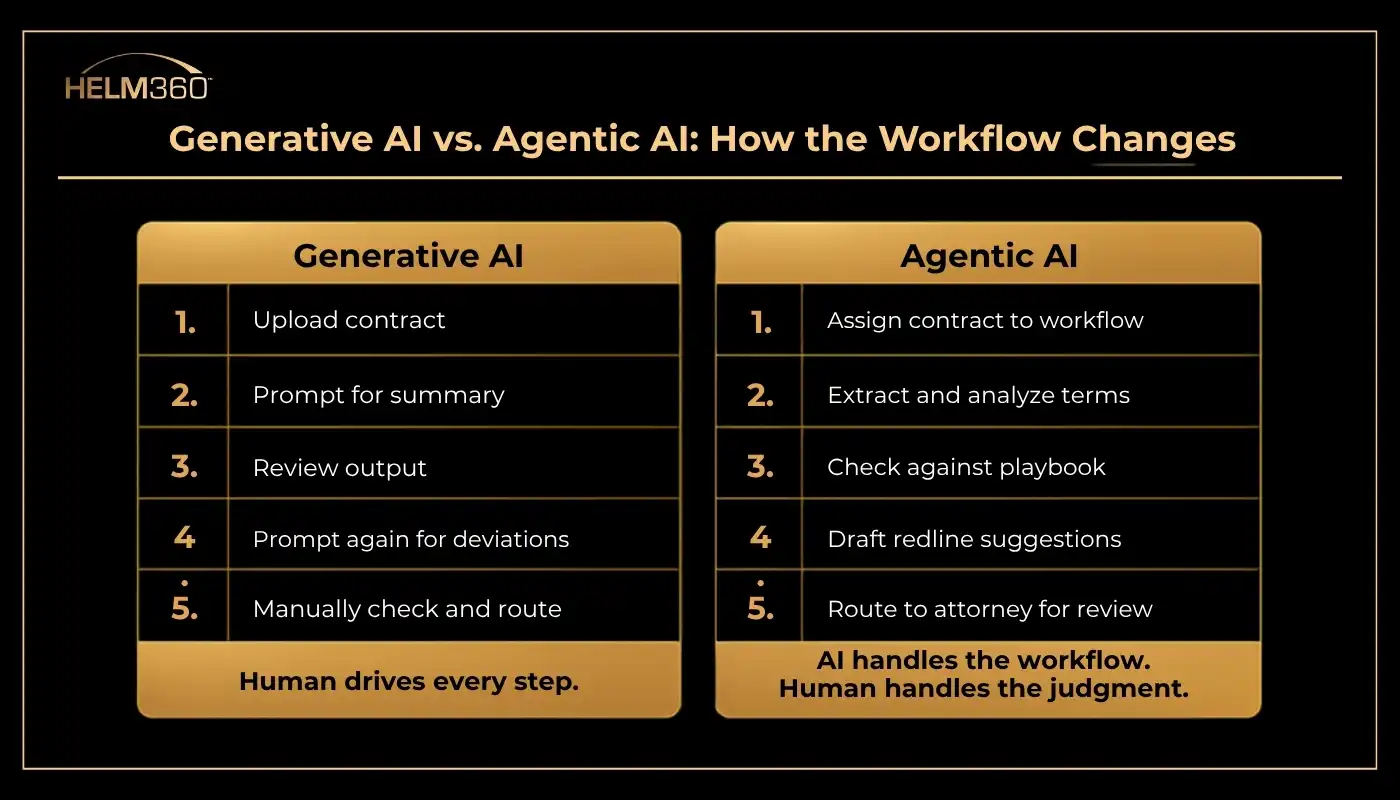
Generative AI is reactive. It produces output when prompted, then stops. Agentic AI is built to plan, chain decisions, and carry a task through multiple steps with minimal ongoing direction, checking in with a human only at defined points.
In a legal context, that difference plays out like this:
- Research to memo, in one motion: An agent researches a regulatory question, drafts a memo based on the findings, flags potential gaps, and routes the draft for attorney review, all as one continuous sequence rather than four separate prompts.
- Intake that runs itself: An agent monitors a matter’s document intake, applies conflicts and compliance checks, and escalates exceptions, without a paralegal manually triggering each step.
- Billing that checks its own math: An agent reconciles billing entries against engagement terms and surfaces discrepancies before an invoice goes out, instead of a client catching them after the fact.
This is not a niche shift. Gartner has projected that 40% of enterprise applications will feature task-specific AI agents by 2026, up from under 5% previously. Legal operations will not be exempt from that curve.
Where Agentic Workflows Are Already Taking Hold in Legal Operations
Adoption is still early relative to generative AI, and that gap is worth naming honestly:
- Coverage of the same Thomson Reuters research in Law.com notes that only 15% of surveyed organizations are already using agentic AI, while roughly a third have no current plans to.
- That caution is reasonable. Autonomous execution carries different risk than a single AI-assisted draft, and legal teams are right to move carefully.
That said, the use cases already emerging point to exactly where the near-term value sits:
- Document and matter intake: Multi-step review chains that classify, route, and pre-populate matter data reduce the manual handoffs that typically slow down onboarding.
- Legal research and drafting chains: Agents that research a question, draft supporting language, and flag inconsistencies before a lawyer opens the document can compress hours of preparatory work.
- Financial operations: Billing, trust accounting, and revenue reconciliation workflows benefit from agents that can cross-reference multiple systems and surface exceptions automatically, rather than requiring someone to run manual audits.
- Compliance monitoring: Agents that continuously check documents and communications against firm policy or regulatory requirements can catch issues at the point of creation instead of during a periodic review.
Governance Belongs at the Center, Not the Edge
Autonomy does not mean less oversight. It means oversight has to be designed into the workflow itself, not applied after the fact. Confidentiality obligations, privilege, and professional responsibility duties do not change just because a task is automated.
Three principles keep an agentic workflow accountable:
- Define checkpoints deliberately: Not every step needs human sign-off, but decisions with legal or client consequence should have a defined pause point built in.
- Maintain a full audit trail: Every action an agent takes should be logged and traceable, the same way a firm would expect from any staff member handling client matters.
- Keep data governance current: Agentic systems are only as reliable as the data behind them. Inconsistent records in a practice management or financial system get amplified by automation, not corrected by it.
This is turning into a compliance expectation, not just good practice. The EU AI Act’s implementation timeline shows most of its remaining obligations, including rules for high-risk AI systems, came into force on 2 August 2026, and state-level requirements like the Colorado AI Act are moving in the same direction. Formalized AI policy is quickly becoming something firms are expected to have, not something they get around to eventually.
Most haven’t gotten there yet. According to the 2026 Legal Industry Report as covered by the American Bar Association, 54% of legal professionals said their firm has provided no training on responsible generative AI use and has no plans to introduce it. That gap is worth closing before, not after, agentic workflows come into the picture. An agent that’s already executing multi-step tasks without a governance framework behind it is a much harder problem to fix retroactively.
What Firms Need in Place Before Deploying Agentic AI
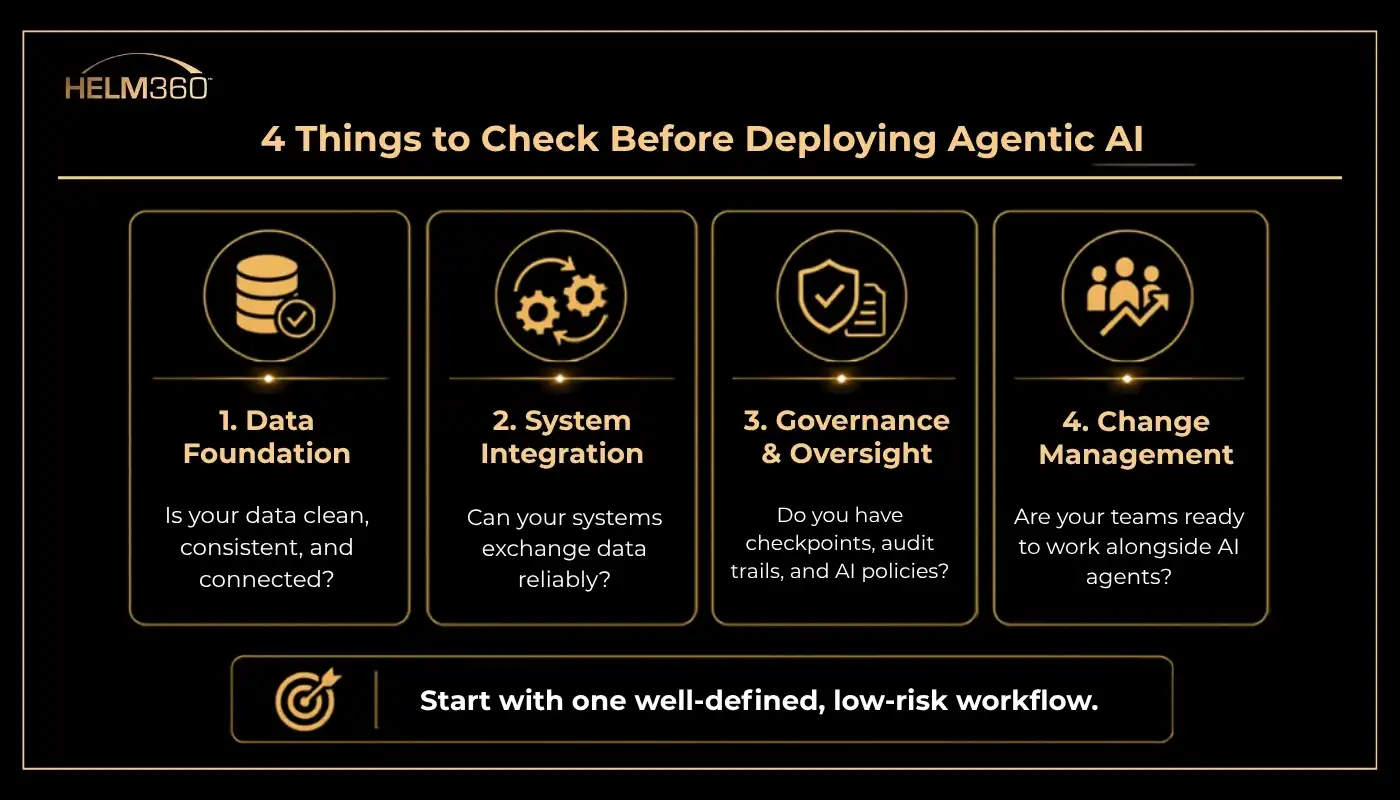
Agentic AI performs best on a stable foundation. Before rolling out autonomous workflows, most firms benefit from confirming a few things are already in order:
- Clean, connected data– Practice management, document management, and financial systems need to talk to each other reliably. Agents that pull from fragmented or duplicated records will propagate errors quickly.
- A defined integration layer– Agentic workflows typically span multiple platforms. Firms need clear API and integration architecture so agents can move between systems without manual bridging.
- Change management for staff– Attorneys and staff need to understand what the agent is doing and why, not just receive the output. Adoption tends to stall when the workflow feels opaque.
- A pilot scope with low ambiguity– Starting with a high-volume, well-defined workflow, such as billing reconciliation or intake triage, gives the firm a controlled environment to validate the technology before extending it to judgment-heavy work.
A Measured Path Forward
The firms getting the most out of agentic AI right now are not the ones moving fastest. They are the ones sequencing deployment around low-risk, high-payoff workflows first, then expanding once governance and data foundations prove out. That approach builds internal confidence instead of triggering the pushback that follows a rushed rollout.
Agentic AI is not a replacement for legal judgment, and it is not meant to operate without oversight. It is a way to remove repetitive, multi-step manual work from a lawyer’s day, so judgment gets applied where it actually matters.
Further Reading and Resources
Agentic AI in legal operations is still an evolving space. For those tracking it further:
- The Legal Helm podcast covers legal technology trends through conversations with people building and implementing these systems.
- Helm360’s blog has more on this topic, including the expert perspectives piece referenced above.
- Helm360’s team can be reached with questions specific to a firm’s own systems.
Frequently Asked Questions
1. What is agentic AI in the context of legal operations?
Agentic AI refers to AI systems that can plan and carry out multi-step tasks with minimal ongoing human direction, as opposed to generative AI, which responds to a single prompt at a time. In legal operations, this means an AI agent can research, draft, check, and route work across a matter lifecycle, pausing only at defined checkpoints.
2. How is agentic AI different from the chatbots law firms already use?
Chatbots and generative AI tools respond reactively to individual prompts. Agentic AI systems chain decisions together and execute a sequence of actions autonomously, only involving a person when the workflow reaches a point that requires judgment or approval.
3. Is agentic AI widely adopted in law firms yet?
Adoption is still early. Industry research indicates that a modest share of professional services organizations have adopted agentic AI so far, though a much larger group is actively planning or evaluating it, suggesting adoption will accelerate over the next few years.
4. What legal workflows are best suited for agentic AI right now?
High-volume, well-defined workflows tend to be the strongest starting point, including matter intake and routing, billing and financial reconciliation, and compliance monitoring. These workflows have clear rules and lower ambiguity, which makes them easier to automate responsibly.
5. Does agentic AI reduce the need for human oversight in legal work?
No. Autonomous execution requires oversight to be designed into the workflow itself, including defined checkpoints, complete audit trails, and clear escalation paths for decisions that carry legal or client consequence.
6. What should a law firm have in place before deploying agentic AI?
Firms generally need clean and connected data across practice management and financial systems, a defined integration layer between platforms, a change management plan for staff, and a pilot workflow with low ambiguity to validate the approach.
7. Can agentic AI work with Elite 3E, ProLaw, Aderant, or Intapp environments?
Yes, though the value depends on how well those systems are integrated and how consistent the underlying data is. Firms with fragmented records across these platforms will need to address that first, since agentic workflows amplify existing data quality rather than correcting it.
8. What are the biggest risks of moving to agentic AI too quickly?
The primary risks are governance gaps and data quality issues. Many firms still lack formal AI policies or structured training, and deploying autonomous workflows without addressing that first can create compliance and client trust issues.
9. How does agentic AI affect legal professional responsibility obligations?
Confidentiality, privilege, and supervision duties do not change because a task is automated. Firms remain responsible for the accuracy and handling of any work an AI agent performs, which is why audit trails and defined human checkpoints matter.
10. Where should a law firm start if it wants to explore agentic AI?
Most firms benefit from starting with a platform and data readiness assessment, then piloting agentic AI on a single, well-defined, low-ambiguity workflow before expanding to more complex, judgment-heavy processes.