


10 Expert Perspectives on How AI Is Redefining Legal Operations
Across The Legal Helm, the most useful conversations about AI have rarely focused on the technology alone.
They have focused on the work around it: how firms capture time, test new systems, review court data, protect client information, train lawyers, and decide which tasks should remain human.
What sits in that archive is not a collection of predictions about where legal AI is heading. It is a set of field notes from founders, attorneys, educators, and operators who are already working inside the shift and have lived through the change.
This post pulls ten of those conversations together. If you are trying to make sense of what AI is doing to legal operations right now, past the conference talking points and vendor pitch decks, this is worth your time.
1. Stop Reconstructing Your Week. Start Querying Your Work Data.
Most law firms still depend on lawyers to reconstruct their work from emails, calendars, documents, browser activity, and memory.
Kourosh Zamani, Co-Founder of Laurel, explains how AI-supported time capture records activity across applications and connects it with the right client or matter.
Laurel’s pre- and post-adoption analysis across more than 50,000 users found:
- 28 additional billable minutes captured per day
- One to two hours of administrative work saved
- Four to five percent improvement in realization rates
Laurel’s data also shows knowledge workers moving through 200 to 400 distinct digital activities during an eight-hour workday.
“I think time will not be something that you enter. It’s something that you’re going to query.”
The larger opportunity goes beyond improving timesheets. Reliable work data helps firms understand effort, capacity, workflow performance, pricing, and profitability.
2. Look in the Mirror Before You Buy the Tool.
AI will not repair unclear responsibilities, weak management, or broken workflows.
Michael McCready, Managing Partner of McCready Law, discusses using AI across marketing analysis, productivity, auditing, financial performance, and broader firm operations.
His distinction between thought and prediction helps firms set realistic expectations:
“AI doesn’t think. AI predicts.”
AI can help firms:
- Identify performance trends
- Flag unusual patterns
- Compare marketing results
- Review productivity data
- Analyze profitability
- Surface areas requiring management attention
A person must still review the result and decide what action to take.
McCready also recommends starting with small, repetitive activities, establishing a baseline, and measuring whether the technology creates a meaningful improvement. The firm’s operating foundation should come before the tool.
3. Make Technology a Partner, Not a Threat.
Legal professionals do not need to become software engineers. They do need to understand how AI affects research, drafting, confidentiality, reasoning, and professional responsibility.
Jeanne Eicks, Associate Dean of Graduate Programs at The Colleges of Law, brings experience as a law school CIO, professor, and legal technology educator.
Her approach does not involve banning AI. Students should explain how they used it, which information supported the response, and where their own reasoning entered the work.
“Technology is here and you have to find a way to make it a partner to what you do instead of an opponent in what you do.”
Practical AI literacy should help legal professionals ask:
- What information supported the answer?
- Which sources should be checked?
- What assumptions might affect the result?
- Is confidential information protected?
- Where is professional review required?
- Who remains responsible for the final work?
Training should also reflect each person’s role. Partners, associates, finance teams, and technology professionals need different guidance.
4. AI Without a Testing Strategy Is an Expensive Pilot.
AI tools still depend on reliable systems, integrations, permissions, and data.
Prav Gudipalli, Director of Quality Assurance at Nikao, discusses testing in financial technology environments where accuracy, security, scalability, and regulatory compliance are essential.
These requirements closely resemble the demands placed on legal platforms.
Automation and AI can help quality assurance teams:
- Create anonymized or synthetic test data
- Run regression testing faster
- Prioritize test cases
- Validate integrations
- Test high transaction volumes
- Maintain automation scripts
- Identify failures earlier
For law firms, a successful demonstration is not enough. Teams need to understand what happens when data is missing, permissions are wrong, integrations fail, or volumes increase.
Gudipalli’s recommended approach is practical: identify a real pain point, introduce a controlled improvement, measure its effect, train the team, and expand only after the workflow performs reliably.
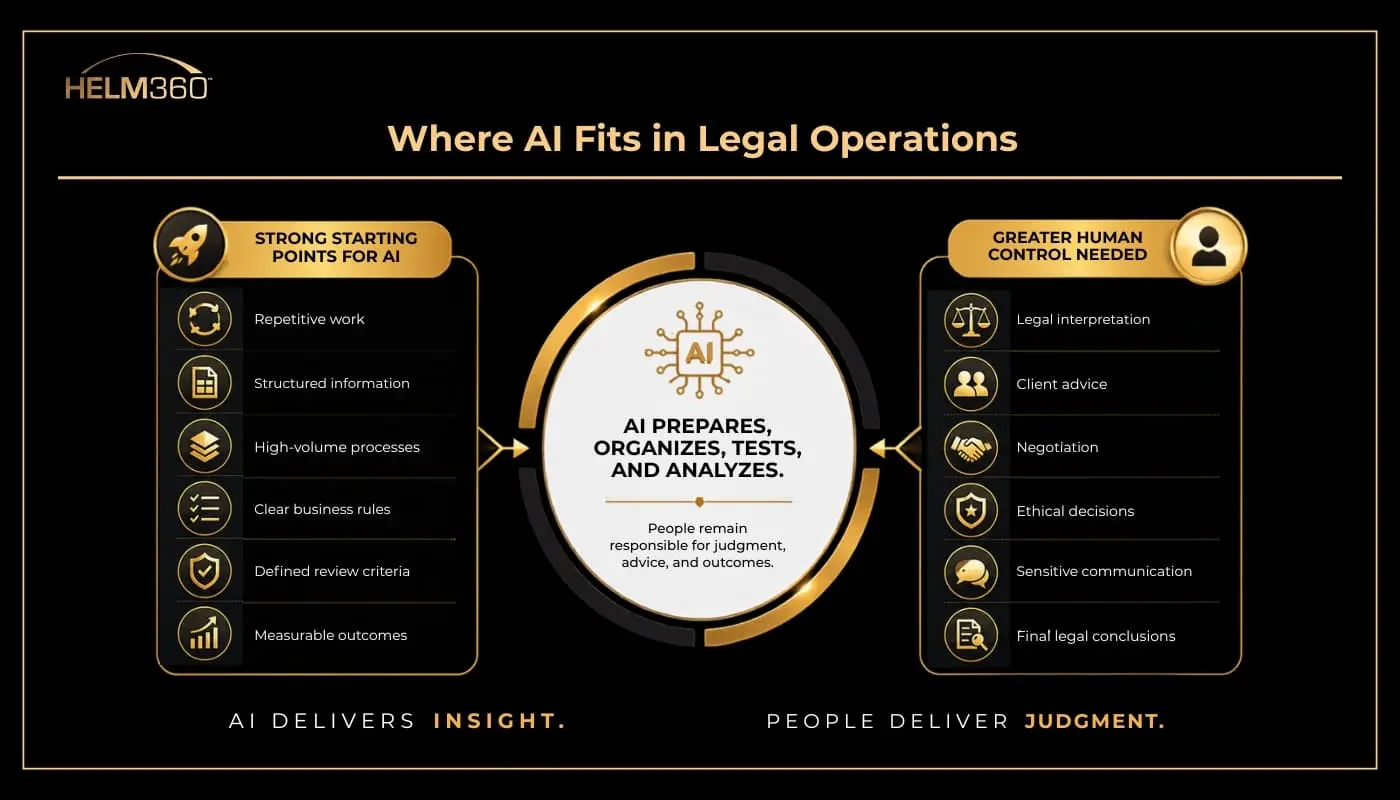
Before firms expand AI across legal operations, they need to separate work suited to automation from work that still requires stronger human control.
5. Free IP Attorneys for the Work Only They Can Do.
Patent professionals spend substantial time searching patent data, monitoring activity, preparing documents, tracking deadlines, and organizing information before strategic analysis begins.
Matt Veale, European Patent Attorney and UPC Representative at Patsnap, explains how AI supports:
- Patent-data searches
- Alerts and monitoring
- Deadline tracking
- Draft preparation
- Portfolio insights
- Research and development decisions
“Your sole impact and your thought process should all be about that added value.”
The patent professional still owns the work requiring legal, technical, and commercial judgment. This includes interpreting relevance, responding to examiner objections, assessing risk, and shaping filing strategy.
Veale also stresses the importance of trusted data. Incomplete or unreliable patent information can lead to incorrect references and misleading conclusions.
The value of AI lies in reducing preparation work so professionals have more time for advice and decision-making.
6. Know Your Judge Before You File the Motion.
State trial court data has traditionally been fragmented across jurisdictions and difficult to search at scale.
Nicole Clark, CEO and Co-Founder of Trellis, explains how structured court data helps litigators examine:
- How a judge ruled on similar motions
- Which arguments appeared in comparable matters
- How opposing counsel handled related cases
- What outcomes occurred in similar disputes
- Whether a motion justifies the time and expense
- How long a matter might remain active
AI helps lawyers locate and organize the information. It does not make the strategic decision.
Clark also stresses the importance of access to the underlying cases and motions:
“The other is the human is required.”
Lawyers need to inspect the supporting records, understand the context, and determine whether the result applies to the matter before them.
Legal analytics should provide better evidence, not unexplained recommendations.
7. Cut the Back-and-Forth Between Your Firm and the Carrier.
Communication between plaintiff-side law firms and insurance carriers often depends on different systems, document formats, and information requirements.
Jim Andrews, President and Co-Founder of Precedent, explains how AI can support:
- Police-report processing
- Medical-record analysis
- Extraction of medical information
- Demand drafting
- Claim setup
- Carrier-specific formatting
- Case-management system integration
Different carriers expect information to be presented in different ways. Precedent structures the demand around the requirements of the receiving carrier.
This can reduce avoidable rework, improve communication, and give attorneys more time for negotiation and substantive case strategy.
The broader legal operations lesson is to examine information handoffs. Delays often appear when data moves between firms, clients, insurers, finance teams, vendors, and external experts.
8. Use Data to Assess Where a Case Is Worth Fighting.
Litigation strategy often depends on professional experience, legal research, and incomplete information about judicial behavior.
Dan Rabinowitz, CEO and Co-Founder of Pre/Dicta, explains how behavioral analytics can add context to decisions involving:
- Motion strategy
- Settlement timing
- Case budgeting
- Litigation duration
- Class certification
- Summary judgment
- Client expectations
Pre/Dicta analyzes information connected with judges, attorneys, parties, and case context. Its published materials report an 85 percent accuracy rate for motion-to-dismiss predictions.
The result remains a forecast, not a guaranteed outcome.
Lawyers must still consider the facts, law, evidence, procedural posture, cost, and client objectives. Predictive analytics should support legal judgment rather than replace it.
The practical value lies in giving litigation teams another source of information before they commit resources or advise a client on strategy.
9. Build Compliance into Your AI Strategy from Day One.
Legal AI projects often begin with features. They should begin with data.
Ed Boal, Head of Legal at Shieldpay at the time of recording, discusses technology in an environment involving client funds, payments, data protection, identification, and regulatory obligations.
A useful starting principle is data minimization. Firms should provide a system only with the information needed for the defined task.
Before approving an AI-supported workflow, firms should understand:
- What information enters the system
- Why the information is required
- Who has access
- Where the information is stored
- How it is protected
- How long it is retained
- How it is retrieved or deleted
- Who remains accountable
Boal also discusses the role of AI and biometric technology in identification and verification processes.
Strong governance does not prevent innovation. It creates the controls needed for responsible adoption.
10. Consolidate Before You Automate.
Adding another AI product to a fragmented workflow can create more logins, integrations, vendors, and disconnected data.
Steven Choi, Co-Founder of Traact, discusses bringing entity management, contracts, permits, licenses, regulatory matters, disputes, and governance into a connected platform.
His framework for identifying a suitable AI use case focuses on two questions:
“Is it repetitive, meaning it’s a lot of administrative, simple tasks that’s going back and forth? And is the environment controlled?”
Suitable starting points include:
- Document classification
- Contract-data extraction
- Entity updates
- Form preparation
- Compliance tracking
- Status reporting
- Deadline monitoring
- Structured record management
The right question is not whether a tool performs one activity well. It is whether the technology improves the complete workflow.
The strongest results come from reducing context switching, connecting information, and removing repetitive administrative work.
The Takeaway: AI Is Elevating Legal Work, One Workflow at a Time
Across all ten conversations, the same pattern surfaces. None of these guests are describing a future where AI replaces legal judgment.
They are describing a present where AI handles the parts of the job that were never really about legal judgment in the first place: time reconstruction, patent-data searches, court-data aggregation, demand drafting, quality assurance cycles, and administrative overhead.
The expertise stays human. The grind gets automated.
The firms advancing fastest are clear about which problems they are solving, focused on which workflows they are improving, and disciplined about how they measure impact.
That intentionality separates a high-value AI strategy from a collection of expensive pilots.