


What Most Law Firms Get Wrong About Automation

Buy a faster car, and you still hit the same potholes, just harder. That’s roughly what’s happening inside a lot of law firms that invested heavily in automation.
This is close to how the conversation goes once the new platform is live and the invoice is already paid:
IT Director: “We automated matter intake back in Q1.”
Managing Partner: “Then why did the new client still take five days to get set up?”
IT Director: “…the software’s working exactly as designed.”
The tool went live. The dashboard shows usage. And the bottleneck everyone hoped it would fix is still there, just wearing a faster interface. If that sounds familiar, your firm is not dealing with an unusual problem.
The technology is not always the problem.
The real issue: most firms treat automation as a software purchase. It’s actually an operational redesign that happens to involve software. Miss that distinction, and even the best tool won’t move the needle.
That distinction is easy to state and hard to act on, mostly because the data around it tells a more complicated story than “adopt more tools.”
When Faster Does Not Mean Fixed
Individual use of generative AI inside law firms has grown faster than almost anything the profession has seen before. According to the 8am 2026 Legal Industry Report, which surveyed more than 1,300 legal professionals, 69% now personally use general-purpose AI tools for work, more than double the 31% reported just a year earlier.
Here’s the number that matters more. The same report found that only 34% of firms have adopted legal-specific AI platforms at the firm level, and only 9% have a written AI policy that is actively enforced. Even general-purpose tools like ChatGPT, Claude, Gemini, and Copilot, the easiest kind of AI to roll out, have only been adopted at the organizational level by 46% of firms.
The report focuses on generative AI, but the pattern applies directly to automation: individual use is moving faster than firm-wide structure.
Read that again. People are moving faster than their firms are.
That is the mismatch playing out in conversations like the one above. Attorneys feel more productive individually. The firm as a whole does not see the financial or operational lift leadership expected. The distance between the two is not a technology problem. It is a structural one, and it is why the same four habits show up at firm after firm.
Four Habits Quietly Working Against You
None of these come down to picking the wrong software. They come down to what happened, or didn’t happen, before the software was ever selected.
1. Automating a broken process. Automation speeds up whatever it’s applied to, including the inefficient parts. If a conflicts check needs five handoffs across three systems before automation, it still needs five handoffs after, just faster and harder to trace when something goes wrong.
2. Treating automation as a one-time project. Go live, declare victory, move on. Meanwhile billing rules change, matter types evolve, and staff turn over. Automation left untouched drifts out of sync with how the firm actually runs within a year, sometimes less.
3. Skipping the governance layer. No named owner. No usage standard. One practice group automates document assembly one way, another group does it differently, and nobody ever decided which approach is correct. It’s the same disconnect showing up in the industry data above, just playing out at the firm level instead of the national one.
4. Stacking tools instead of connecting them. Every new point solution solves one narrow problem and adds one more login, one more silo, one more handoff. Add enough of these and the firm ends up with a patchwork that doesn’t talk to itself, no matter how capable each individual piece is.
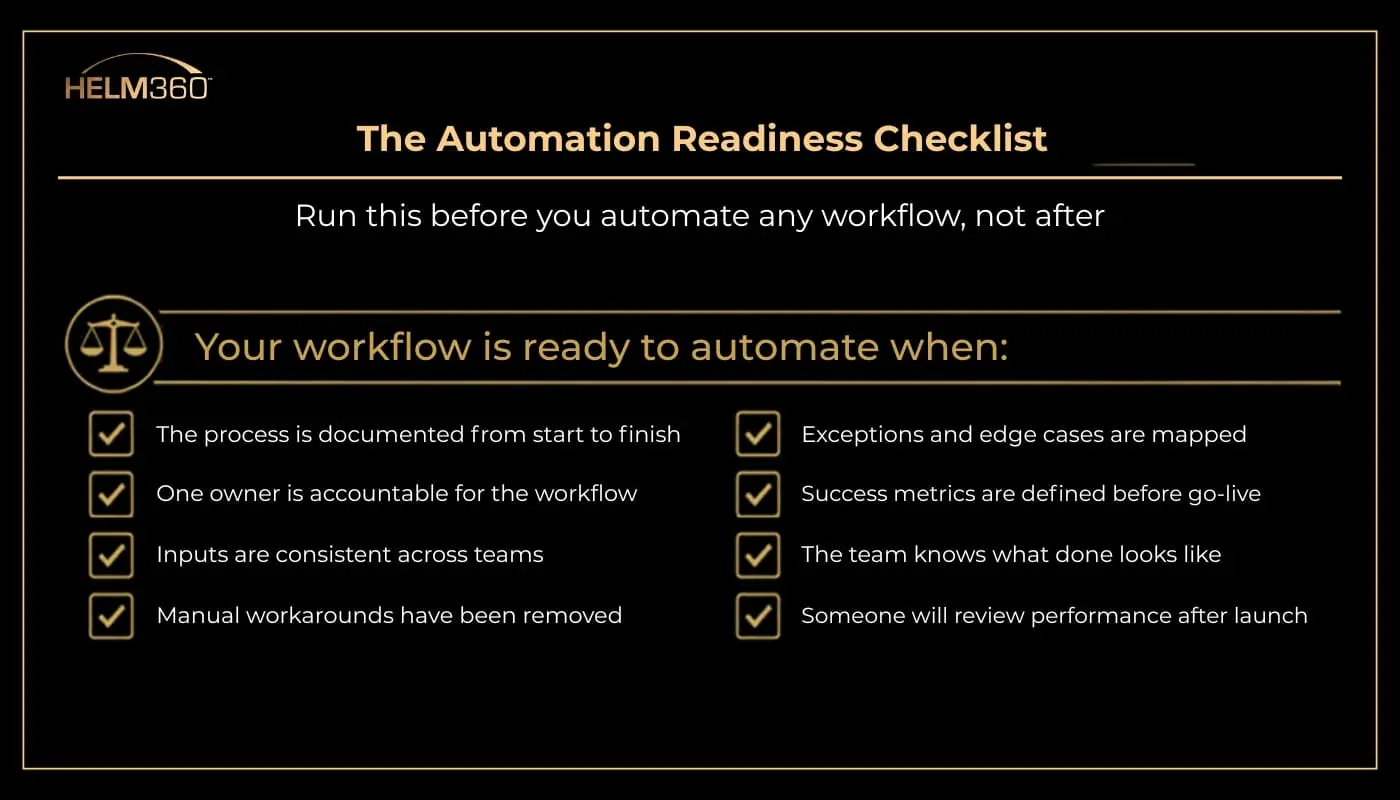
The pattern across all four is the same: the firm reached for a tool before it understood the problem well enough to know what “fixed” would even look like. That’s exactly what the checklist below is meant to catch, before the purchase order goes out, not after.
How the Firms Ahead Actually Operate
Every firm seeing real returns from automation shares a pattern, and it starts before any tool gets touched.
- They diagnose before they deploy. They map the workflow, find where time and accuracy leak, and confirm it is a process issue automation can solve, not a training or staffing issue a new tool will only hide.
- They build governance alongside the tool, not after it. Ownership, usage rules, and review cadence are set on day one, next to the implementation plan, not added once something breaks.
- They integrate instead of accumulate. New automation is evaluated against the systems the firm already runs on, such as Elite 3E, Aderant, ProLaw, and Intapp. The goal is to connect systems, not add another standalone tool to the pile.
- They measure outcomes, not logins. Adoption percentages are easy to report, but they say little about whether billing cycles shortened or rework decreased. Cycle time, rework rate, and data accuracy tell the story leadership cares about.
Put those four habits together and something important happens: the same disconnect hurting many firms becomes a source of advantage for disciplined ones.
The Upside Almost Nobody's Chasing Yet
The widening distance between how fast people adopt automation and how slowly firms build structure around it is not only a risk to manage. Right now, it is one of the clearest competitive advantages available in legal operations, precisely because so few firms have closed it yet.
Close that distance, and the time savings individual attorneys are already feeling start showing up where leadership actually looks: reporting accuracy, billing turnaround, client-facing responsiveness, and cleaner operational data.
Closing a distance that size does not happen by accident, and it does not happen all at once. It happens in a specific order.
Five Steps, in the Right Order
- Audit before you automate. Pick one high-friction workflow, intake, conflicts, or billing, and map every step before you evaluate a single tool.
- Assign ownership. Every automated workflow needs one named person accountable for reviewing performance and updating rules as the firm changes.
- Consolidate where you can. Favor automation that integrates with your existing practice management and financial systems over yet another standalone add-on.
- Set a review cadence. Revisit automated workflows quarterly, or immediately after any major process change, not just at renewal time.
- Track what the business actually cares about. Cycle time, error rate, and reporting turnaround beat adoption dashboards every time someone asks whether the investment paid off.
Follow that sequence and the conversation in that conference room starts to change. Not because the software got better, but because the question changes from “why isn’t this working” to “here’s exactly what improved, and here’s how we know.”
Where This Leaves Your Firm
Automation isn’t underdelivering for law firms because the technology is immature. It’s underdelivering because too many initiatives skip the diagnostic work, the governance structure, and the integration planning that make the technology actually work.
The same discipline shows up outside legal ops, too. In a recent episode of The Legal Helm, Nikao’s QA Director Prav Gudipalli talked through how automation and AI are reshaping testing frameworks for large-scale financial platform migrations. The parallel holds here: automation earns trust only when there is a repeatable way to verify it is still doing what it is supposed to, not only at go-live.
The firms winning here aren’t running more tools than everyone else. They’re running fewer tools, connected more intelligently, with clear ownership behind every one of them. That’s a more achievable target than it sounds, and it’s the one worth aiming for before the next budget cycle, not after.
The firms winning here aren’t running more tools than everyone else. They’re running fewer tools, connected more intelligently, with clear ownership behind every one of them. That’s a more achievable target than it sounds, and it’s the one worth aiming for before the next budget cycle, not after.
Want a Second Opinion on Your Automation Strategy?
If your firm has invested in automation but isn’t seeing the lift you expected, the issue is rarely the software itself. Helm360’s consulting team helps law firms:
- Diagnose workflow bottlenecks before recommending a fix
- Align automation with existing systems like Elite 3E, Aderant, ProLaw, and Intapp
- Build the governance structure that turns individual time savings into firm-wide results
Talk to our team about a workflow assessment, or explore our consulting and integration services to see how firms move from tool adoption to measurable operational improvement.
Frequently Asked Questions
1. What does "automation" actually mean for a law firm?
For law firms, automation means using software to handle repeatable steps in a workflow, such as intake, conflicts checks, or billing, without manual input at each stage. It works best when applied to a process that’s already documented and consistent, not as a substitute for fixing an undefined one.
2. Why doesn't automation always reduce costs or save time for law firms?
Automation speeds up whatever workflow it’s applied to, including inefficient ones. If the underlying process has unclear ownership, inconsistent steps, or no defined success measure, automation reduces the manual effort involved but not necessarily the friction driving the delay.
3. What's the difference between individual AI adoption and firm-wide automation?
Individual adoption means attorneys or staff use AI tools on their own initiative. Firm-wide automation means the firm has formally adopted, governed, and standardized how those tools are used across practice groups. Industry data shows individual adoption is running well ahead of firm-wide governance at most firms today.
4. How should a law firm start an automation initiative?
Start by mapping one high-friction workflow end to end, such as intake or billing, before evaluating any software. Confirm the bottleneck is a process issue automation can actually solve, assign a named owner, and define what success looks like before selecting a tool.
5. Who should own an automated workflow once it's live?
Every automated workflow should have one named person responsible for reviewing its performance, updating rules as processes change, and confirming it still matches how the firm operates. Without a clear owner, automation tends to drift out of alignment within a year or less.
6. How often should law firms review their automated workflows?
Quarterly reviews are a reasonable baseline, with additional reviews triggered any time billing rules, matter types, or staffing change. Automation that isn’t revisited regularly tends to fall out of sync with how the firm actually works.