


What Every Law Firm CIO Should Include in a Legal Technology Roadmap

Law firm technology roadmaps now reach well beyond application upgrades and annual IT budgets. They influence how firms manage matters, protect client information, support attorneys, measure profitability, and respond to changing client expectations.
The challenge for a CIO is not simply deciding which technology to purchase. It is creating a practical, connected plan that improves the firm’s operating model without disrupting legal work.
The pace of change makes that plan more valuable. ILTA’s 2026 Technology Survey, as reported by LawNext, found 94% of firms using or exploring generative AI, up from 80% a year earlier. The Thomson Reuters Institute’s 2026 State of the US Legal Market report notes that average technology spending grew 9.7% in 2025.
A strong roadmap connects these investments to business priorities, client service, risk management, and measurable operational improvement.
1. Start With Business and Practice Priorities
A roadmap should begin with the firm’s strategic objectives, not with a list of software products. Before evaluating platforms, the CIO can work with firm leadership, finance, legal operations, and practice group leaders to ask:
- Which processes consume the most administrative time?
- Where do attorneys and staff work around existing systems?
- Which applications create duplicate data or manual re-entry?
- Where does leadership lack timely, reliable information?
- Which systems are approaching end of life?
Two examples show how this works in practice:
- Matter profitability: a firm focused here may need stronger time capture, budgeting, billing visibility, and financial reporting.
- New business intake: a firm focused here may need conflicts, intake, CRM, and practice management workflows to connect.
This business-first approach keeps technology investments from becoming isolated projects. It also gives the CIO a clear basis for prioritization and executive sponsorship.
2. Establish a Reliable Data Foundation
Firms often manage information across practice management, document management, finance, email, spreadsheets, and specialized legal tools. A client or matter record that appears differently across those systems can affect conflicts checking, billing, collections, and profitability analysis.
Helm360’s guide to data governance versus data quality for law firms makes the point well: reliable reporting depends on consistent, well-managed source data as much as on accurate calculations.
The roadmap can define how the firm will improve:
- Data ownership and accountability
- Common client, matter, and financial definitions
- Data quality standards and exception reporting
- Integration between core applications
- Retention, access, and lifecycle policies
- Data extraction during migrations and upgrades
A simple data architecture map, showing systems of record, integration points, and remediation priorities, is a useful companion document.
3. Treat Cybersecurity as an Operating Requirement
Law firms hold privileged communications, personal information, financial records, and confidential work product. Security therefore works best as part of every technology decision, rather than as a separate workstream.
The ABA’s 2024 Legal Technology Survey Report found that 73% of responding firms use cloud-based legal tools and 60% have formal cybersecurity policies. With cloud use well established, formalizing security practice is a natural next step for the roadmap.
Key areas to document:
- Access: identity management, multifactor authentication, role-based and least-privilege controls
- Protection: endpoint monitoring, encryption in transit and at rest
- Resilience: backup, recovery, business continuity, incident response
- People and partners: phishing awareness training, vendor security reviews
- AI use: approved tools and data handling rules
Documenting security requirements before platform selection keeps them from becoming add-ons after implementation begins.
4. Build a Responsible AI Strategy
AI deserves its own section in the roadmap, tied to specific workflows where professional review stays in place. Common starting points include:
- Document review and summarization
- Legal research support
- First drafts of correspondence and internal documents
- Precedent retrieval and knowledge management
- Time entry and billing assistance
- Matter status reporting
The Thomson Reuters Institute’s 2025 Generative AI in Professional Services report found that 95% of surveyed professionals expect GenAI to become central to their organization’s daily workflow within five years, yet only 20% were measuring return on investment. Defining measures at the outset closes that gap.
An AI section of the roadmap should set out:
- Approved and prohibited use cases
- Data privacy and confidentiality requirements
- Human review responsibilities
- Vendor evaluation criteria
- Accuracy and quality testing
- Training for attorneys and business professionals
- Metrics for time savings, quality, and adoption
Before adopting an AI use case, firms can use a simple framework to assess whether the opportunity is clearly defined, appropriately governed, and measurable.

5. Prioritize Integration Over Tool Expansion
A firm can own excellent applications and still lose time if they do not exchange information. The roadmap should document how practice management, financial, document management, CRM, conflicts and intake, timekeeping and billing, and reporting platforms connect.
Integration is where many firms find quick wins:
- Challenge: duplicate entry across systems.
Roadmap response: identify a system of record for each data element and automate the handoff. - Challenge: leadership reports that combine data from several sources.
Roadmap response: build a shared reporting layer on agreed definitions. - Challenge: short-term workarounds that become permanent.
Roadmap response: log interim solutions with an owner and a retirement date.
Each integration should be reliable, maintainable, secure, and aligned with the firm’s future architecture.
6. Plan for Application Performance and Lifecycle
Roadmaps often focus on new systems while the applications a firm already depends on continue to evolve. A complete plan includes:
- Performance and health testing
- Upgrade readiness assessments and customization reviews
- License and usage analysis
- Dependency mapping and retirement plans for redundant systems
- Training and adoption support
For firms on Elite 3E, ProLaw, or Intapp, upgrades can affect integrations, reports, workflows, and templates. Testing that reflects real legal and financial processes works better than technical validation alone. Helm360’s QA testing and upgrade preparation services are built around that practical requirement.
7. Define Metrics and Governance
A roadmap proves its value when leadership can see results. A steering group drawn from IT, finance, legal operations, information security, and attorneys can assign every initiative an owner, timeline, dependencies, and success measure.
Useful measures to consider:
- Operations: matter opening and intake cycle time, report delivery time
- Financial: time entry completion, invoice turnaround, collection performance
- Technology: application uptime, help desk trends, data quality exceptions
- People: user adoption, attorney and client satisfaction
- Risk: security control maturity, AI usage and accuracy
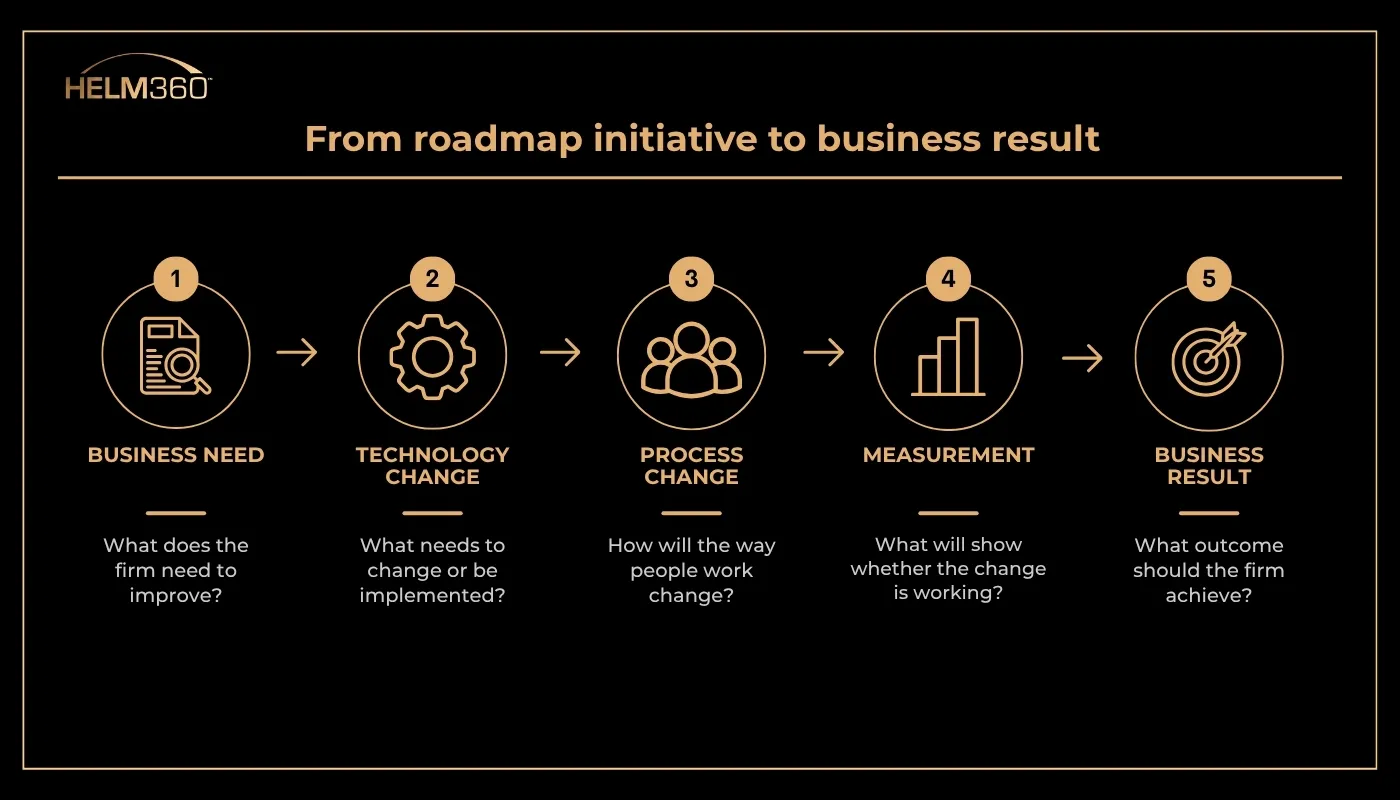
The same principle can be applied to each roadmap initiative: connect the business need to the technology change, the resulting process change, and a measurable outcome.
8. Use a Phased Implementation Model
A multi-year roadmap should give direction without becoming inflexible. Four phases let the firm address urgent needs first while building toward larger changes:
- Stabilize: close security gaps, improve application performance, document critical integrations, confirm continuity requirements.
- Standardize: set data definitions, reduce unnecessary customization, strengthen governance, improve dashboards.
- Modernize: upgrade or replace aging platforms, expand secure cloud capability, introduce targeted AI use cases, automate high-volume administrative work.
- Optimize: measure results, refine workflows, retire redundant tools, and reassess priorities as the firm evolves.
This structure gives stakeholders visible progress and leaves room to adapt to client expectations, technology, and firm strategy.
Plan Your Next Steps With Helm360
A legal technology roadmap works best as a shared operating plan that connects systems, data, security, people, and measurable outcomes. Helm360 supports law firms with application managed services, data extraction and transformation, reporting and integration, QA testing, upgrade planning and preparation, and consulting.
To discuss your own roadmap, you can:
- Contact the Helm360 team for a conversation about priorities
- Review our consulting services for roadmap planning and system optimization
- Listen to The Legal Helm podcast for perspectives from legal technology leaders
Frequently Asked Questions
1. What is a legal technology roadmap?
It is a structured plan that aligns a law firm’s systems, data, security, integrations, and AI initiatives with business and client service objectives.
2. Why does a law firm CIO need a technology roadmap?
A roadmap helps the CIO prioritize investments, manage risk, coordinate stakeholders, and show how technology contributes to efficiency, profitability, and service quality.
3. What should be included in a law firm technology roadmap?
Include business priorities, data governance, cybersecurity, AI governance, integrations, application lifecycle planning, implementation phases, ownership, and success metrics.
4. How should law firms approach AI adoption?
Begin with defined workflows, approved data sources, security controls, human review, user training, and measurable outcomes. AI should support professional judgment.
5. What role does data governance play in legal technology?
It sets ownership, quality standards, consistent definitions, and lifecycle policies, which helps firms produce reliable reports across systems.
6. How can law firms measure technology ROI?
Track reduced manual work, faster intake, billing cycle time, collections, adoption, error rates, support costs, and attorney or client satisfaction.
7. Why are integrations important for law firms?
Integrations let practice management, financial, document, CRM, conflicts, and reporting systems share information, which reduces duplicate entry and improves visibility.
8. How often should a law firm update its technology roadmap?
Review it at least annually, and sooner when firm strategy, client requirements, security risk, or application architecture changes significantly.