


RAG vs. Public AI and Why Retrieval Matters for Law Firms
The Operational Challenge With Public AI
Limited Firm Context
Hallucination Risk
Confidentiality and Governance
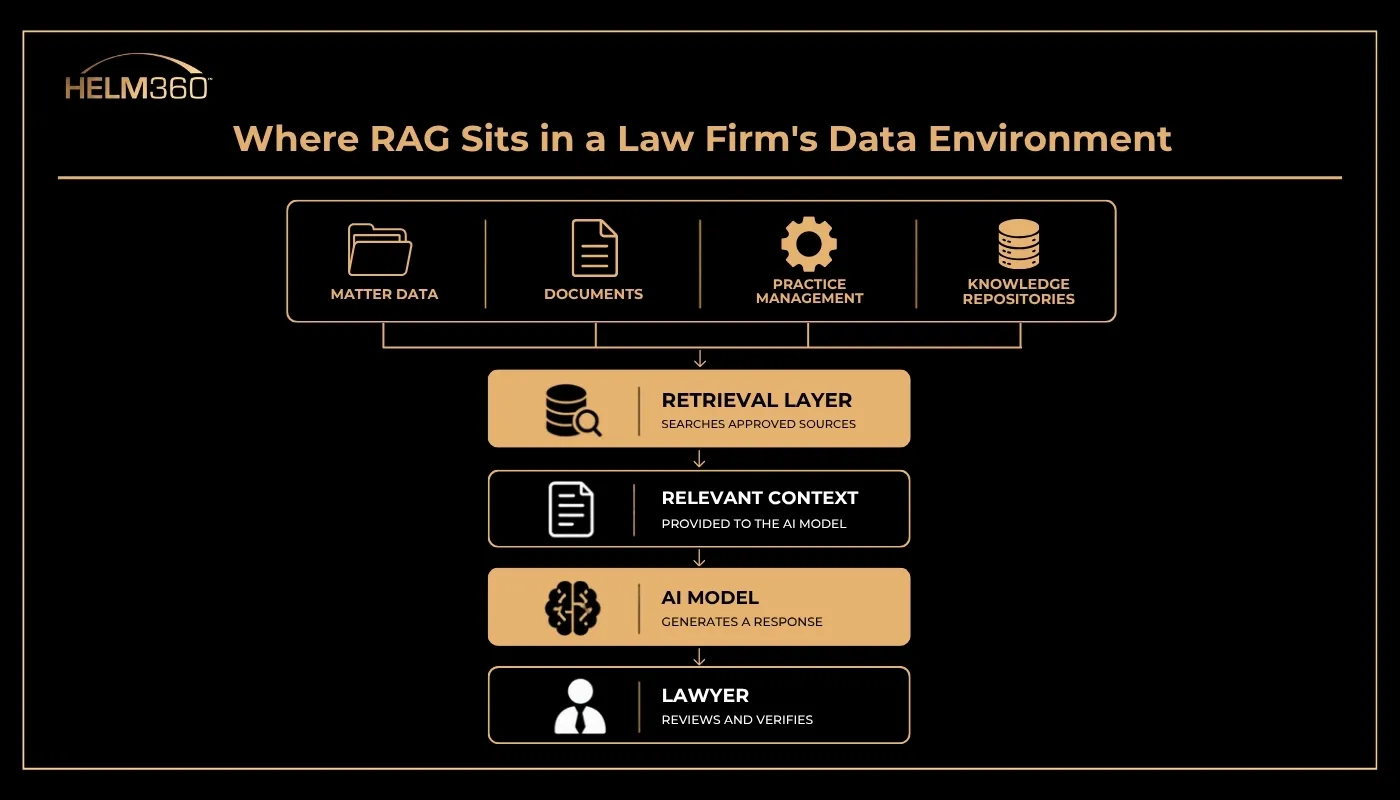
What Is RAG?
- Matter documents
- Precedent libraries
- Internal policies
- Knowledge repositories
- Practice management data
- Document management systems
- Other approved information sources
RAG Improves Grounding, Not Certainty
Where RAG Adds Value in a Law Firm
•Legal Research and Memo Drafting
•Contract Review and Due Diligence
•Internal Knowledge Queries
•Conflicts and Compliance Screening
•Matter Intelligence
Choosing the Right AI Approach for Your Firm
- Brainstorming
- Generic drafting
- Summarizing public information
- Improving writing clarity
- Early-stage ideation
Data Quality
Data Access
Source Visibility
Confidentiality and Access Controls
System Integration
- Practice management
- Document management
- Financial systems
- Knowledge repositories
- Other relevant applications
Workflow Performance
- Accuracy
- Retrieval quality
- Source support
- Time savings
- User adoption
- Workflow impact
What This Means for Law Firms
- Where does the information come from?
- Who is allowed to access it?
- Can the supporting information be reviewed?
- Does the technology work with existing systems?
- Where does human judgment remain necessary?
Frequently Asked Questions
RAG and general-purpose AI serve different purposes. A general-purpose chatbot is useful for tasks such as brainstorming, drafting, and working with information supplied by the user. RAG adds a retrieval layer that brings information from defined sources into the AI workflow. For legal work involving firm-specific or controlled information, the relevant comparison is often how well each approach fits the firm’s data, permissions, workflow, and review requirements.
Yes. A RAG system can retrieve information from private documents and other approved firm repositories when the architecture provides appropriate connections and access controls. The firm needs to determine which users, systems, documents, and information the AI is permitted to access.
Permissions need to be part of the system design. A RAG implementation should determine what information a user is authorized to access before using that information as context for an AI response. Existing access rules, confidentiality requirements, and ethical walls need to be considered when connecting firm repositories.
RAG gives a model access to information from external sources at the time of a request. Fine-tuning changes the model’s behavior by training it further on a selected dataset. For law firms, RAG is often relevant when the goal is to work with information that changes over time, such as matter documents, internal knowledge, or legal materials, without retraining the underlying model each time the source information changes.
No. Vector databases are one technology used to store and retrieve information for RAG systems, but they are not the definition of RAG itself. A RAG architecture involves retrieving relevant external information and providing it to a language model as context. The specific retrieval technology depends on the implementation.
There is no standard cost. Pricing depends on factors such as:
- Number and type of data sources
- Data volume
- AI model and infrastructure
- Integration requirements
- Security and access controls
- Implementation and ongoing maintenance
A focused pilot involving one workflow and a limited set of sources typically requires a different investment from a firm-wide deployment.
The main challenges involve the quality and relevance of retrieved information, access controls, integration with existing systems, response accuracy, and human review. RAG reduces reliance on model-only generation, but research on RAG-based legal research tools has found that meaningful errors can still occur.