


Preparing Your Law Firm for AI Search and How Clients Will Find Legal Expertise in 2027

A general counsel types a question into an AI assistant. Three law firm names appear with brief explanations. Your firm is not among them.
That is the new reality of client acquisition.
In 2026, 41.9% of consumers said they would turn to ChatGPT when researching an attorney, up from just 9% in 2023. The heaviest adopters are not younger clients either. Consumers aged 45 to 60 lead every age group, with 76% saying they would use AI to research which firm to hire. These figures come from a 2026 consumer study of 1,110 U.S. consumers. (Internet Marketing for Lawyers)
For law firms, this is not a future scenario. It is the current reality of client acquisition today.
The 2025 Clio Legal Trends Report reports that 79% of legal professionals use AI in their firms.
Why AI Search Changes Everything for Law Firms
Traditional SEO optimized for keywords and backlinks.
AI search experiences work differently. They synthesize information from multiple sources when generating an answer.
When a prospective client asks an AI assistant for recommendations, the system can generate a synthesized answer based on information it retrieves and other signals available to it.
The impact is measurable. When an AI summary appears in search results, organic clicks drop from 15% to just 8%. A Pew Research Center analysis of Google searches found users clicked a traditional search result on 8% of visits when an AI summary appeared, compared with 15% when no AI summary appeared.
This means firms need to consider visibility inside AI-generated answers alongside traditional search visibility.
The discovery funnel has shifted.
Your firm is still competing for page one rankings. You are also competing for visibility in AI-generated responses.
The New Discovery Funnel: How AI Evaluates Law Firms
AI search systems use different retrieval and ranking methods. There is no single public formula used by every AI assistant.
For law firms, four areas deserve attention:
The New Discovery Funnel: How AI Evaluates Law Firms
Generic practice area pages do not suffice.
AI search experiences need useful information to work with. Focus on:
- Detailed insights
- Case studies
- Thought leadership
- Client-focused FAQs
- Practice-specific explanations
- Original analysis
Google’s current guidance emphasizes helpful, reliable, people-first content and original value. Google for Developers
2. Structured Data and Schema Markup
Relevant structured data helps search engines understand page content and supports eligibility for certain Search features.
For law firms, structured data should accurately describe the content presented on the page.
Schema does not guarantee AI placement. Google states there is no special schema required for AI Overviews or AI Mode. Google for Developers
3. Third-Party Citations and Reviews
Reputable external sources contribute to your firm’s broader online presence and reputation.
Maintain accurate information across:
- Legal directories
- Industry publications
- Professional associations
- Firm profiles
- Review platforms
- Relevant media coverage
4. Consistency Across Public Information
Keep your firm’s information consistent across your website and external profiles.
Review:
- Firm name
- Locations
- Practice areas
- Attorney profiles
- Contact information
- Services
- Professional credentials
Inconsistent public information creates unnecessary ambiguity for prospective clients and search systems.
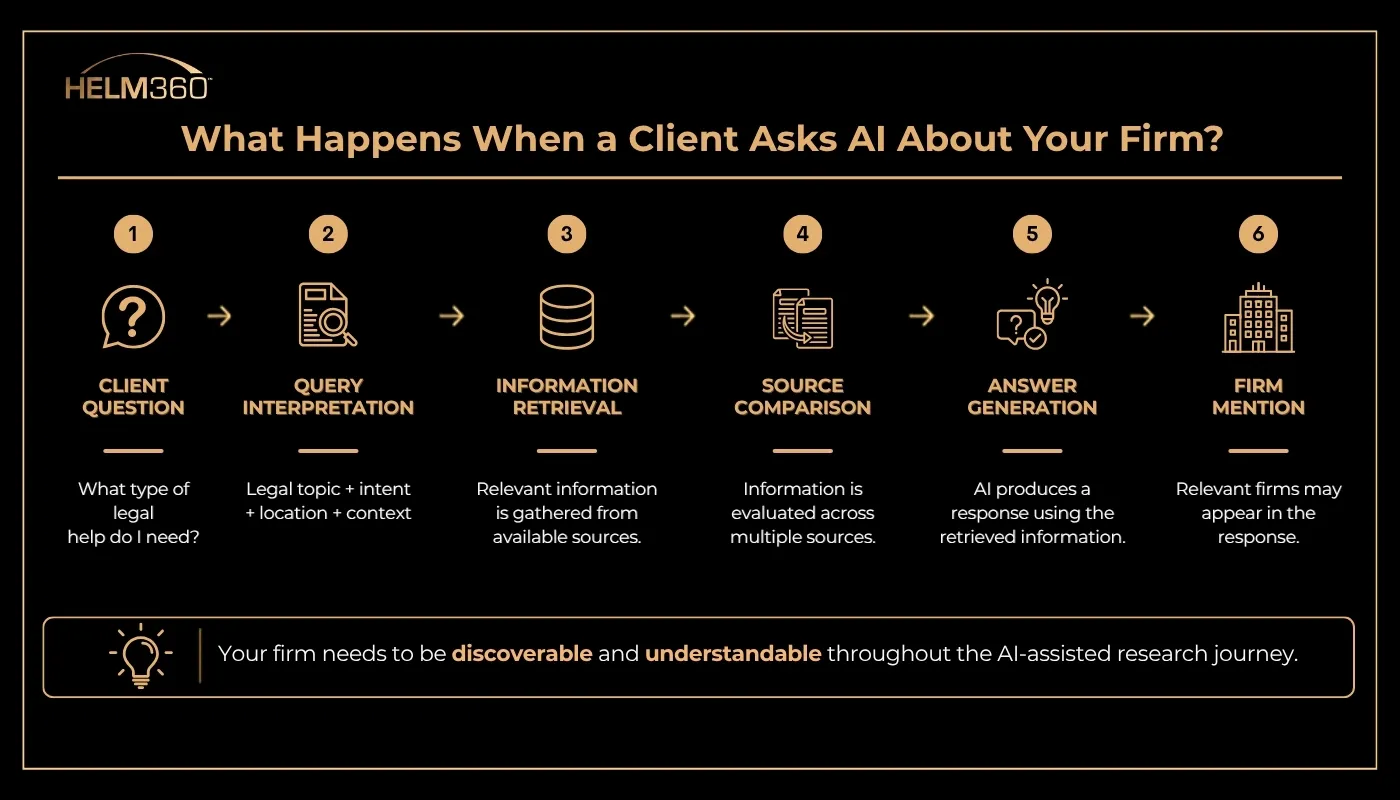
But what happens after a prospective client turns to AI to find legal help?
The process below shows how a client’s question can move through an AI-assisted search experience before a firm appears in the response.
Practical Steps to Prepare Your Firm for AI Search
Getting ready for AI search goes beyond chasing algorithms.
The focus is on making your firm’s expertise easier to find, verify, and recommend.
1. Audit and Enrich Your Content
Review your:
- Practice area pages
- Attorney bios
- Thought leadership content
- FAQs
- Case studies
Ask:
- Does this content answer specific client questions in plain language?
- Are there real examples, outcomes, or insights that demonstrate depth?
- Is the information current and accurate?
- Is the information consistent across your public profiles?
Detailed, client-focused content gives search systems useful information to understand and surface.
2. Implement Legal Schema Markup
Work with your web team to add relevant structured data to key pages.
This includes structured data where appropriate for:
- Attorneys
- Legal services
- Organizations
- Articles
- Events
Schema does not guarantee AI placement, but it helps search engines understand page content and supports certain search features.
3. Strengthen Third-Party Presence
AI search experiences can draw information from multiple sources.
Ensure your firm maintains:
- Up-to-date profiles in major legal directories
- Consistent firm information across LinkedIn, Google Business Profile, and industry associations
- Regular contributions to reputable legal publications and podcasts
- Accurate attorney profiles and professional credentials
4. Align Internal Systems With External Messaging
One of the most overlooked factors is information consistency.
Your internal systems do not directly determine AI search visibility. They do support the accuracy of the information your firm publishes and maintains externally.
If your matter management system lists different practice areas than your website, or attorney information in your CRM does not match public profiles, resolve those discrepancies so your public information remains accurate.
When these issues involve the underlying applications or firm data, the required support can be different.
Helm360 provides separate services for these needs. Its consulting services support legal technology projects such as system implementations, troubleshooting, training, and application-related work, while its data services focus on data discovery, validation, cleansing, extraction, conversion, and migration. Learn more about Helm360 and its legal technology services.
For firms working through data inconsistencies across legal systems, Helm360’s Data Governance vs. Data Quality provides a related look at how data quality, ownership, access, and governance affect legal operations.
What Legal Operations Leaders Should Watch in 2027
AI search is evolving quickly. Legal operations and technology leaders should monitor these developments:
- AI citation patterns: An Ahrefs analysis of 4 million AI Overview URLs found that 37.9% of cited URLs also appeared within the first 10 search result blocks for the same query.
- Referral traffic from AI assistants: A 2026 MagnifyLab study of 50 UK law firm websites found monthly AI referral sessions grew 8.4 times between January 2025 and June 2026. ChatGPT accounted for 89.7% of trackable AI referral traffic in the dataset. These figures represent UK law firms and should not be treated as a universal benchmark.
- Client behavior: The 2026 consumer study from Internet Marketing for Lawyers found Google remained the most-used source for attorney research at 71.9%, while ChatGPT reached 41.9%. More than 70% of ChatGPT users said they would also use Google during their research process.
The numbers point to a broader shift. AI is becoming part of legal research and firm discovery, while traditional search remains important.
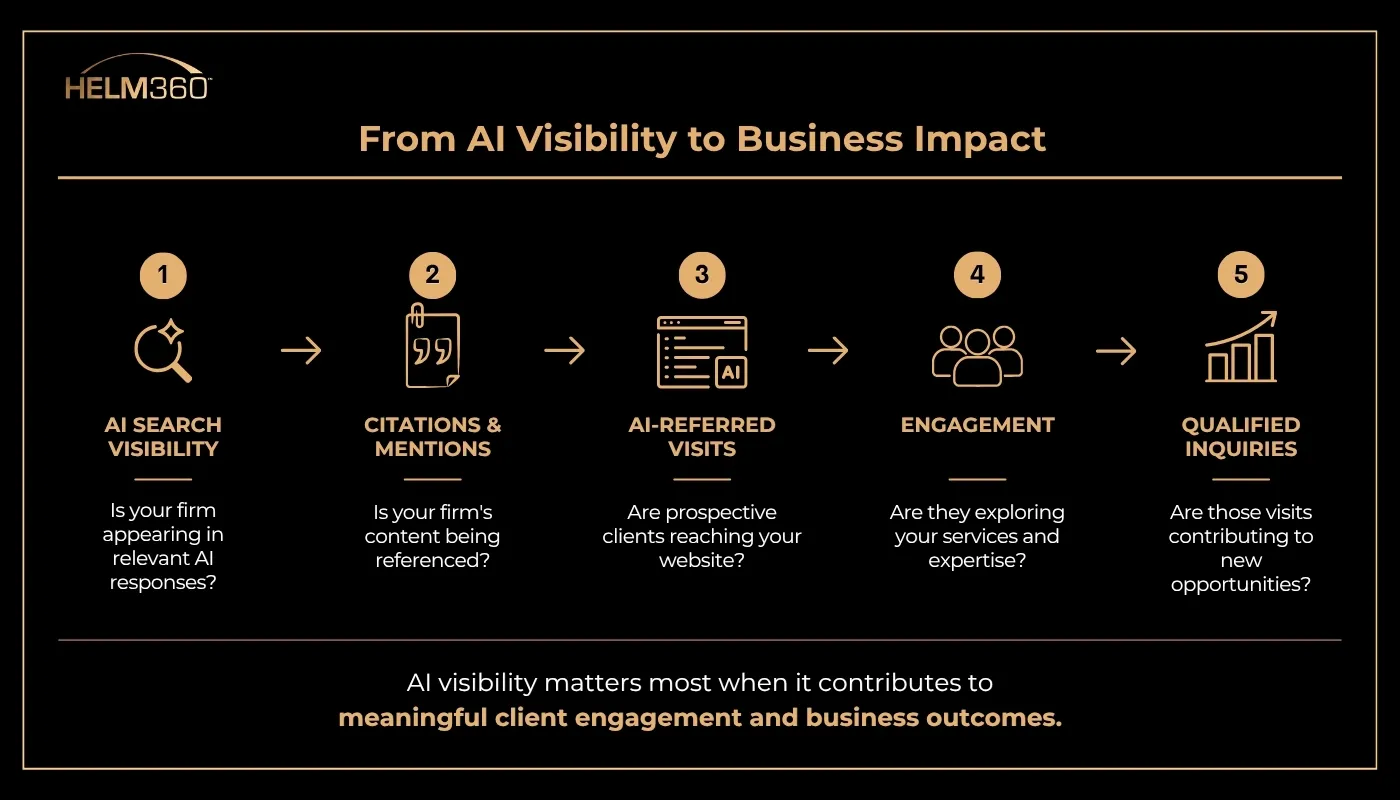
The question for firms is how to connect visibility with what happens after a prospective client finds them.
Building a Sustainable AI Search Strategy
Preparing for AI search is not a one-time project.
It requires ongoing attention to:
- Content quality
- System integration
- Public information
- Market positioning
- Search performance
- AI visibility
Firms should focus on creating useful, original content for real people while maintaining the technical foundation required for search visibility.
Google’s current guidance reinforces the importance of foundational SEO, helpful content, technical accessibility, internal linking, and accurate structured data for generative AI search experiences.
For a broader look at how AI is changing legal operations, see 10 Expert Perspectives on How AI Is Redefining Legal Operations.
How Helm360 Supports Your Firm's Technology Environment
At Helm360, we help law firms align their technology, data, and processes so they can focus on clients instead of software.
Our legal technology services include:
- Application integrations
- Application upgrades
- Consulting services
- Data services
- Reporting and development
- Application managed services
- Legal technology support
Helm360 works across legal technology environments including Elite 3E, ProLaw, Enterprise, and Intapp. Its consulting services support system implementations, troubleshooting, training, integrations, and related legal technology projects.
For firms evaluating AI alongside broader technology initiatives, the focus should remain on reliable data, connected systems, clear processes, and technology aligned with how the firm operates.
If your firm is evaluating how AI search affects client acquisition, contact Helm360 to discuss your technology and data environment.
Frequently Asked Questions
1. What is AI search optimization for law firms?
AI search optimization focuses on making a law firm’s expertise, services, and public information easier for AI-powered search systems to find, understand, and reference.
2. How can law firms improve AI search visibility?
Focus on useful, specific content, strong technical SEO, accurate firm information, relevant third-party presence, and clear attorney and practice-area information.
3. Does SEO still matter for AI search?
Yes. Traditional SEO remains an important foundation for AI search visibility. Google’s guidance confirms that existing SEO practices continue to apply to AI Overviews and AI Mode.
4. What type of content should law firms create for AI search?
Create content around the questions prospective clients ask. Practice-area guides, legal FAQs, case studies, attorney insights, and detailed explanations of legal processes are useful formats.
5. Does schema markup help law firms appear in AI search?
Structured data helps search engines understand page content. It does not guarantee placement in AI-generated results, and there is no special schema required specifically for Google’s AI search features.
6. How should law firms measure AI search visibility?
Track AI mentions and citations alongside traditional SEO metrics. Also review AI-referred traffic, engagement, and qualified inquiries to understand whether visibility is contributing to business results.
7. What are AEO and GEO for law firms?
AEO, or Answer Engine Optimization, and GEO, or Generative Engine Optimization, are industry terms for improving visibility in AI-generated answers. The practical focus remains useful content, technical SEO, accurate information, and a strong digital presence.