


How Law Firms Can Improve Visibility in Local Search Using Data
Most firms competing online are still playing by rules that changed two years ago. Here is what actually works in 2026.
When a prospective client types “estate planning attorney near me” or asks their phone which employment law firm handles wrongful termination cases in their city, the firms that appear first are not necessarily the most experienced. They are the ones whose data is in the right shape.
Local search in 2026 operates across two parallel tracks. The first is traditional local SEO, covering map pack rankings, citation consistency, and review profiles. The second is newer and increasingly influential: Answer Engine Optimization (AEO). Together, these two tracks determine whether a firm gets found by clients searching on Google, or by AI platforms composing direct answers without a single blue link in sight.
Let’s learn what actually drives visibility today and what it takes to stay competitive.
The Local Search Landscape in 2026
Three numbers give useful context for why this conversation matters for law firms right now:
- 46% of all Google searches carry local intent (Source)
- ~60% of searches now end without a click (Source)
- ~78% of legal and finance queries trigger a Google AI Overview, varying by query type and specificity (Source)
That last figure is particularly relevant. When AI generates an answer at the top of the results page, the firm whose content gets cited there earns visibility without the user ever clicking further. For firms not appearing in those answers, the audience has already moved on before reaching organic results.
What Google is Actually Measuring
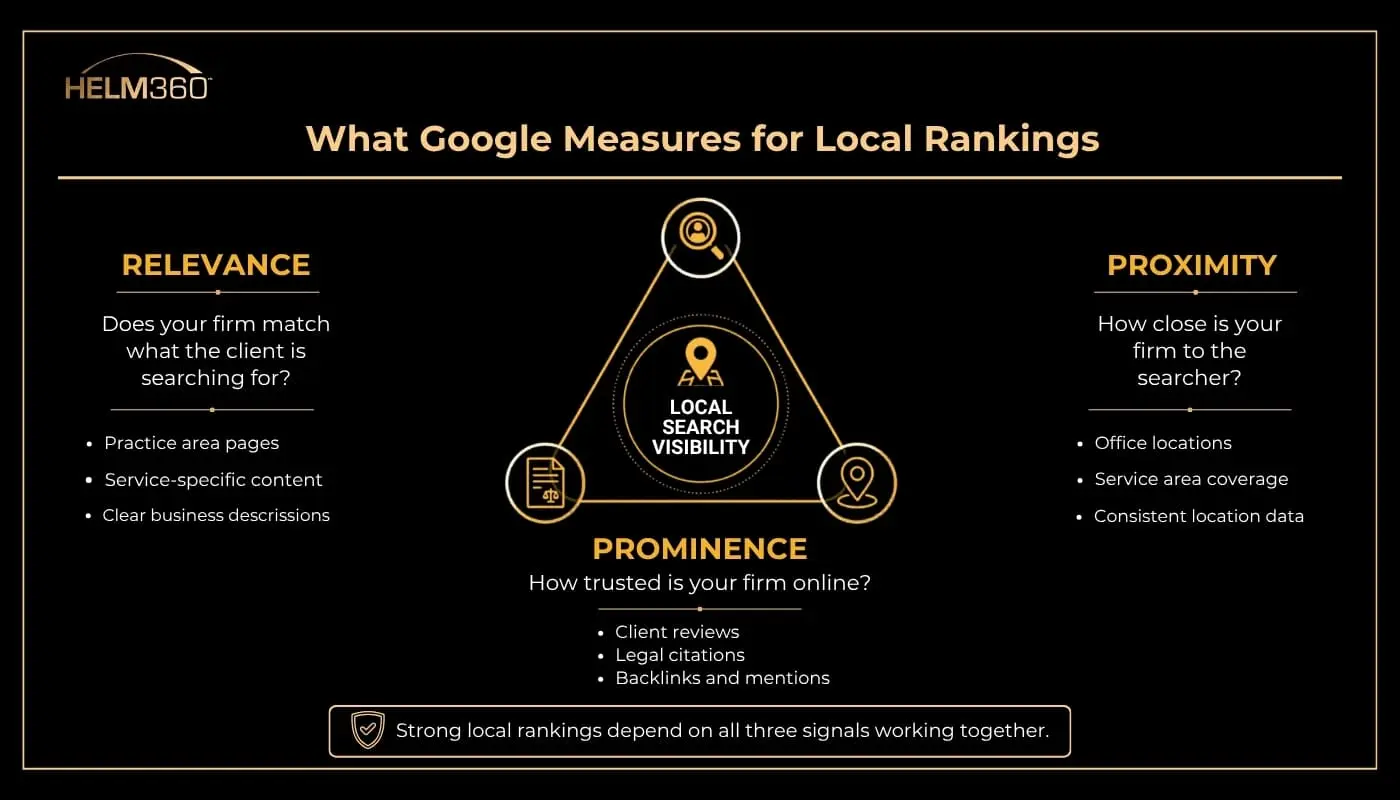
Local rankings are still governed by three core signals. Understanding them is useful because it frames where investment actually makes a difference.
The visual below breaks down each signal and what it means for law firms specifically:
The Data Problem Most Firms Do Not Realise They Have
Local visibility starts with something unglamorous: information accuracy. Business name, address, and phone number (NAP) consistency across Google Business Profile, legal directories, bar association listings, and your own website is foundational. When these do not match, search engines register conflicting signals and quietly reduce trust in the listing.
A simple example: A firm listed as “Harper & Okafor LLP” on its website, “Harper and Okafor” on Martindale-Hubbell, and “Harper Okafor Law” on Avvo is sending three different identity signals to the same algorithm. Each inconsistency compounds the others.
Beyond name and address, the data points most directly affecting rankings include:
- Google Business Profile completeness- Fully completed profiles, including service categories, Q&A sections, and practice area descriptions, consistently outperform incomplete ones. Most firms leave significant sections blank.
- Review volume and recency- A profile with 80 old reviews will often rank below a competitor with 30 current ones. Recency is a live signal, not a one-time achievement.
- Structured data markup- Schema types like LegalService, Attorney, and LocalBusiness tell search engines precisely what your firm does and where. Without them, the algorithm guesses, and it sometimes guesses wrong.
How Local AEO Differs From Local SEO
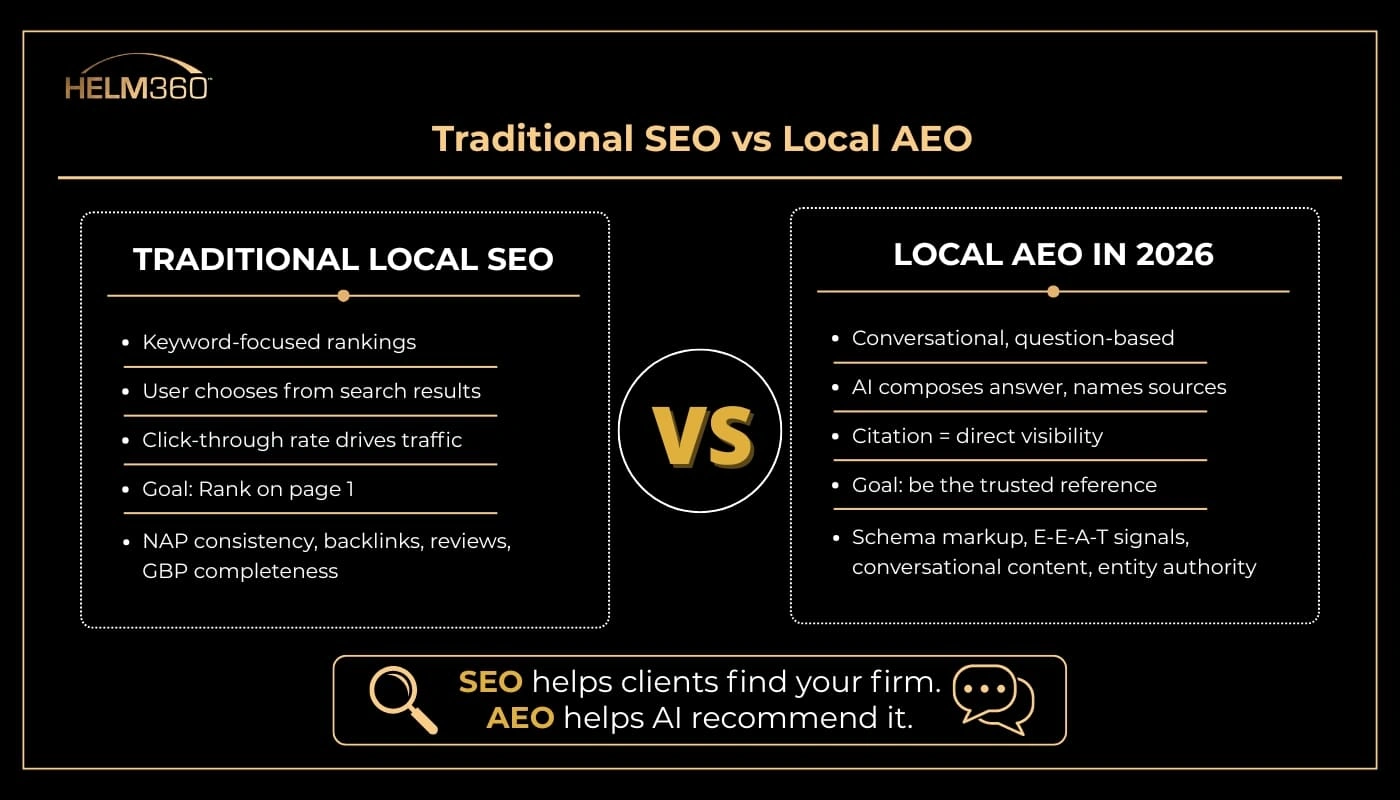
Traditional local SEO focuses on earning a position in the Google Map Pack or standard organic results. Local AEO (Answer Engine Optimization) is the next-generation layer that focuses on conversational intent. When a client asks an AI tool like ChatGPT, Google AI Overviews, or Perplexity for a recommendation, AEO determines whether your firm is the one it reads, cites, and surfaces.
The practical difference: traditional SEO earns you a position on a results page. AEO earns you a mention inside an AI-generated answer.
The comparison below shows exactly how the two tracks differ in intent, format, and outcome:
For law firms, this shift has a specific advantage. Legal content sits in what Google classifies as YMYL territory (Your Money or Your Life), meaning AI platforms apply a higher standard before citing a source.
Firms that demonstrate strong E-E-A-T signals- experience, expertise, authoritativeness, and trustworthiness are better positioned to be included, while lower-quality sources are less likely to appear.
Key Pillars for Local AEO
Unlike traditional SEO’s focus on keywords and backlinks, AEO prioritises directness, entity authority, and high-quality conversational content. For law firms, that translates to five specific practices:
1. Conversational long-tail content
Clients use voice assistants and AI tools to ask full-sentence questions. Content and Google business profile Q&As should mirror natural language, not just target short keyword strings.
2. Entity authority and location proof
AI platforms synthesise data from across the web. Mentions from reputable local institutions, bar associations, and community publications build the kind of off-page credibility AI trusts.
3. Schema markup
Structured data acts as a machine-readable translation of your firm’s details, allowing AI to ingest your hours, services, and location without inference.
4. Genuine reviews
AI aggregates sentiment from reviews to assess whether your firm is a credible fit for the user’s specific need. Volume and recency both matter.
5. Clear, digestible formatting
AI engines favour structured content: short paragraphs, clear headings, and direct answers. If a page is hard for a human to scan, it’s hard for an AI to extract.
Five Things That Actually Move the Needle
1. Audit your data footprint first.
Map every place your firm appears: GBP, Avvo, FindLaw, Justia, Martindale, bar directories, your own site, and more. Tools like BrightLocal or Moz Local surface inconsistencies quickly. Fix conflicts before building on top of them.
2. Build location-specific practice area pages.
A single homepage listing all services doesn’t serve local intent. Separate pages by practice area and geography carry stronger local signals and are the pages AI platforms pull from when composing location-specific answers.
3. Systematise review collection.
Build a simple process into the client lifecycle: a follow-up at case close, a note from the relationship attorney. Asking inconsistently produces inconsistent results.
4. Write for questions, not just keywords.
FAQs, question-based headings, and direct, concise answers are the content format AI platforms prefer when selecting sources. Structure content around how clients actually ask, not how lawyers describe their services.
5. Implement legal schema markup sitewide.
LegalService, Attorney, and LocalBusiness schema should be part of your site template. It’s one of the clearest signals you can send to both traditional search and AI platforms about who you are and where you operate.
What to Measure
Total impressions and overall traffic are too broad to be actionable. The signals worth monitoring:
- Local pack ranking positions by practice area and city
- Google Business Profile actions: calls, direction requests, website clicks
- Conversion rate from location-specific landing pages
- Review growth rate, with attention to recency
- Citation accuracy score across key directories
- AI citation tracking: appearances in ChatGPT, Perplexity, and Google AI Overviews
That last one is new for most firms. Tools specifically designed to monitor LLM citation frequency are emerging, and for firms in competitive markets this will become a standard part of the reporting stack. For a broader framework connecting these metrics to business outcomes, read a guide to measuring marketing ROI in law firms.
The Bottom Line
Local search visibility in 2026 rewards firms that maintain accurate data, consistent business information, and content that aligns with how clients actually search. While visibility is often viewed as a marketing challenge, many of the underlying issues are rooted in data quality and information management.
As search engines and AI platforms place greater emphasis on trusted data and authoritative sources, the quality of a firm’s information ecosystem becomes increasingly important.
For law firms, improving visibility is no longer just about rankings. It is about ensuring the information that represents the firm is accurate, accessible, and trusted wherever potential clients and AI platforms look for answers.
If your firm is evaluating data quality, information governance, or system integration initiatives, connect with the Helm360 team to explore how a stronger data foundation can support long-term business performance.
Frequently Asked Questions
1. What is local SEO for law firms?
Local SEO helps law firms appear in Google Maps, local search results, and location-based searches. It focuses on Google Business Profile optimization, reviews, citations, location pages, and local relevance signals.
2. How can law firms appear in Google AI Overviews?
Law firms improve their chances of appearing in AI Overviews by publishing authoritative content, demonstrating strong E-E-A-T signals, implementing structured data, and maintaining consistent business information across trusted sources.
3. Why are law firms losing visibility in local search?
Common causes include inconsistent business information, outdated directory listings, weak review profiles, missing schema markup, poor location targeting, and content that does not align with how clients search.
4. Does Google Business Profile still matter in 2026?
Yes. Google Business Profile remains one of the strongest local ranking signals. Complete profiles with accurate information, reviews, practice area descriptions, and regular updates typically perform better than incomplete profiles.
5. What is E-E-A-T and why is it important for law firms?
E-E-A-T stands for Experience, Expertise, Authoritativeness, and Trustworthiness. Because legal content falls into Google’s YMYL category, strong E-E-A-T signals help search engines and AI platforms determine whether a law firm is a trustworthy source.
6. How often should law firms audit their local listings?
Most firms should review their business listings at least quarterly and after any office move, phone number change, merger, rebrand, or website update to ensure information remains consistent across platforms.
7. Can AI platforms like ChatGPT influence law firm visibility?
Yes. AI-powered search experiences increasingly influence how users discover professional services. Firms with strong entity authority, accurate business information, structured data, and authoritative content are more likely to be surfaced or cited by AI platforms.