


How AI Improves Contract Lifecycle Management Without Replacing Lawyers
How many contracts does your firm manage right now, and how many of them are sitting somewhere between “sent for review” and “forgotten until renewal season”?
It is not a trick question. Most legal operations teams know the answer feels uncomfortable. The contracts are technically being managed, just not well. Renewals get missed. Clause language drifts between matters. And somewhere in a spreadsheet, an obligation deadline passes quietly.
None of this happens because the team is not capable. It happens because the volume of contract work has outgrown the systems built to handle it.
That is the gap AI-assisted contract lifecycle management is designed to address, not by replacing legal judgment, but by reducing the operational burden that slows everything else down. The question worth asking in 2026 is not whether AI belongs in CLM. It is how to use it in a way that actually works for your firm.
The Scale of the Problem (And Why It Keeps Getting Bigger)
Before getting into what AI does, it helps to understand what poor contract management actually costs, because the numbers are striking.
- Organizations lose an average of 9% of annual revenue to poor contract oversight, missed obligations, and inefficient processes, according to WorldCC’s August 2025 research.
- Top-performing firms keep that leakage to around 3%. Underperformers regularly exceed 15%.
- Contract data is fragmented across an average of 24 different systems in most organizations, making unified visibility almost impossible.
For law firms managing high contract volumes across multiple practice areas, the operational math is hard to ignore. The firms that figure out how to run CLM well are not just saving time. They are capturing revenue that was previously slipping out through process gaps.
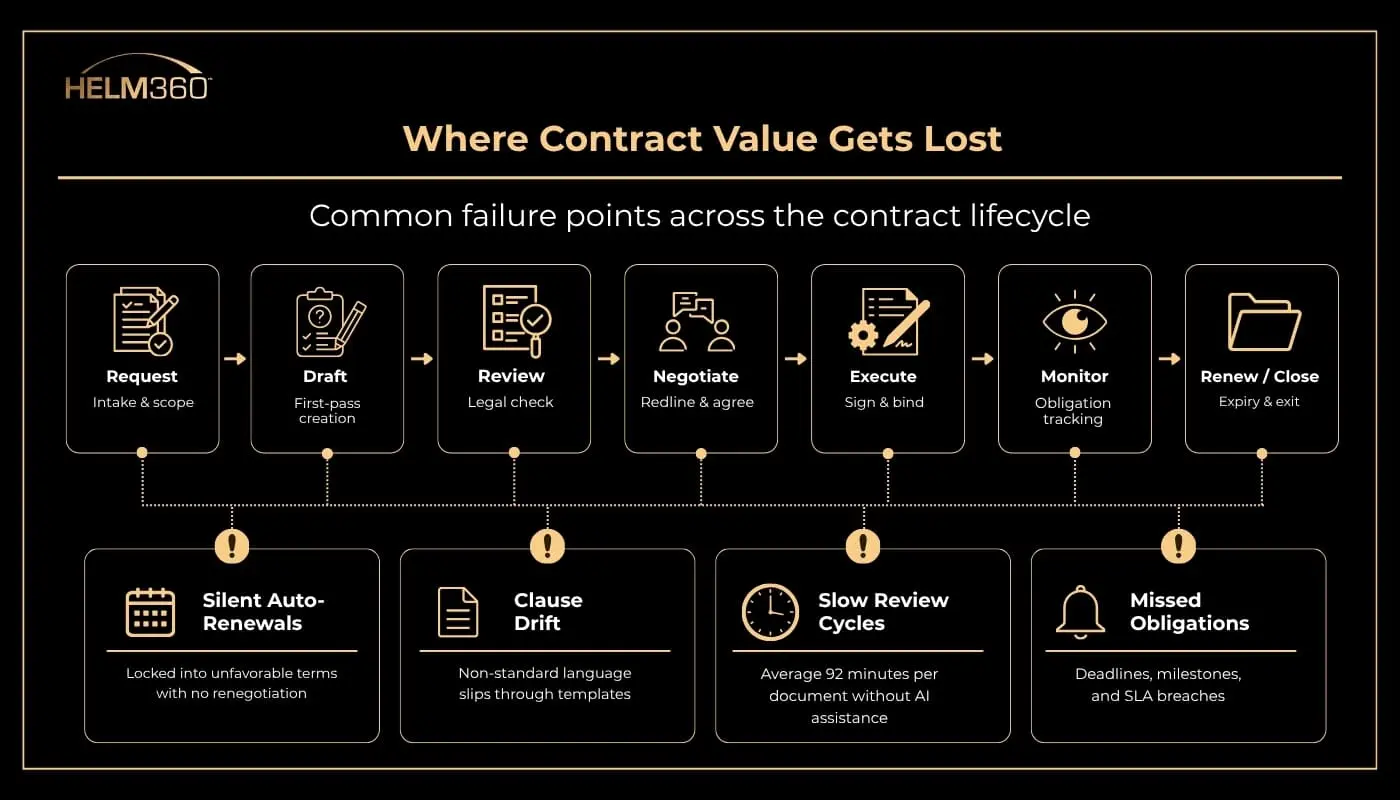
The most common breakdowns tend to occur at specific points in the contract lifecycle. The visual below highlights where value, time, and visibility are most often lost.
What AI Actually Does in a CLM Workflow
This is where it helps to be specific, because “AI in contracts” is often used to describe everything from basic drafting assistance to advanced contract intelligence platforms. For law firms evaluating real tools, the capabilities worth understanding fall into five areas.
1. Drafting From Approved Templates
AI tools generate first drafts from clause libraries and approved templates, drawing on practice area, jurisdiction, and matter type. The lawyer sets the standards; the AI applies them at speed. No more starting from a blank page for routine agreements.
2. Automated Clause Review and Flagging
AI scans incoming contracts for non-standard language, missing provisions, and deviations from preferred positions in seconds. Human contract review averages 92 minutes per document; AI-assisted review takes around 26 seconds. Across hundreds of matters, that time difference changes what is operationally possible.
3. Risk Identification and Obligation Tracking
Rather than relying on manual checklists or calendar reminders, AI-powered platforms surface risk indicators automatically, flag expiring obligations, and alert teams before deadlines become problems. Post-execution monitoring, the phase where most contract value is lost, becomes systematic rather than accidental.
4. Plain-Language Contract Search
Lawyers can query a contract repository in natural language: “Which NDAs expire next quarter?” or “Show all agreements with uncapped liability clauses.” That kind of search used to require a paralegal and an afternoon. Now it takes seconds. For firms managing hundreds or thousands of active contracts, structured search is one of the most immediately practical uses of AI.
5. Structured Data Extraction
AI pulls key terms, dates, parties, and obligations from contracts and stores them as searchable, structured data. This feeds into reporting, risk dashboards, and business development conversations in ways that spreadsheet-based tracking never could.
What AI Does Not Do (And Why That Line Matters)
Here is where the honest conversation needs to happen, because the anxiety around AI replacing lawyers is real, and it is worth addressing directly.
A 2026 analysis from Harvard Law School’s Center on the Legal Profession found that none of the AmLaw 100 firms interviewed anticipated reducing practicing attorney headcount, even those reporting significant productivity gains.
The reason is straightforward: AI handles volume and pattern recognition. It does not handle judgment.
Contract lifecycle management sits squarely in that distinction.
What AI does well:
- Identifying that a limitation of liability clause deviates from standard positions
- Flagging a non-standard force majeure provision
- Tracking that an obligation deadline is approaching
- Summarizing a contract’s key terms in thirty seconds
What still requires a lawyer:
- Deciding whether to accept that deviation based on the client relationship and commercial context
- Weighing a flagged clause against the client’s industry, the counterparty’s financial position, and the deal’s strategic importance
- Advising a client on risk tolerance, not just risk identification
- Negotiating, persuading, and making judgment calls that depend on context no algorithm can fully understand
The Everlaw survey found AI adoption among corporate legal teams more than doubled from 23% in 2024 to 54% in 2025, with the emphasis shifting clearly toward augmentation, using technology to enhance human expertise, not replace it.
The firms seeing the best results are not the ones using AI most aggressively. They are the ones that clearly understand which decisions belong to technology and which require legal judgment.
Where Law Firms Are Actually Seeing Gains
When CLM technology is implemented well, the benefits tend to appear in a few specific areas.
Faster turnaround on routine agreements.
NDAs, MSAs, and standard commercial agreements that previously spent days in a review queue can move through in hours.
Reduced post-execution risk.
Automated obligation monitoring catches the deadlines and auto-renewals that used to slip through. The post-execution phase has historically been where contract value quietly erodes; systematic AI monitoring addresses that directly.
Searchable contract intelligence.
Firms using AI-enabled CLM gain structured, queryable data across their entire contract portfolio. That data informs rate negotiations, resource planning, and client advisory conversations in ways that disconnected spreadsheets never could.
More capacity for complex work.
82% of legal AI users report increased overall efficiency, translating directly into more time for the work that requires genuine legal expertise.
It is also worth noting that 64% of in-house legal teams now expect to depend less on outside counsel because of AI capabilities they are building internally. For law firms, that shift is a competitive signal. The firms that can demonstrate operational efficiency and faster contract turnaround are better positioned to retain and grow those client relationships.
Common Pitfalls That Derail CLM Implementations
The technology is rarely the problem. Most CLM challenges stem from implementation, governance, integration, and adoption. The following are the patterns that most commonly create problems.
- Starting too broad. Firms that try to automate everything at once end up with low adoption and fragmented results. Starting with one practice group or one contract type, then scaling methodically, consistently produces better outcomes.
- Underinvesting in governance. Who maintains the clause library? Who approves template changes? Who reviews flagged items? Without clear ownership, the system drifts, and teams stop trusting it.
- Treating integration as an afterthought. A CLM tool that does not connect to existing practice management, document management, and billing systems creates more fragmentation, not less. The report from LegalOn found that 51% of legal teams cite difficulty integrating with existing systems as a top implementation challenge.
- Skipping change management. Adoption is the hardest part. When AI recommendations feel like a black box, attorneys stop trusting them and default back to old workflows. Teams need to understand what the system does, why it flags specific issues, and where legal judgment remains essential.
- Choosing the wrong scope for the rollout. Most practitioners recommend starting small, one department, one workflow, or new contracts only, then expanding over time. Repsol’s legal team, for example, reported a 96% adoption rate with Harvey because the technology fit naturally into existing workflows rather than forcing lawyers into an entirely new way of working.
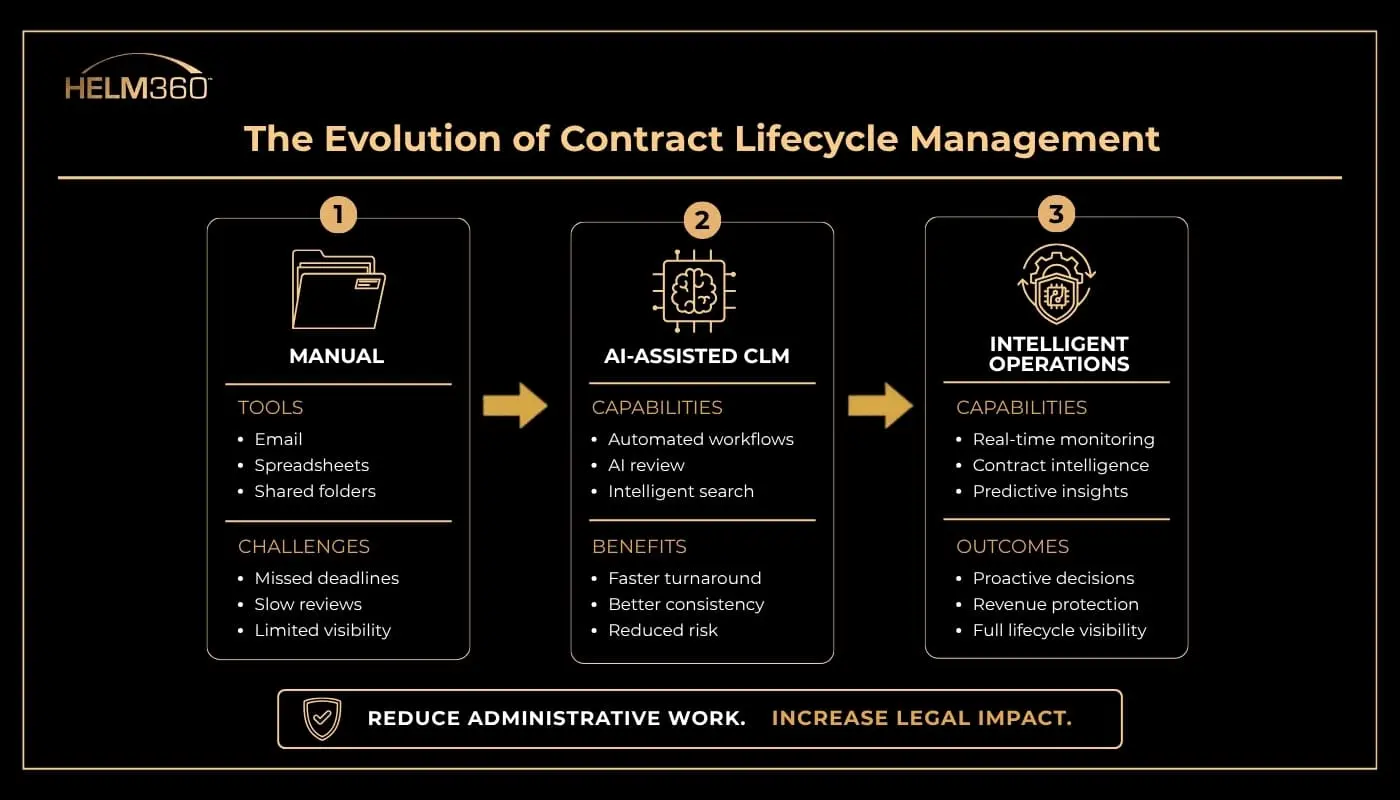
Most firms do not move from manual contract management to fully optimized CLM overnight. Progress typically happens in stages, with each stage reducing operational friction and increasing visibility.
The Governance Questions Every Firm Should Be Asking
Deploying AI in contract management raises questions that go beyond selecting a platform. Here are the ones worth working through before a firm commits to a tool or a rollout:
When AI flags a clause or suggests a revision, where is the record of why that suggestion was made, and who reviewed it?
If a client or court asks how a contract position was reached, can the firm demonstrate that a lawyer made the final call?
How does the system handle errors or bad suggestions, and does it learn from corrections over time?
These are not abstract compliance questions. In legal environments, explainability, accountability, and auditability matter. Firms need to understand how recommendations are generated, who approves them, and how decisions can be traced when questions arise later.
For firms thinking through how AI governance fits into their broader legal technology strategy, Helm360’s whitepaper on ethical AI use in law covers the accountability and transparency frameworks firms are building internally, and what good governance actually looks like in practice.
A Practical Starting Point
The firms making the most progress with AI-assisted CLM are not necessarily the ones with the biggest budgets or the most sophisticated platforms. They are the ones that started with a clear-eyed assessment of where their current process breaks down.
A few questions worth sitting with:
- Which contract types consume the most attorney time relative to their actual complexity?
- Where do contracts currently stall, and why?
- How many agreements renewed last year without active renegotiation because no one flagged the deadline in time?
- If someone asked you to pull every NDA expiring in the next 90 days, how long would that take?
The answers tend to point to a short list of high-impact areas where AI assistance produces immediate, measurable results. That is the right place to start, not with a sweeping platform rollout, but with a specific problem and a specific workflow.
Before evaluating vendors, it helps to establish clear criteria around governance, workflow integration, and quality control. Helm360’s AI content checklist for law firms is a useful reference for firms evaluating AI tools more systematically.
The Shift That Is Already Happening
CLM is one of the more structured, lower-risk applications of AI in legal operations, which makes it a sensible entry point for firms building out broader AI capabilities. The lessons from a good CLM implementation, around governance, integration, change management, and human oversight, transfer directly to other AI use cases across the firm.
The gap between firms using AI-assisted CLM effectively and those still managing contracts through spreadsheets and email chains is becoming increasingly measurable in cycle times, revenue leakage, operational visibility, and client responsiveness.
The question for most firms is no longer whether AI belongs in CLM. It is how to implement it in a way that works for the people doing the work, the clients expecting the results, and the standards the firm expects to maintain.
Take the Next Step in Your Contracts Strategy
If your firm is looking to improve visibility, efficiency, or risk management across your contract workflows, a good starting point is understanding where the operational friction actually lives.
Helm360 works with law firms and legal operations teams to optimize the technology infrastructure that legal work depends on, from data and reporting to practice management systems that integrate with the tools attorneys use every day.
Talk to a Helm360 consultant about where contract lifecycle management and AI-assisted workflows fit into your firm’s broader legal technology strategy.
Frequently Asked Questions
1. What is contract lifecycle management (CLM)?
Contract lifecycle management (CLM) is the process of managing contracts from creation and negotiation through execution, obligation tracking, renewal, and close. CLM helps law firms improve visibility, reduce risk, and streamline contract operations.
2. How does AI improve contract lifecycle management?
AI helps automate contract review, identify clause deviations, track obligations, extract key data, and enable contract search. This reduces manual effort while allowing lawyers to focus on legal judgment and client advice.
3. Can AI replace lawyers in contract review?
No. AI can identify risks, summarize agreements, and flag non-standard language, but legal judgment, negotiation strategy, and client-specific advice still require attorney oversight.
4. What should law firms look for in an AI CLM platform?
Law firms should evaluate integration capabilities, audit trails, governance controls, clause management, reporting features, and how well the platform fits existing legal workflows.
5. How long does it take to implement a CLM system?
Implementation timelines vary by scope. Smaller deployments can take a few weeks, while firm-wide implementations with system integrations often take several months.
6. What are the biggest challenges in CLM implementation?
The most common challenges include poor adoption, weak governance, integration issues, unclear ownership, and attempting to automate too much too quickly.