


Data Governance vs. Data Quality: What Law Firms Need First
One client can appear as three different records. One matter can carry inconsistent billing codes across systems. A report can be calculated perfectly and still give leadership an unreliable view of firm performance.
These are not simply technical issues. They can affect matter intake, conflict checking, billing, collections, profitability reporting, and the quality of information available to firm leaders.
The underlying challenge is often a lack of clarity about two related but different disciplines: data quality and data governance.
Data quality determines whether information is accurate, complete, consistent, and usable. Data governance establishes who owns that information, who can change it, and what controls help maintain its quality over time.
Understanding the distinction gives law firms a more practical basis for deciding what to prioritize first, and how to make the improvement sustainable.
Two Related Layers of the Same System
Data quality and data governance are often used interchangeably in law firm conversations, but they operate at different layers of the same information environment.
Data quality is about the condition of the information itself:
- Is the record accurate?
- Is it complete?
- Is it current?
- Is it free from unnecessary duplication?
- Does it support the business process it is being used for?
Data governance is about the structure surrounding that information:
- Who owns the data?
- Who can create, edit, or merge records?
- Which system is considered authoritative?
- What standards apply across departments?
- How are changes reviewed and documented?
A firm can have clean data today without having the governance structure needed to maintain it tomorrow. It can also have a well-documented governance policy while working with years of unresolved duplicate client and matter records.
Each scenario leaves an important part of the operating model incomplete.
What Data Quality Actually Looks Like Inside a Firm
Data-quality gaps often become visible in daily operations before anyone formally labels them as a data-management issue.
They may appear as:
- Duplicate client or matter records created during onboarding or system migrations.
- Inconsistent billing codes that make realization reporting less reliable.
- Incomplete conflict information that requires additional intake and clearance review.
- Mismatched entries between the practice management system and downstream reporting tools.
- Missing or outdated matter attributes that affect dashboards and business-development analysis.
A recent Helm360 review of common data issues found that firms lose a meaningful share of billable work to gaps like poor time entry descriptions, inconsistent codes, and mismatched entries, a pattern that compounds quietly until it shows up in billing disputes or unreliable dashboards.
Our related piece on the early warning signs of data problems walks through how these issues typically surface first.
What Data Governance Actually Looks Like Inside a Firm
Governance operates one level above individual records. It provides the framework that helps a firm maintain data quality as people, systems, and workflows change.
A practical governance model usually includes:
- Clearly assigned data ownership by practice group or business function.
- Access controls that define who can create, edit, or merge records.
- Retention and archiving rules aligned with the matter lifecycle.
- Consistent data definitions across finance, operations, marketing, and IT.
- An audit trail showing when records were changed and by whom.
- A defined process for reviewing and resolving data-quality issues.
Without these controls, the benefits of a data-cleanup project may gradually decline as new records enter the system through inconsistent processes.
Why the Distinction Matters More Heading Into 2026
Legal departments and law firms are placing greater emphasis on data intelligence, operational visibility, and responsible AI adoption. As regulatory expectations evolve and AI-supported tools become more common, firms need to understand both the condition of their data and the controls surrounding it.
Matter intake is especially important because it is often the first point where client, matter, billing, and conflict information enters the firm’s systems together. The quality of those initial records can influence downstream reporting, conflict searches, workflow automation, and client communications, as explored in Helm360’s 2026 legal technology trends analysis.
This is also why governance should not be treated as a separate compliance activity. It needs to be incorporated into the systems and processes employees already use.
A dataset with unresolved quality issues can still produce outputs that appear reliable but require additional validation. Similarly, a clean dataset without a governance structure may become inconsistent as intake volume and system activity increase.
The distinction becomes clearer when the two concepts are viewed side by side.
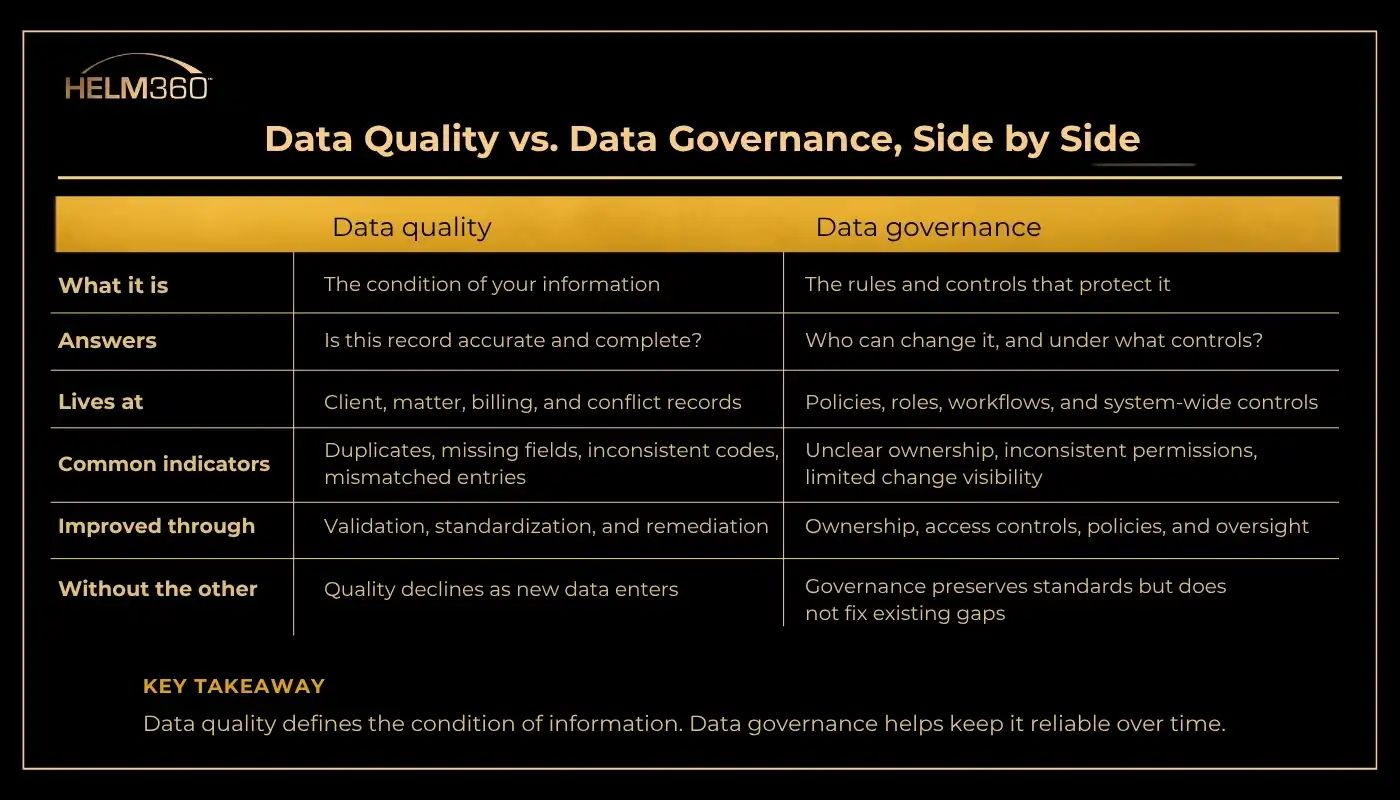
Seeing the difference is useful, but the practical question for firm leaders is more specific: which layer should receive attention first?
Which One Should a Firm Fix First?
The right starting point depends on where the most visible operational challenge is occurring.
A firm may benefit from a focused data-quality assessment when:
- Reports show different numbers for the same client or matter across systems.
- Conflict searches produce inconsistent results because records are duplicated or entered differently.
- Billing teams spend significant time reconciling entries before invoices are issued.
- Leadership lacks confidence in profitability, realization, or collections reporting.
- A system migration or integration is being planned.
Signs Your Firm Should Prioritize Governance
Governance may need greater attention when:
- Data was previously improved but no longer meets the firm’s standards.
- Ownership of client and matter data is unclear across departments.
- Access to create, edit, or merge records is applied inconsistently.
- Different teams use different definitions for the same operational terms.
- New technology initiatives are being introduced without clear data responsibilities.
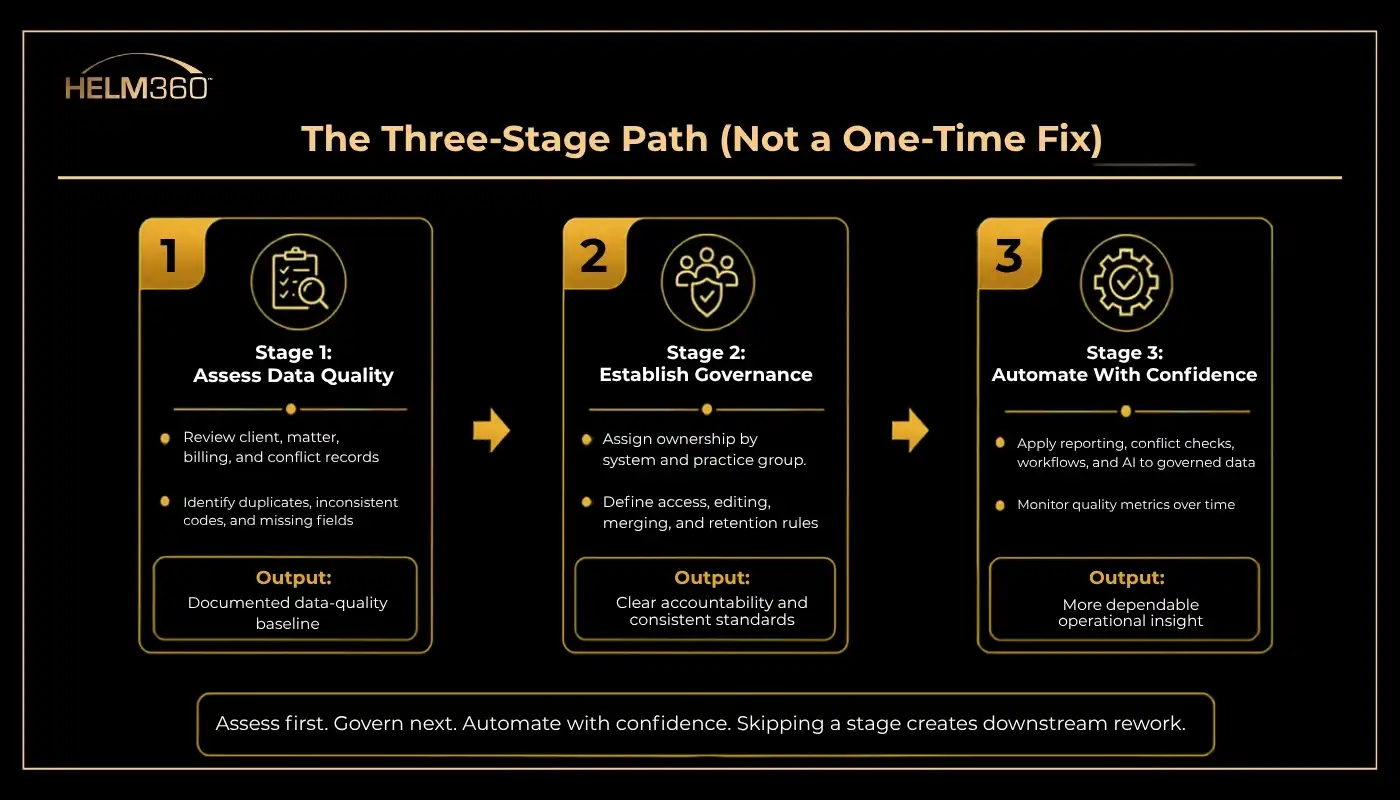
In practice, most firms need to sequence both. A short, focused quality assessment establishes a clean baseline, and governance rules are then built to protect that baseline rather than chase it.
Firms that skip the assessment and jump straight to automation often end up automating an inconsistent process, a pattern our traditional conflicts processes analysis covers in more detail.
Building Both Into a Single Strategy
Firms that gain the most value treat data quality and governance as one continuous program rather than two separate initiatives.
That typically means:
- Running a baseline data-quality assessment before finalizing governance policies.
- Assigning data stewardship roles to specific systems, such as Elite 3E, ProLaw, or Intapp.
- Building governance standards directly into intake and conflicts workflows.
- Establishing consistent definitions for terms such as active matter, originating attorney, realization, and collection.
- Reviewing data-quality metrics on a recurring basis.
- Connecting data standards to upgrades, integrations, migrations, reporting, and AI initiatives.
This approach also supports broader operational risk management. Firms seeking a structured way to evaluate data, process, and technology risks can use the Law Firm Operational Risk Checklist as a starting point.
Get a Clear Picture of Where Your Firm Stands
Deciding what to prioritize does not need to be a guessing exercise. Helm360 works with law firms to assess data-quality gaps and governance maturity together, helping firms make informed decisions about reporting, automation, migrations, and AI initiatives.
To discuss a practical assessment for your systems and workflows, Contact Helm360.
Frequently Asked Questions
1. What is the difference between data governance and data quality in a law firm?
Data quality refers to the accuracy, completeness, and consistency of records such as client and matter data. Data governance refers to the policies, ownership, and controls that help maintain that data over time.
2. Which should a law firm prioritize first, data governance or data quality?
It depends on the firm’s current challenges. Firms experiencing duplicate records, billing discrepancies, or inconsistent conflict-search results may benefit from a data-quality assessment first. Firms whose data standards are difficult to maintain may need stronger governance controls.
3. Can a firm have good data governance without good data quality?
Yes. A firm can have documented ownership and access policies while still working with incomplete, duplicated, or inconsistent records. Governance creates the structure for improvement, but it does not automatically correct existing quality issues.
4. How does data quality affect conflict checking?
Duplicate or inconsistently entered client and party records can make it more difficult for conflict-search tools to identify potential matches. Standardized naming conventions and complete relationship data can improve search reliability.
5. How often should a law firm review its data quality?
Data quality should be reviewed on a recurring basis. Many firms incorporate quarterly or biannual reviews into their operational risk, reporting, or technology-management processes.
7. Does AI adoption increase the need for data governance?
Yes. AI-supported tools depend on reliable information, appropriate access controls, and clearly understood data sources. Governance helps establish accountability and supports more responsible AI implementation.
8. Who should own data governance at a law firm?
Ownership is usually shared. Legal operations can help define business policies and data standards, while IT implements the technical controls needed to apply them across systems.