


Why Traditional Conflicts Processes Are Failing, and How Firms Are Fixing Them with Intapp
A conflicts check that once took an hour now takes three days. Nobody changed the rules of professional responsibility. What changed is the firm: more lawyers, more offices, more corporate clients with subsidiaries nobody mapped, and a conflicts system still running on the assumptions of a much smaller practice.
This is one of the most common, and most quietly expensive, gaps we see in firms that have grown through lateral hires, mergers, or new practice areas. The conflicts process rarely gets rebuilt at the same pace as the firm around it. It’s not a discipline problem or an effort problem. Risk and conflicts teams are usually working harder than ever. It’s that the underlying data and workflow were never designed to hold up at the firm’s current size, and every additional client relationship or corporate structure exposes that gap a little further.
Why the Traditional Conflicts Process Breaks Down at Scale
Most conflicts processes were never designed with growth in mind. They were built to answer a simple question, “have we worked against this party before,” using whatever data happened to be searchable at the time. That approach holds up reasonably well in a small, single-office firm. It falls apart quickly once a firm expands.
A few patterns show up repeatedly across firms we’ve worked with:
- Entity resolution gaps. A prospective client’s parent company, subsidiary, or former name doesn’t match cleanly against historical records, so a real conflict slips through undetected rather than getting flagged for review.
- Disconnected data sources. Client and matter information lives across practice management systems, CRM platforms, deal rooms, and individual attorney contact lists that were never built to talk to one another, so no single search actually covers the full picture.
- Manual escalation. When a potential conflict surfaces, resolving it often depends on someone remembering to loop in the right partner or risk committee member, rather than a defined, repeatable workflow.
- Little to no audit trail. When a regulator, client, or malpractice carrier later asks how a conflict was reviewed and cleared, many firms cannot produce a clean, timestamped answer, only a reconstructed memory of who said what.
According to the American Bar Association’s TechReport, conflict-checking software is the single most commonly available legal-specific technology at law firms, with 63% of respondents reporting they have it. That number matters because it shifts where the real problem sits. Conflicts software adoption isn’t the bottleneck anymore. What’s missing for most firms is a process built around that software, one that accounts for entity relationships, cross-system data, and consistent escalation rather than treating the software as a static search box.
The Real Cost of a Fragmented Conflicts Process
A slow or unreliable conflicts process rarely shows up as a single dramatic failure. More often, it quietly costs firms in ways that are easy to overlook:
- Delayed matter opening. New business waits days for clearance that should take hours, frustrating attorneys and clients alike, and occasionally pushing prospective clients toward a firm that can move faster.
- Inconsistent risk decisions. Without documented criteria, similar conflicts get resolved differently depending on who happens to review them, which is itself a governance risk.
- Rework and rechecking. Incomplete first-pass searches mean conflicts teams often have to re-run checks manually when new parties or related entities surface mid-matter.
- Exposure at the worst possible moment. A missed conflict rarely surfaces during a quiet period. It tends to appear during litigation, a lateral partner’s due diligence review, or a regulatory inquiry, exactly when the cost of getting it wrong is highest.
None of this reflects a lack of diligence on the part of conflicts and risk teams. It reflects a process that was never rebuilt to match the firm’s current size and complexity.
What a Modern, Intapp-Enabled Conflicts Process Looks Like
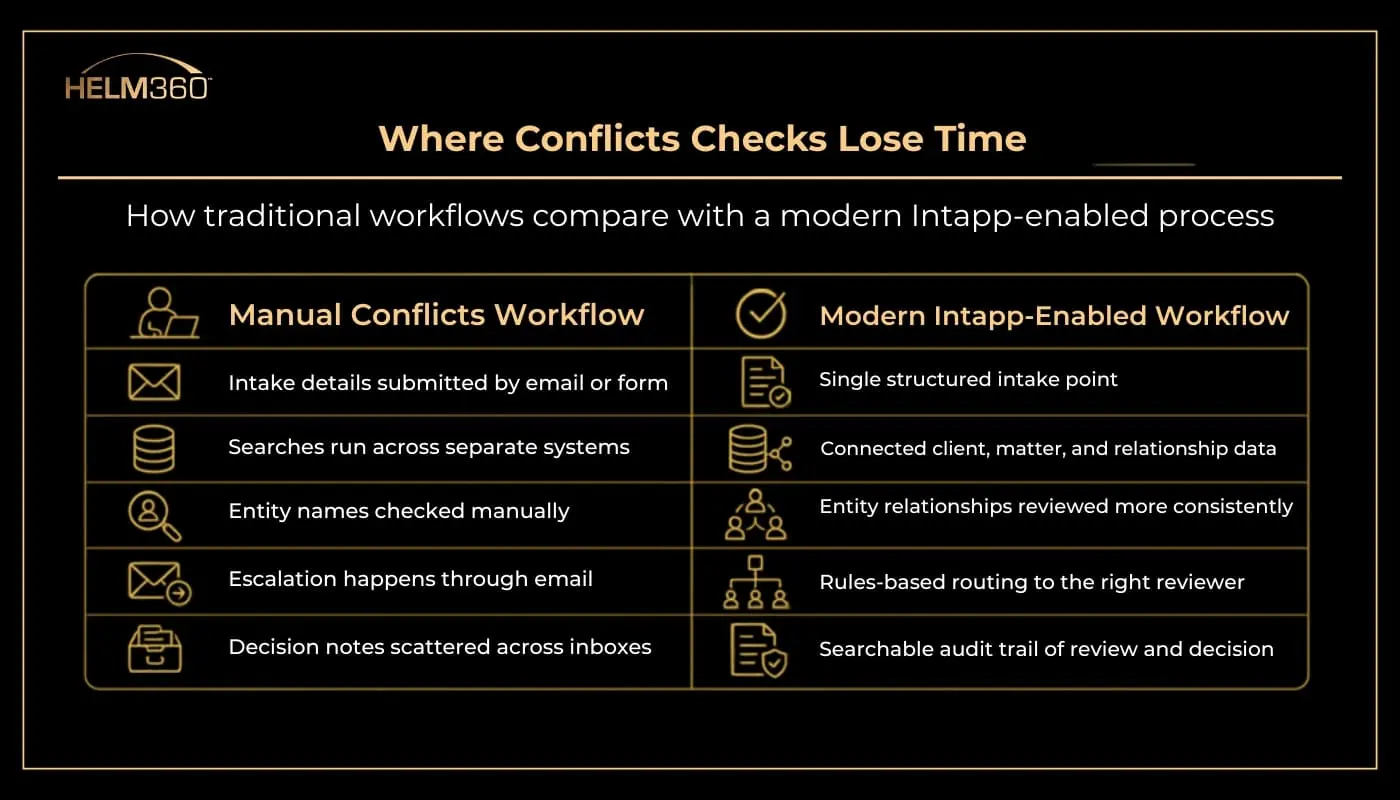
Rebuilding a conflicts process isn’t about adding another point solution on top of an already crowded tech stack. It’s about restructuring how data, workflow, and decision-making connect. Firms that have done this well with Intapp Conflicts tend to focus on four areas.
1. A Centralized Data Foundation
Rather than searching multiple disconnected systems one at a time, firms create a more reliable conflicts data foundation by connecting client, matter, and relationship data from the systems that matter most. This alone eliminates a large share of the gaps that come from partial or inconsistent searches, since no one is relying on remembering which system to check first.
2. Automated Entity Resolution
Corporate family structures, subsidiaries, name variations, and historical aliases can be matched more consistently when entity data is structured, enriched, and connected to the conflicts workflow. For firms working with corporate clients that restructure, acquire, or rebrand regularly, this is often where the biggest reduction in missed conflicts shows up, because entity relationships are exactly what manual searches miss most often.
3. Configurable Workflow and Escalation
Instead of ad hoc email chains, conflicts route automatically to the right reviewer based on defined risk criteria, whether that’s a practice group leader, general counsel, or risk committee. Decisions happen faster not because reviewers work harder, but because the right person sees the issue immediately rather than after someone remembers to forward it.
4. A Complete, Retrievable Audit Trail
Searches, decisions, waivers, and review steps can be captured in a searchable, time-stamped record when the workflow is configured properly. That gives the firm a clearer answer if a client, regulator, or malpractice carrier later asks how a matter was reviewed and cleared.
Firms further along in this shift are also connecting conflicts data to broader intake and risk workflows. Intake is no longer treated as a standalone administrative step. It becomes the point where client, matter, party, billing, and risk information begins to take shape.
For a closer look at that operating model, read our related article on how high-growth law firms automate intake and conflicts with Intapp.
Data Quality: The Piece Firms Often Underestimate
Workflow automation only performs as well as the data feeding it. Firms that skip a data cleanup step before implementing Intapp Conflicts often end up automating an inconsistent process rather than fixing it. Before configuring workflows, it’s worth investing time in:
- Standardizing client and matter naming conventions across systems
- Resolving duplicate or outdated records
- Mapping corporate hierarchies and known affiliates
- Establishing clear ownership for keeping this data current going forward
This groundwork is unglamorous, but it’s what determines whether the new process actually catches more conflicts or just processes the old gaps faster.
Getting Started with a Practical, Phased Approach
Firms that succeed with this kind of transition rarely try to overhaul everything at once. A phased approach tends to work better:
- Audit the current process to identify where checks slow down or where conflicts have historically been missed.
- Define risk criteria with input from the risk committee and firm leadership, so escalation rules reflect actual firm policy.
- Consolidate and clean data before automating workflows around it.
- Pilot with one practice group to refine workflow rules before firm-wide rollout.
- Plan for adoption, since even the best-configured system underperforms if partners and staff don’t trust or use it consistently.
For a closer look at how this connects to broader legal operations, The Legal Helm’s conversation with Marie-Claire Le Houerou of Intapp explores how firms are rethinking compliance and operational workflows well beyond conflicts.
Moving Forward
A conflicts process built for a firm’s earlier stage of growth won’t automatically scale with it. The firms managing this well aren’t necessarily bigger or better resourced. They’ve simply treated conflicts as a workflow and data problem worth solving deliberately, rather than a task to keep patching.
If your firm’s conflicts process is starting to show these same pressure points, it may be worth a closer look at where the friction actually lives. Helm360 works with firms on exactly this kind of assessment and implementation, drawing on our experience as an Intapp implementation partner supporting Conflicts, Intake, and Risk deployments. Reach out to our team to talk through what a modernized conflicts process could look like for your firm.
Frequently Asked Questions
1. Why do conflicts checks slow down as a firm grows, even with software already in place?
Having conflicts software doesn’t automatically mean the underlying data or workflow scaled with the firm. As client rosters, offices, and practice groups multiply, gaps in entity matching, disconnected data sources, and manual escalation steps become more visible and more costly, even though the software itself hasn’t changed.
2. Is Intapp Conflicts only relevant for large, multi-office firms?
No. Mid-sized firms with growing corporate client bases, cross-border matters, or a steady stream of lateral hires face many of the same entity-matching and data-fragmentation issues as larger firms. The scale of implementation differs, but the underlying problem doesn’t require a firm to be enormous before it becomes worth solving.
3. How long does it typically take to modernize a conflicts process with Intapp?
Timelines vary based on data quality, the number of source systems being consolidated, and how many practice groups are involved in the initial rollout. Firms that clean up their data before configuring workflows, and that pilot with one practice group first, tend to reach a stable, firm-wide process faster than those that try to convert everything at once.
4. Does automating conflicts checks reduce the role of partners and risk committees in the decision?
No. Automation handles the search and routing, surfacing potential conflicts consistently and quickly. The judgment call, whether a flagged conflict is waivable, material, or a non-issue, still sits with the attorneys and risk professionals responsible for that decision.
5. What's the first step for a firm that wants to start this process?
Most firms start with an audit of their current conflicts workflow to identify where searches are incomplete, where escalation breaks down, and where data quality issues are creating false negatives. That assessment shapes everything that follows, from data cleanup to workflow configuration.