


How to Identify System Bottlenecks in Law Firms

Why This Matters More Than Most Firms Realize
Where Bottlenecks Most Commonly Form
1. Billing and Time Entry: The Revenue Leak Nobody Authorized
- High volumes of bill holds going into month-end
- Time recorded days after work was performed, relying on reconstructed memory
- Frequent narrative edits during pre-bill review that push cycles back
- Write-down rates that vary significantly across partners with no clear explanation
2. Matter Handoffs: The Delays Nobody Documents
- How long does intake-to-matter setup take on average, and what is the range?
- Where do approvals consistently stall?
- Which handoff steps require the most follow-up to complete?
3. Data Integrity and Reporting Latency: The Blind Spots Nobody Notices
- Can leadership pull reliable matter profitability and realization data without hours of manual assembly?
- Are finance and legal ops consistently working from the same numbers?
- Do your KPIs reflect this week’s reality, or last month’s?
4. Application Performance Under Load: The Delays Nobody Anticipates
- A slow billing run pushes month-end close by two days
- Staff create a manual workaround to compensate
- The workaround becomes routine, and the performance issue disappears from view
5. Process Standardization Gaps: The Variance Nobody Tracks
- The same task takes noticeably longer in one office or practice group than another
- New staff take much longer to reach productivity because processes are not documented
- The same question gets escalated repeatedly, with no authoritative answer in place
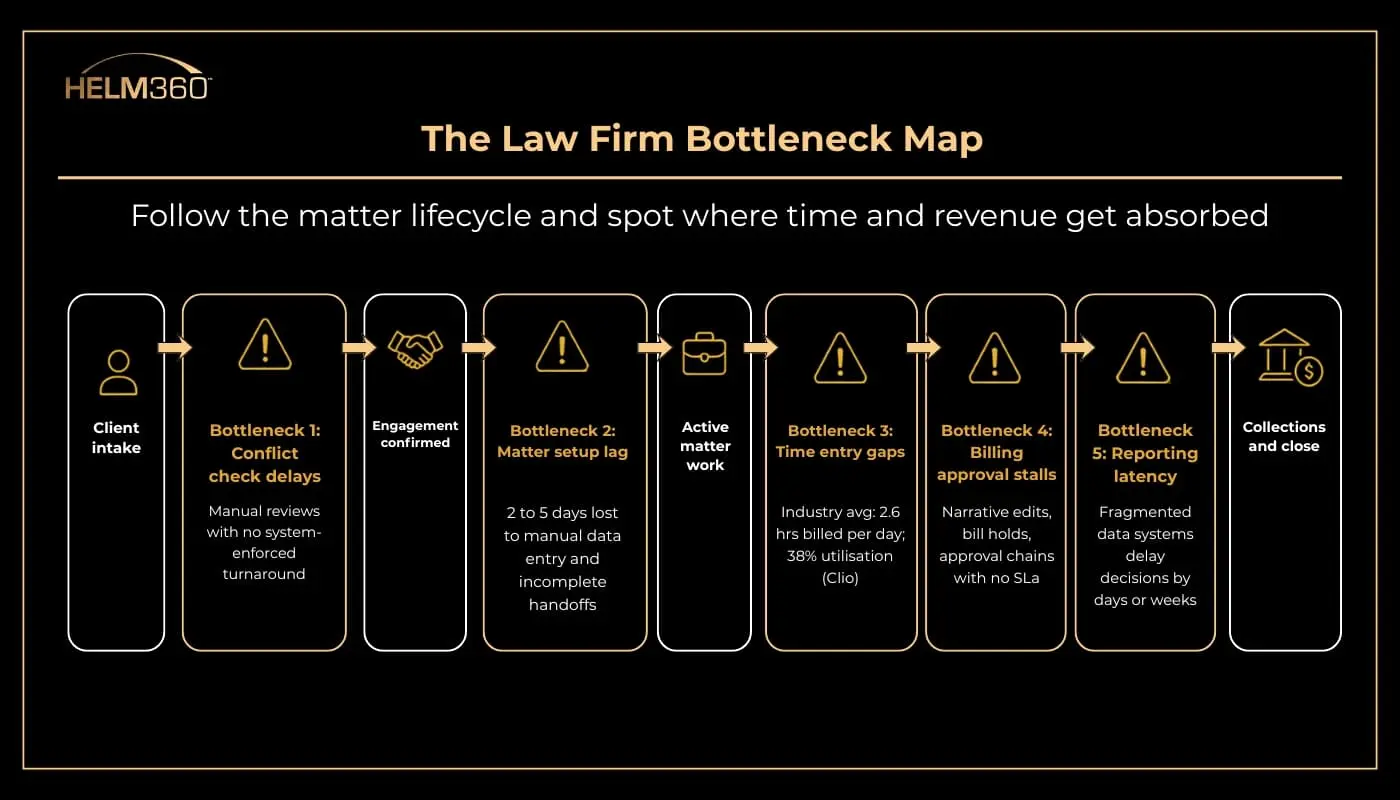
How to Build a Practical Bottleneck Identification Process
Step 1: Establish baseline metrics.
Step 2: Map workflows against actual behavior.
Step 3: Review application performance data.
Step 4: Engage cross-functional input.
Step 5: Build ongoing visibility.
The Role of the Right Technology Partner
Conclusion
Frequently Asked Questions
The most common ones are billing and time entry delays, matter handoff gaps, fragmented reporting systems, application performance issues during peak periods, and inconsistent processes across practice groups. Most firms are dealing with more than one at the same time, which is why they tend to compound quietly before anyone names them.
Because the problem rarely starts at the billing stage. It originates upstream in how time is captured, how narratives get reviewed, and where approvals stall. Fixing the output without addressing those habits tends to produce short-lived improvement.
If pulling a reliable realization or matter profitability report requires someone to manually assemble a spreadsheet first, you already have one. Another clear sign is finance and legal ops consistently working from different numbers.
Usually, a combination of infrastructure not sized for peak load, database queries that have not been optimized, and configuration issues that accumulate over time. The problem often goes unaddressed because teams adapt with workarounds rather than escalating it as a system issue.
Start by understanding why they are happening. The most common causes are late time entry, narrative inconsistencies during pre-bill review, and junior work that exceeds partner expectations. Visibility into write-down patterns by timekeeper and practice group is usually the first step toward meaningful reduction.