


Why Well-Equipped Law Firms Still Run on a Spreadsheet Nobody Talks About

Every legal operations lead has a version of this story. Somewhere between a systems review and a hallway conversation, they find it: a shared spreadsheet a paralegal built two years ago to track conflicts status, still updated daily, still emailed around every Friday. The firm has a fully licensed intake and conflicts platform. It has had one for years. The spreadsheet survives anyway, quietly doing the job the system was bought to do.
This isn’t a story about a firm falling behind. It’s a story about the gap between buying the right technology and actually trusting it enough to let the old habit go. That gap rarely shows up on a systems audit, but it shapes more of daily legal operations than most dashboards will ever capture.
The Investment Was Rarely the Problem
Law firm technology spending has climbed steadily for years, and by most measures, firms are putting real money behind it. Year-over-year technology investment at large firms has consistently outpaced inflation through 2024. Firms aren’t short on tools. What they’re often short on is confidence that those tools talk to each other, and to the people using them.
A 2025 industry survey found the average firm now juggles between five and ten different applications to run its operations, yet fewer than half of respondents were satisfied with how well those systems worked together. When systems don’t connect cleanly, a spreadsheet becomes the translator between them. That’s not a failure of judgment. It’s the most reasonable response to a real gap, built by the person closest to the problem.
Three Small Decisions That Build a Shadow Process
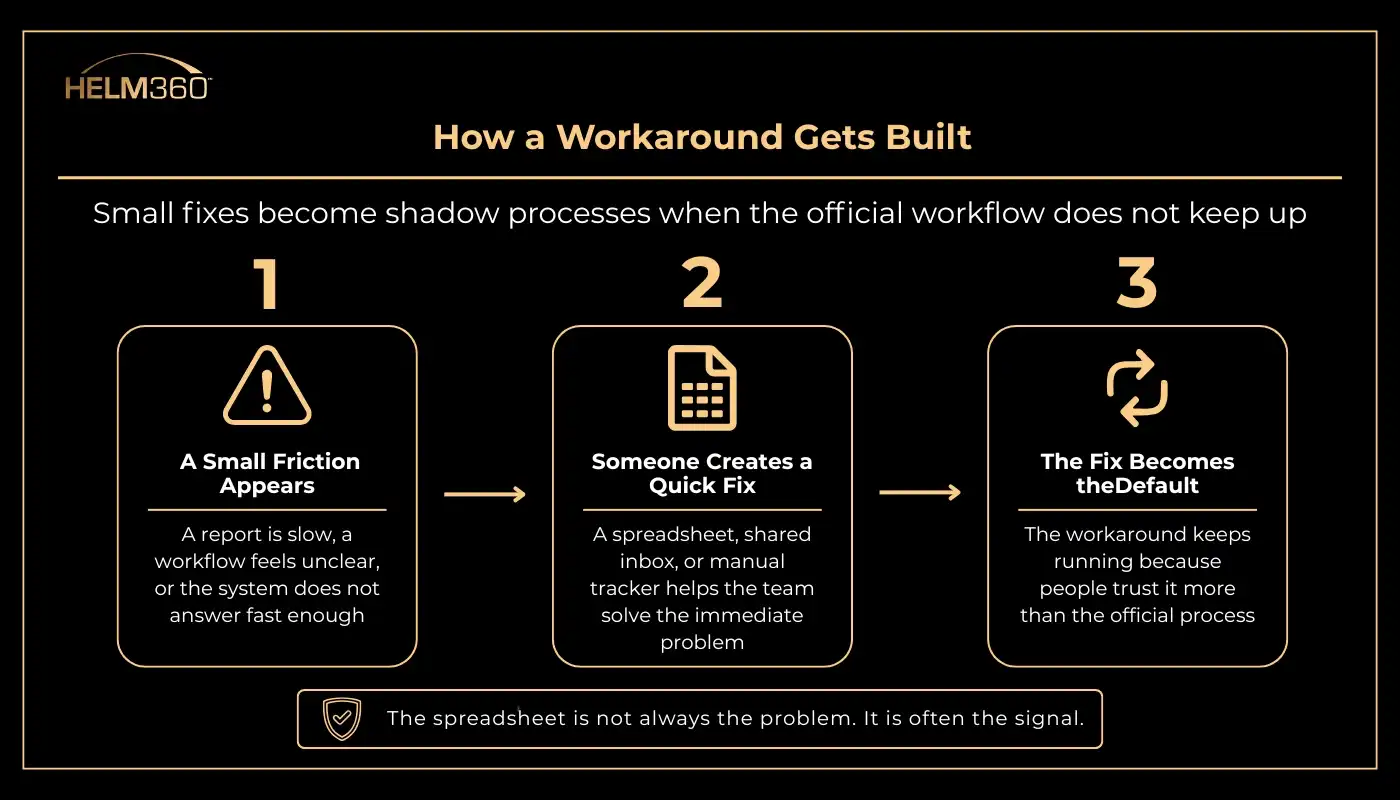
Nobody sets out to build a workaround. It happens in stages that each feel completely sensible at the time.
- The system is technically correct but practically slow. A conflicts report that takes twenty minutes to generate during a busy intake week gets replaced by a two-minute manual check, just this once. It becomes the default the following week too.
- Training never quite closes the gap. A new associate wasn’t shown the full intake workflow, so a colleague hands them “the tracker we actually use.” The unofficial process gets passed down before the official one ever does.
- Finance needs an answer before the system can give one. A number is due today, and the correct report won’t be ready until month-end close, so someone builds a bridge to cover the wait. The bridge outlasts the reason it was built.
None of these decisions looks reckless in isolation. Strung together across a few years and a few departments, they add up to an entire second operating system running quietly underneath the official one, and almost nobody signed off on any of it.
What the Workaround Is Actually Telling You
Boards and firm leadership feel this gap too, often before anyone can name it. When legal risk questions reach the leadership level, teams are still frequently pulling answers together in spreadsheets rather than directly from their systems, simply because the official systems weren’t built to answer that specific question quickly.
Here’s the part most firms miss: the workaround is not the problem. It’s a diagnostic. One legal technology consultancy puts it plainly, describing shadow workflows as a symptom, not the root issue. Shut the spreadsheet down without fixing what caused it, and the workaround doesn’t disappear. It just moves somewhere less visible, usually somewhere IT and compliance can’t see it at all.
So instead of asking why staff keep using the old process, a more useful question is what the official process fails to give them that the spreadsheet does.
What Closes the Gap for Good
Firms that manage to retire these workarounds permanently tend to follow a similar pattern. It isn’t a policy memo. It’s removing the reason the workaround existed in the first place.
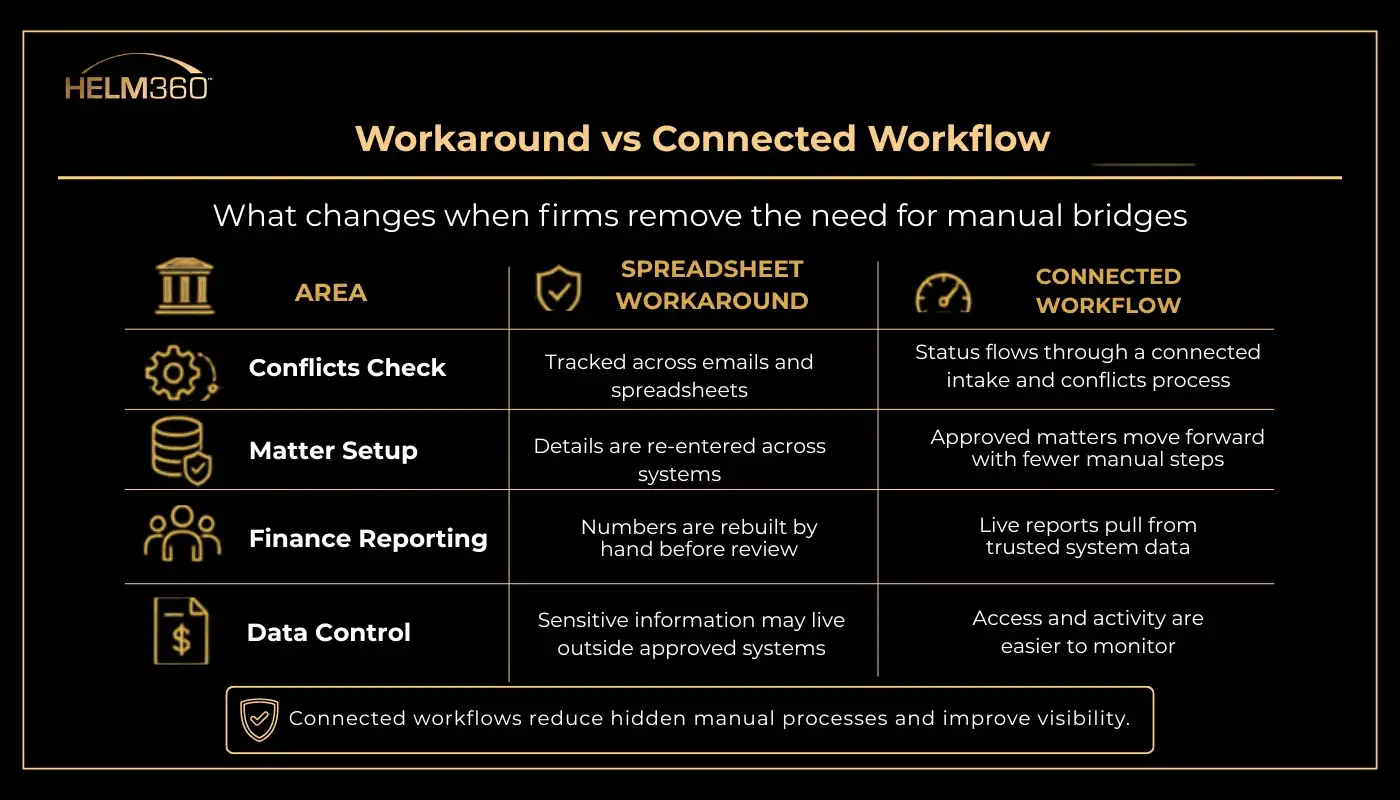
- Connect the systems that create the gap. When Intapp intake data flows directly into practice management and billing, there’s no window of time where someone needs a spreadsheet to bridge the two. Approved matters move forward on their own, which is a large part of why firms that build this connection see intake and conflicts processes speed up without extra manual steps.
- Shorten the distance between a question and its answer. A finance team that can pull a live report from Elite 3E in minutes has no reason to keep a shadow tracker running in parallel. Firms that invest in structured, well-designed reporting usually find the workaround disappears on its own, because it was never really about the spreadsheet. It was about speed.
- Let staff see the new process hold up before asking them to trust it. People don’t abandon a manual habit they’ve relied on for years just because a system launched. They abandon it once they’ve watched it survive real pressure. Firms running structured testing through upgrades and migrations give staff that proof earlier, which shortens the trust-building period considerably.
A Quick Self-Check Before Your Next Systems Review
Before the next technology conversation at your firm, it’s worth asking three questions that a standard systems audit usually misses:
- Where do people go when the “real” system feels too slow? That destination, whether it’s a spreadsheet, a shared inbox, or a sticky note on a monitor, is your actual bottleneck map.
- Which reports get rebuilt by hand every month? If someone is manually reassembling a number your system should already produce, that’s not a training issue. It’s a reporting gap.
- What did the newest person on the team learn from a colleague instead of from the system itself? That’s usually the clearest sign of where documentation, training, or integration quietly broke down.
The answers won’t show up in a license utilization report. They only show up when you ask the people doing the work.
The Real Signal Worth Watching
The next time someone stumbles onto a spreadsheet quietly doing the job an expensive system was bought to do, resist the urge to just shut it down. That spreadsheet is pointing at something specific, whether it’s a missing integration, a slow report, or a training gap nobody closed. Firms that treat it as a signal, rather than a discipline problem, tend to close these gaps faster and keep them closed.
The goal was never zero workarounds. It’s making sure the ones that remain are choices people make on purpose, not habits nobody ever had a reason to question.
Curious What’s Quietly Holding Your Firm’s Workflows Together?
Most firms don’t need to guess where their workarounds live. A short conversation with the teams doing the daily work usually surfaces them fast, along with the reason they exist.
Talk to Helm360 about a workflow and systems review → to find out what’s really bridging the gaps in your intake, billing, or reporting processes.
See how connected intake and conflicts workflows work in practice through Helm360’s Intapp integration approach.
For more on how firms are rethinking reporting speed and trust in their systems, listen to The Legal Helm podcast.
Frequently Asked Questions
1. Why do law firms still rely on manual workarounds after investing in legal technology?
Workarounds usually form because a step in the official process is slower, less trusted, or less well understood than the manual alternative. The technology investment solves part of the problem, but the workaround often persists until the underlying friction, not just the tool, is addressed.
2. Are shadow spreadsheets a security risk for law firms?
They can be, especially when they contain conflicts data, billing information, or matter details outside firm-approved systems. The bigger risk usually isn’t the spreadsheet itself, but the lack of visibility into where sensitive data is actually living.
3. How can a firm find out where its shadow workflows are?
The most reliable method is a direct conversation with the staff running day-to-day processes, since these workarounds rarely appear in system usage reports. Asking where people go when the main system feels slow is often more revealing than any audit.
4. Does connecting Intapp with practice management systems reduce manual conflicts tracking?
Yes. When intake and conflicts data flow directly into practice management and billing, approved matters move forward automatically, removing much of the manual bridging that spreadsheets are typically built to handle.
5. Is it possible to eliminate manual workarounds completely?
Not entirely, and that isn’t really the goal. The aim is to make sure any remaining manual steps are intentional choices rather than default habits nobody has questioned in years.
6. What’s the first step to reducing manual workarounds in legal operations?
Start by identifying where reports are being rebuilt by hand or where new staff are learning an unofficial process from a colleague. Both are strong indicators of exactly where a workflow or integration gap exists.